Home energy work in Antibes:
heat pumps, air conditioning, solar and electrical
Antibes is really three property markets in one commune, and a quote that suits a Cap villa is the wrong quote for a Juan-les-Pins apartment.
Most contractors quote Antibes as though it were a single place. In practice a detached villa on Cap d'Antibes, a flat in a seasonal-rental block in Juan-les-Pins and a house inside the ramparts of the old town are three different jobs: the approval route, the access for equipment and the distance to salt water all change with the address. Which of the three you own sets the cost and the timeline, even when the quoted machine is identical.
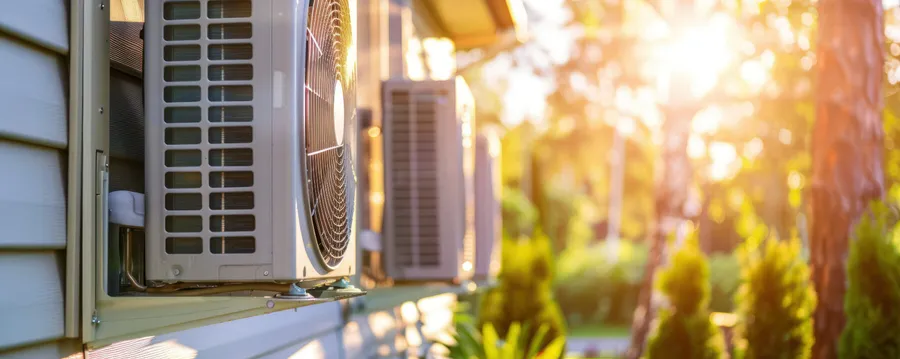
Why Antibes needs three different answers
On the Cap, most properties are detached with their own land. There is no syndic, no assembly vote and usually somewhere discreet to put an outdoor unit. That makes it the easiest part of the commune to work in and the part where the widest range of systems is available.
In Juan-les-Pins the housing is dense, much of it built for the resort boom, and a large share is held in copropriété. The rules there are the same ones that govern apartment work in Nice: if the equipment touches a shared surface, the assembly decides. Inside the old town you add heritage sensitivity and streets that no van will fit down.
What can a Cap d'Antibes villa take, from ground-mounted units to solar?
Practically the full range. Larger plots make ground-mounted outdoor units possible, which solves the two problems that dominate apartment work: where the unit goes and who has to approve it. Detached roofs also make solar panels a straightforward proposition rather than a collective decision.
Where villas do get complicated is scale. A large property with a pool, outbuildings and several zones is not a single-split job. It usually wants a multi-split system or several independent circuits, and the electrical supply needs checking before anyone specifies equipment.
Does the walled old town of Antibes change what is allowed?
Yes, on two counts. The old town is historic fabric visible from the port and the ramparts, so exterior changes are assessed on visibility and generally need a déclaration préalable before work starts. The second count is purely practical: if a street takes no vehicle, equipment is carried in by hand and the labour line on your quote reflects that.
Why do Juan-les-Pins apartments follow the same rules as Nice?
Ownership structure sets the process. Under the law of 10 July 1965 anything fixed to a façade, balcony or roof is a common part, so the general assembly authorises it. Seasonal rental adds a timing problem on top: owners want work done outside the letting season, which compresses the window into a few months and fills contractors' diaries early.
Our guide to installing AC in a French copropriété sets out what to prepare before the assembly meets.
How much does salt air shorten an outdoor unit on the Cap?
Enough to be worth specifying against. Cap d'Antibes is surrounded by water on three sides and the seafront at Juan-les-Pins is exposed to onshore wind. Salt attacks coil fins, casings and fixings, and a unit chosen on price alone can look tired within a few seasons.
Coastal coil coatings and stainless fixings are standard options from most manufacturers. Ask for them explicitly, because a quote written for an inland property will not include them.
Is solar worth it on a second home that sits empty half the year?
Occupancy changes the answer more than sunshine does. Self-consumption is what makes solar pay, and an empty house consumes very little, so most of the generation gets exported at a rate well below what you pay to import.
Where a property has a genuine year-round base load, a pool pump, a dehumidifier, frost protection, the picture improves, and battery storage becomes worth pricing. Our second-home energy guide goes through the trade-offs, and winterising a Côte d'Azur second home covers what to leave running.
From Cap d'Antibes to Biot and Villeneuve-Loubet: where we work
Across Antibes and Juan-les-Pins, out to Cap d'Antibes, and inland to Biot and Villeneuve-Loubet where plots get larger and the constraints ease. The full commune list is on areas we cover.
Common questions about home energy work in Antibes
Can work go ahead while we are out of the country?
Often yes, and for second-home owners it is usually the only workable arrangement. It needs someone able to give access, a written scope agreed in advance so nothing is decided on the day, and photographs at the milestones. Agreeing who signs off the completed work before anyone starts avoids the awkward conversation later.
Does a pool heat pump need the same approval as an air conditioning unit?
If it sits on your own land at a detached villa, generally not. In a copropriété the test is the same as for any other equipment: does it touch or alter a common part, and can it be heard from a neighbouring property. A pool machine running through the night is judged on noise the same way an air conditioning condenser is.
What happens if most owners in our building are non-resident?
Assemblies can struggle to reach a quorum, which is common in Juan-les-Pins blocks bought as holiday flats. Proxies are the practical answer, and French copropriete rules allow an owner to be represented. It is worth speaking to the syndic early about how they usually handle it.
Should the installer hold garantie decennale for this work?
Yes. It is the ten-year structural liability insurance that French contractors are required to carry, and you should see the attestation before work starts, with the cover matching the trade being performed. Our glossary entry on garantie decennale explains what to check on the certificate.