Insulation, windows and roofing for Riviera homes, from English-speaking specialists
Most houses along this coast were built for summer. Single glazing, canal tiles laid straight over the rafters and thick stone walls were fine when nobody heated in January or cooled in August. Now the DPE grades all of it, and the grade follows the house into every sale and every tenancy. We connect English-speaking homeowners with vetted insulation, window, roofing and facade contractors across Nice, Antibes, Cannes and the villages inland.
Looking for an English-speaking installer on the Côte d'Azur? Get quotes →
The building stock
Why Riviera houses lose heat in winter and gain it in summer
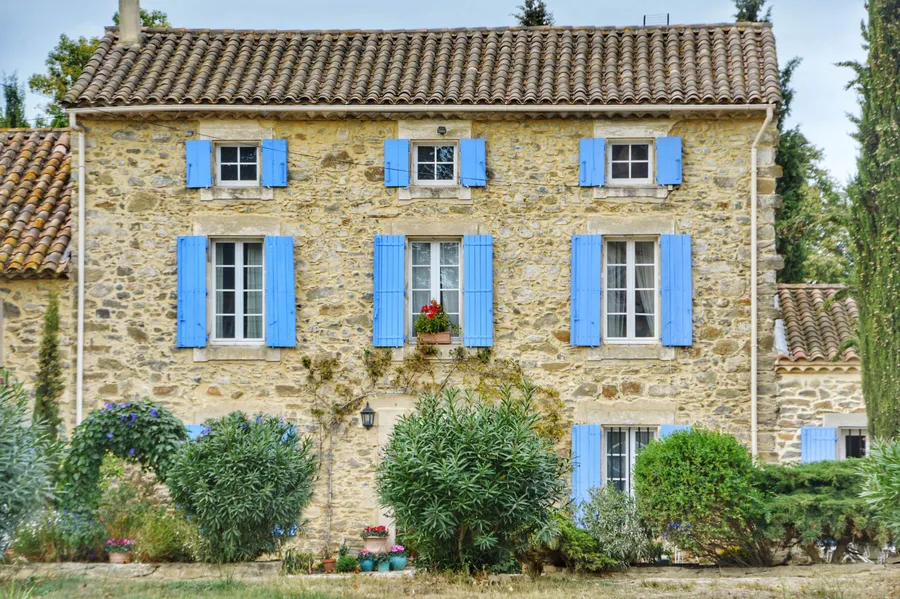
Buyers from Manchester or Hamburg arrive expecting a Mediterranean house to be cheap to run. Then the first February electricity bill lands. The coast is mild, but the houses were never built to hold heat. Walk round an older villa in Vence or a village house in Biot and you'll find the same three things: single panes in timber frames, a roof of curved terracotta tuiles canal with nothing between the tiles and the bedroom ceiling, and solid walls of stone or hollow brick with no insulating layer anywhere.
ADEME's breakdown for a poorly insulated house puts 25 to 30% of heat loss through the roof, 20 to 25% through the walls, another 20 to 25% through air leaks and ventilation, and 10 to 15% through the windows. Those figures describe heat leaving in January. In July they run in reverse. A terracotta roof in full afternoon sun keeps radiating into the rooms below until midnight, and a west-facing single-glazed window does the same from five o'clock onwards.
That's why the case for insulation here is about cooling as much as heating. A loft blown full of mineral wool keeps the heat in during the twelve cold weeks and keeps it out during the twelve hot ones, and it costs a fraction of what the air conditioning it replaces would burn through in electricity. The DPE now carries a summer-comfort indicator alongside the energy grade, so the calculation has caught up with what anyone who has slept under an uninsulated roof in August already knew.
Exterior shutters do a job an air-conditioning unit can't: they stop the sun before it reaches the glass. They are also the first thing a mairie will comment on when you change them, which is why the permit section below exists.
The energy label
Which insulation and window works move a DPE rating?
The DPE is a calculation. Nobody reads your meter. The assessor feeds the building envelope and the equipment into a standard model and runs it against reference weather for climate zone H3, the Mediterranean band. Because H3 winters are mild, the heating system counts for less than it would in Lille, and the envelope counts for more. That's good news for the reader with a stone house and a G on the certificate, because the envelope is the part you can fix trade by trade.
The roof comes first, by a distance. An uninsulated loft is the biggest single leak in the ADEME breakdown and the cheapest to close: blown wool to a resistance of R 7 or above, the threshold the CEE scheme demands, for 20 to 60 EUR per m². Our guide to improving a DPE rating puts it at the top of the list for the same reason.
Windows come next where the glazing is single. Replacing it with double glazing at a Uw (the window's heat-loss figure; lower is better) of 1.3 or under takes out most of the 10 to 15% window share and, on the coast, does more for summer comfort than the percentage suggests. Walls follow. External insulation (ITE) wraps the house and leaves the stone's thermal mass on the inside; internal insulation (ITI) is cheaper and needs no permission, but costs floor space. For a house rated E, F or G, the roof-plus-windows-plus-walls combination is how you reach the two-class gain that MaPrimeRénov' rénovation d'ampleur requires.
Services
Insulation, window and roofing services we cover
Five trades that all touch the outside of the house, and that all end up on the same devis when a roof is re-laid or a facade is redone. Prices are French national ranges for 2026, installed, before any aid.
Windows & shutters
Replacing single glazing with double at Uw 1.3 (or 1.7 with a higher solar factor), in PVC, aluminium or timber, plus new or repaired shutters. Budget 400 to 1,300 EUR per standard PVC window installed; aluminium costs more. Any change of colour, material or size needs a déclaration préalable.
Explore Windows & shuttersRoof insulation
Blown mineral wool or cellulose across an unused loft, or boards between and over the rafters under a converted one. Usually the cheapest big DPE gain: 20 to 60 EUR per m² installed for a loft, and CEE-eligible at R 7 or above.
Explore Roof insulationWall insulation
External (ITE) wraps the house in insulation under new render, 120 to 270 EUR per m². Internal (ITI) lines the rooms, 30 to 90 EUR per m², and costs floor space. Out of MaPrimeRénov' par geste since January 2026; CEE still pays.
Explore Wall insulationRoofing
Re-laying tuiles canal, replacing battens and underlay, curing leaks, and adding insulation while the tiles are off. Tiles laid run 60 to 90 EUR per m²; a full réfection with structure, scaffolding and waste runs 100 to 250. Roofing without insulation sits at 10% TVA.
Explore RoofingFacade renovation
Ravalement: repairing render, treating cracks and damp, repainting to the commune's palette. 40 to 150 EUR per m² depending on finish, with scaffolding about a fifth of the bill. Pair it with external insulation and you scaffold once.
Explore Facade renovationGet matched with vetted English-speaking installers in your area.
Get quotesFinancial aid
What does MaPrimeRénov' pay for insulation and windows in 2026?
On their own, nothing, since 1 September 2026. Décret n° 2026-822 of 25 August 2026 (Journal officiel n° 0199 of 27 August) removed insulation, windows, ventilation, thermodynamic and solar water heaters and wood stoves from the parcours par geste; article 5 applies the new list to every application filed from 1 September. Wall insulation had already gone on 1 January. The single-measure route now pays for four things in mainland France: air-to-water and geothermal heat pumps, connection to a heat network, and removal of an oil tank.
Insulation and windows are still funded inside MaPrimeRénov' rénovation d'ampleur, the whole-house route. The conditions are firm: the house must be rated E, F or G on the DPE, the project must gain at least two classes, an energy audit comes first, a Mon Accompagnateur Rénov' adviser is mandatory, the house must be over 15 years old, and it must be your principal residence. That's a whole renovation programme. A window order on its own no longer qualifies. Our MaPrimeRénov' guide walks through it.
CEE premiums from the energy suppliers are now the main cash aid for a single insulation or window job. They cover loft, rafter, wall and floor insulation and window replacement, on a principal or secondary residence, provided an RGE contractor does the work to the required performance: R 7 for a loft, R 6 for rafters, R 3.7 for walls, and for windows either Uw 1.3 with a solar factor of 0.3 or Uw 1.7 with 0.36. The Côte d'Azur is climate zone H3, the lowest CEE band, so national comparison sites overstate what you'll get here. Ask the contractor for the H3 amount in writing.
TVA at 5.5% applies to energy renovation work in any dwelling completed more than two years ago, main home or holiday home, and the tax rules list roof, wall and floor insulation, windows, insulating shutters and mobile solar protection by name. No RGE is needed for the rate. The old separate Cerfa attestation was dropped in early 2025 (loi de finances 2025); you now certify on the devis or invoice itself that the building is residential and over two years old. The honest comparator is 10%, the rate on other improvement work, so on a 10,000 EUR job the reduced rate saves about 410 EUR. Roof repairs and a ravalement without insulation stay at 10%.
The Éco-PTZ is an interest-free loan, not a grant, and insulation and windows are still on its list after the August reform. Ceilings are 7,000 EUR for a windows-only project, 15,000 EUR for one other measure, 25,000 EUR for two and 30,000 EUR for three or more, over up to 20 years. Principal residence only, house over two years old, RGE contractor.
Planning rules
Do you need a permit to change windows, shutters or a roof?
Usually a déclaration préalable (DP), and sometimes nothing. Service-public.fr lists fenêtres, volets, toiture and ravalement de façade among the works that change a building's external appearance and so need a DP. The test is whether anything visible changes: colour, material or dimensions. Swap white timber windows for white timber windows of the same size and you file nothing. Swap them for anthracite aluminium, or fit roller shutters where there were hinged wooden ones, and you file. Many communes publish a nuancier, an approved colour chart for shutters and render, and the DP is where it gets enforced.
The mairie has one month to answer. In a protected sector, which includes the surroundings of any listed monument, the Architecte des Bâtiments de France gives an opinion and the period becomes two months. The ABF can attach conditions (the shutter colour, the tile type, keeping the render lime-based) or refuse. Silence at the end of the period counts as approval, but get the tacit approval certificate from the mairie before the scaffolding goes up. Our permits guide covers the full procedure.
Like for like
Same colour, same material, same dimensions, same opening type. No filing needed. Keep the old devis and a photo of the old windows in case a neighbour or a future buyer asks.
Anything visible changes
New frame colour or material, different tile, new render tone, roller shutters replacing hinged ones, a roof window. Déclaration préalable at the mairie, one month to answer, works wait for it.
Protected perimeter
Within 500 m of a listed monument and visible from it, or inside a site patrimonial remarquable (a protected old town, such as Vieux Nice or old Antibes). The DP goes to the ABF as well, the period is two months, and expect conditions on colour, material and profile.
Before you sign
What should an insulation or window devis include?
A French devis is a contract the moment you sign it, and for this kind of work the numbers on it decide whether you get CEE, the Éco-PTZ and the 5.5% rate at all. A one-line "isolation combles, 3,200 EUR" is a quote you can't check and a subsidy application you can't file. Ask for these, line by line:
- Surface and location. Square metres per element: loft floor, each wall elevation, each window with its dimensions and which room it serves.
- The performance figure. R-value in m².K/W for insulation, Uw and Sw (heat loss and solar gain) for windows, with the product name and thickness. If it isn't written, the CEE file will bounce.
- The RGE number and its domain. RGE is issued per trade. A qualification for heat pumps doesn't cover insulation, and the CEE and Éco-PTZ checks look at the domain, so a heat-pump RGE logo on an insulation devis fails.
- Who files the DP, and whether the start date waits for the mairie's answer.
- Scaffolding as its own line, with hire duration. On roofing and facade work it can be a fifth of the total.
- Dépose and waste. Removing old windows, old tiles and old insulation and taking them to the déchetterie (the council tip). None of it is free to dump.
- TVA per line, with the 5.5% attestation text for the energy works and 10% on the rest.
- Garantie décennale. Insurer and policy number. Roofing and ITE are structural enough that the ten-year cover matters; see what the guarantee covers.
Get two devis on this basis and the cheaper one usually stops being cheaper. The contractors we work with expect to be asked for all of it, in English.
French terms
Key terms to know
Key French terms for this service
Questions
Frequently asked questions about insulation and windows on the Cote d'Azur
If your question isn't here, send it with your request and we'll answer it directly.
External insulation (ITE) is usually the better technical answer for a stone house. It leaves the mass of the wall on the warm side, so the stone keeps doing what it does well in summer, and it fixes cold bridges at floors and window reveals in one go. It also costs 120 to 270 EUR per m², changes the look of the facade (so it needs a déclaration préalable, and an ABF opinion in a protected perimeter), and can be refused outright on a facade the commune wants kept as it is.
Internal insulation (ITI) costs 30 to 90 EUR per m² and needs no permission, but it takes several centimetres off every room along the outside walls and it has to be done with materials that let an old wall breathe. On a rendered village house, ask for both prices. On an exposed stone facade you like, ITI is often the only option the mairie will accept.
Two of the four schemes, yes. MaPrimeRénov' requires the house to be your résidence principale, and so does the Éco-PTZ (service-public.fr states both conditions plainly). A holiday home gets neither.
CEE energy-supplier premiums are paid on a principal or secondary residence as long as an RGE contractor does the work to the required R-value or Uw. And the 5.5% TVA rate has no residence condition at all: any dwelling completed more than two years ago qualifies for energy renovation work. Our second-home energy guide goes through the rest.
No. MaPrimeRénov' only ever funded the window itself, and since 1 September 2026 it no longer funds windows on their own either. Where shutters do count is TVA: the tax rules list volets isolants and mobile solar protection among the energy works that take the 5.5% rate in a dwelling over two years old. So new insulating shutters sit on the same reduced rate as the double glazing behind them.
Blowing mineral wool or cellulose into an unused loft is a half-day to one-day job for a house of 80 to 100 m², and you don't need to move out or move furniture. Insulating between and under the rafters of a converted roof space takes longer because the ceiling has to come down or the tiles have to come off. If the roof itself is due for re-laying, do the insulation in the same operation: you pay for scaffolding once, and the roofer can fit an insulating board above the rafters while the tiles are stacked in the garden.
Not for any of the work on this page. An architect is only mandatory when a project needs a permis de construire and the house will have more than 150 m² of surface de plancher afterwards. Changing windows, shutters, roof tiles or render goes through a déclaration préalable, and a DP never requires one. A protected perimeter adds an ABF opinion, not an architect. Where an architect earns their fee is a whole-house rénovation d'ampleur on an old building, where someone has to sequence the roof, the walls and the windows so each trade doesn't undo the last one's work.