Outdoor summer kitchens on the Côte d'Azur
A grill on wheels is furniture. Build it into a stone counter with a sink and a roof, and France sees a new building. The mairie (town hall) may want a filing, and the TVA (French VAT) is 20%. Near woodland, the summer fire rules decide whether you can light it at all.
Need an English-speaking builder for an outdoor kitchen on the Côte d'Azur?
Get quotesOn this page9 sections
- When does an outdoor kitchen need a town hall filing?
- Is a covered outdoor kitchen taxed as new floor space?
- Running power, water and gas out to a kitchen in the garden
- Can you light a barbecue or wood oven in summer near the woods?
- Why an outdoor kitchen is taxed at 20%, and what else drives its cost
- Outdoor kitchen worktops and steel that survive salt air and summer sun
- Building an outdoor kitchen on a flat's terrace needs the owners' vote
- French terms for an outdoor kitchen project
- Frequently asked questions about outdoor kitchens on the Côte d'Azur
Planning
When does an outdoor kitchen need a town hall filing?
Ask a French builder for a cuisine d'été (summer kitchen) and you'll usually get a masonry counter with a grill and a sink, often a pizza oven, sometimes a roof. Once it's built in, the planning rules treat it as a new construction, like a garden shed.
Outside protected sectors, its footprint decides. That's the emprise au sol, the ground it covers seen from above. Up to 5 m², with no more than 5 m² of floor area, you file nothing. From 5 to 20 m² you need a déclaration préalable (planning declaration). Above 20 m² it's a permis de construire (planning permission).
Near a listed monument, in a protected old town or on a classified site, the 5 m² exemption goes. A déclaration is needed from the first square metre up to 20 m², and a permis above that. The mairie then has two months to answer, and the ABF (the state heritage architects) reviews the file. They can set the stone and the colours.
The PLU (the local zoning plan) can be stricter about siting, materials and colour. So can the rules of a housing estate (lotissement). Where the PLU says nothing on siting, a structure goes on the boundary or at least 3 m from it. A strict PLU can catch even a small counter with no roof, so ask the mairie's planning office before you build. If a required filing is skipped, the problem stays with you as the owner.
Roof and building tax
Is a covered outdoor kitchen taxed as new floor space?
Only once it has walls. Before that, the roof matters for planning. A roof on posts counts towards the footprint, whether it's open timber, a shade sail on a frame or a bioclimatic pergola with motorised louvres. The mairie looks at the kitchen block and the roof over it together. A small counter under a large pergola can cross the 5 m² or 20 m² line, so give the planning office one plan showing both.
Fixed to the house, the PLU may treat the roof as an extension. That raises the déclaration limit to 40 m² in an urban zone, and leaves it at 20 m² elsewhere. Ask the mairie which reading it applies. The pergola rules in full are on our terrace and pergola page.
The taxe d'aménagement (one-off building tax) counts only space that's closed and covered, with more than 1.80 m of headroom. An open kitchen under an open pergola, or under a roof with no walls, creates no taxable space. Close it in on its sides, as a walled cooking room or a glazed pool house with a kitchen, and above 5 m² it becomes taxable floor area. A design with one or two walls sits in between, and the mairie decides how it counts.
Power, water and gas
Running power, water and gas out to a kitchen in the garden
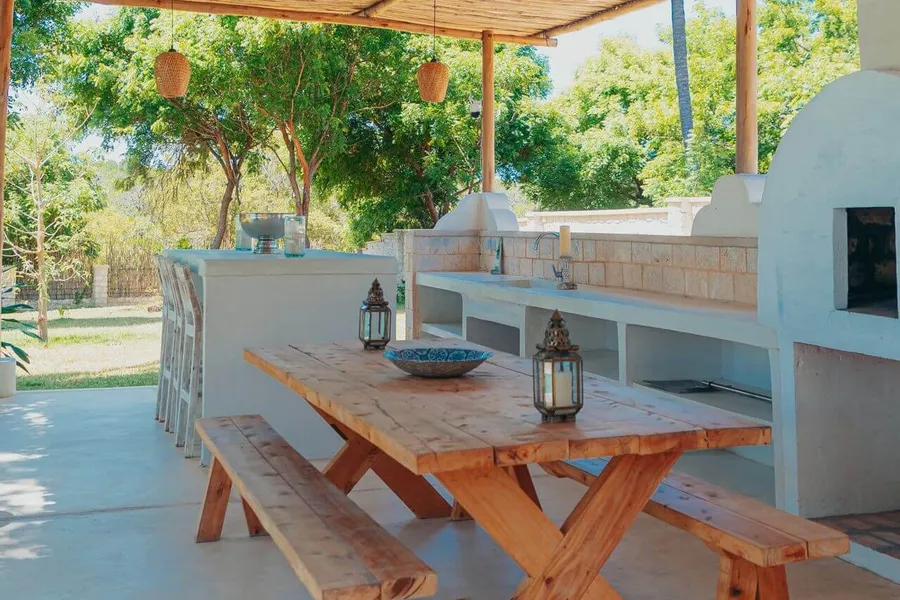
A grill, a fridge and lights outside need their own protected circuit from the house. Outdoor sockets sit behind a safety cut-out, the device that trips when current leaks, and they must be rated for wet weather. Ask the electrician to put the circuit on the quote, with covered sockets.
The sink is where projects go wrong. Washing-up water is household waste water, so it goes where the house's waste water goes: the mains sewer, or the septic tank if the house has one. It must never be tied into the rainwater drain, which carries water away untreated, and it can't run out onto the garden.
Ask where the sink will drain and how far away the nearest waste pipe is. Septic tanks are common up in the hills. If you have one, ask whether the tank and the SPANC (the septic tank inspection service) need to know about the extra sink.
Inland and up the hills, frost comes most winters, and a pipe left full can split. Ask for a stop valve indoors and a drain point, so the outdoor supply can be emptied before winter. That matters most if the house sits empty.
Piping gas out to the kitchen, from the mains or a propane tank, changes the house's gas installation. A qualified gas installer does it and gives you a certificat de conformité (certificate of conformity) at the end. A plancha (flat griddle) on a bottle has a flexible hose with a use-by date printed on it, so replace the hose when the date passes. Store bottles outside and upright, never in a cellar.
Fire rules
Can you light a barbecue or wood oven in summer near the woods?
In both the Alpes-Maritimes and the Var, the préfet (the State's representative in the department) sets fire rules. They cover woods, scrub, heath and maquis (dense Mediterranean scrub), and all land within 200 m of them. Plenty of hillside plots fall inside. From 1 June to 30 September every year, owners in that zone may not light fires, and the préfet can add extra dates, for example in a drought. In the Var the ban also applies on any day when the average wind tops 40 km/h.
One exception shapes the design. A fixed barbecue built against the house, with a masonry chimney, a cap and a fine spark-guard mesh at the top, can still be used in summer. A freestanding grill at the far end of the garden can't, and nor can a mobile wood or charcoal barbecue. In the Var the exception also requires the plot to meet the legal duty to clear scrub. Our garden page sets out that duty for the Alpes-Maritimes.
A wood-fired pizza oven follows the same logic. In a fire zone, a wood oven or grill for summer use should be built against the house. It needs a chimney fitted with a spark guard, on a plot that meets the clearing duty. Check with the mairie before you build. The rules don't name gas planchas, so if you plan one, ask the mairie how it treats them.
Outside the summer period in the Alpes-Maritimes, keep a mobile barbecue off grass and away from trees, with water to hand. Watch it the whole time, and make sure it's out before you leave it.
Smoke is the other risk. The Civil Code, since a 2024 law, makes an owner or tenant liable for smoke and smells beyond normal neighbourhood inconvenience. The neighbour doesn't have to prove any fault. Site the grill and the oven chimney away from the neighbour's terrace and windows, and check the summer wind before the base goes in.
Tell us about the outdoor kitchen you have in mind, and we'll put you in touch with an English-speaking builder who quotes in writing.
Get quotesWhat drives the price
Why an outdoor kitchen is taxed at 20%, and what else drives its cost
Distance from the house comes first. Every metre between the kitchen and the house is a trench for the cable, the water pipe and the waste pipe, and gas adds another line. A kitchen built against the back wall needs far less of that than one down by the pool.
The chimney and the base come next. A wood oven, or a barbecue you want to use in summer near woodland, needs a masonry flue with a spark guard. A sloping plot needs a level base or footings before any counter goes up. A roof adds its own structure, and bioclimatic louvres add a motor and wiring.
Appliances and finishes set the rest: seaside-grade steel and stone worktops cost more than render and tile.
Then there's the TVA. The 10% rate for work on a home over two years old doesn't reach a new outdoor kitchen. The tax office treats a new garden construction as new building, at 20%, even in masonry. Appliances are 20% however you buy them, built in or not. An open pergola fixed to the house can take 10%, but a freestanding one is 20%. Ask which TVA rate is on each line, and why.
Get at least two written quotes for the same layout, with the base, the services, the chimney and the appliances priced as separate lines.
Materials
Outdoor kitchen worktops and steel that survive salt air and summer sun
Within sight of the sea, salt air leaves rust spots on ordinary stainless steel. Ask for 316-grade stainless, not 304, on the doors, the handles and the grill. Ask the supplier to confirm the grade in writing.
Pale limestone and travertine look right beside an old mas (a Provençal farmhouse). They're porous, though, and oil and red wine stain them. Ask whether the worktop will be sealed and how often that has to be redone. Concrete worktops need sealing too.
Hard water leaves white scale on taps and steel. Wipe them dry after use.
Apartments
Building an outdoor kitchen on a flat's terrace needs the owners' vote
A roof terrace or garden for your use alone is still a common part in a copropriété (the building's co-ownership). A freestanding grill and a table are furniture. A built counter, a gas line or a drain through the slab is building work on common parts. It needs a vote at the AG (the owners' general meeting).
Light changes pass by a majority of all owners. Building something takes a double majority. Without the vote, the other owners can make you remove it at your cost. Ask the syndic (the building's managing agent) whether the building's rules say anything about barbecues or gas bottles on terraces, because buildings differ. You may still need the mairie's filing on top.
French terms
French terms for an outdoor kitchen project
Key French terms for this service
Related
More on pergolas, scrub clearing and outdoor permits
Questions
Frequently asked questions about outdoor kitchens on the Côte d'Azur
If your question isn't here, send it with your request and we'll answer it directly.
Only if they are qualified for gas work. Running a supply out to the kitchen, from the mains or from a propane tank, changes the house's gas installation. The installer must hand you a certificat de conformité (certificate of conformity) when the work is done. If a general builder is doing the kitchen, ask who on the devis (written quote) does the gas, and get the certificate named as part of the job.
It depends on how close the woods are. The rules cover woods, scrub, heath and maquis, and all land within 200 m of them. A plot more than 200 m from any of those falls outside the zone. Many communes on the coast have wooded hills behind the houses, so ask the mairie whether your plot is inside the zone before you design the kitchen.
No. Washing-up water is household waste water, and it goes where the house's waste water goes. Where the mains sewer is within reach, connecting to it is compulsory. A house off the sewer sends it to the septic system. Letting waste water run onto public land can bring a fine of up to 1,500 EUR, so ask how the drain will reach the house's pipes.
No. The planning rules give a louvred aluminium roof no special status. It counts towards the footprint like any roof on posts, and the 5 m² and 20 m² lines apply to the kitchen and the roof together. Open louvres don't make it taxable floor space. If it's fixed to the house and leaves the space open, the pergola itself can take 10% TVA.
Possibly, but you have to apply to the mayor at least 10 days ahead. If it is granted, the rules still apply on the day: a 5 m band cleared around the fire, no wind, no trees overhead, and someone watching it the whole time. A fixed barbecue built against the house with a spark-guarded chimney, on a plot cleared of scrub, avoids the request.
Yes. Once the cooking room is closed, covered and over 5 m², it owes the taxe d'aménagement on its floor area. A main home gets 50% off the first 100 m² of new space. A second home gets no reduction, so the full amount applies.
Sources
Official sources for outdoor kitchen permits, fire rules and TVA
- Service-Public.fr: building an annex in the garden (F31471) Nothing to file up to 5 m², a déclaration préalable from 5 to 20 m², a permis above, and a filing from the first m² in a protected sector.
- Service-Public.fr: taxe d'aménagement (F23263) Only closed and covered space with more than 1.80 m of headroom is taxed, so an open kitchen under an open roof is not. A main home gets a reduction that a second home does not.
- BOFiP: TVA on garden constructions (BOI-ANNX-000208) Garden constructions and freestanding garden pergolas are taxed at the normal 20% rate, even when built in masonry.
- Service-Public.fr: waste water and the sewer (F447) Kitchen water is household waste water; it goes to the sewer or the septic system, and connection is compulsory where the sewer is within reach.
- Préfecture des Alpes-Maritimes: open burning and use of fire The 200 m zone, the 1 June to 30 September period, and the exception for a fixed barbecue attached to the house with a spark-guarded flue.
- Préfecture du Var: fire bans and periods The red period from 1 June to 30 September, windy days, the attached-barbecue exception and the mayor's permission for a cooking fire.
- Service-Public.fr: work on an exclusive-use terrace in a copropriété (F31518) A terrace for one owner's use is still a common part. Building on it needs the general meeting's vote, and work done without one can be ordered removed.
- Légifrance: Code civil, article 1253 An owner or occupant is liable for nuisance beyond normal neighbourhood inconvenience, such as smoke, without any fault having to be proved.
Rules checked against these sources in October 2026.