Wall insulation for stone and rubble houses on the Cote d'Azur
A thick old stone wall behaves nothing like a modern cavity wall, and the right insulation choice depends on understanding that before anything else. External insulation (ITE) and internal insulation (ITI) solve different problems, cost very different amounts, and one of them can run straight into a planning refusal. This page walks through how to choose between them, what each costs, and what still gets funded now that MaPrimeRénov' has stopped paying for it.
Looking for an English-speaking installer on the Côte d'Azur? Get quotes →
The physics that matters
Why stone walls on the Cote d'Azur are cold in January and hot in August
A traditional Riviera wall, whether it's dressed stone, rubble fill or thick rendered masonry, doesn't work the way a modern insulated wall works. It doesn't resist heat flow so much as absorb it and release it slowly. Building physics calls this thermal mass: a heavy, dense wall soaks up heat during the day and gives it back hours later, once the sun has gone down. That's a useful trait in a climate with hot summer days and cool summer nights, and a liability in a mild winter with cold mornings.
On a January morning, an old stone house often feels colder inside than the outside air temperature would suggest, because the wall itself has spent the night radiating stored coolness back into the room. On an August evening, the same wall does the opposite: it keeps releasing the heat it absorbed all afternoon, long after the outside air has cooled. Neither effect has much to do with insulation value in the conventional sense. It's the mass doing the work here, something no resistance figure on a datasheet captures.
This matters directly for the ITE-or-ITI decision. Insulating the outside of the wall (ITE) keeps that mass inside the building envelope, on the warm side of the insulation layer, so the wall keeps doing its summer job of storing and delaying heat. Insulating the inside (ITI) puts a layer of insulation between the room and the wall, which cuts the room off from the mass entirely. You gain a warmer room faster in winter, but you lose most of the slow summer cooling the wall used to give you for free. Neither choice is wrong; they just solve different problems, and it's worth knowing which one you're solving before you commit.
Choosing a method
External or internal wall insulation: which works on an old Riviera house?
ITE wraps a continuous layer of insulation around the outside of the building, finished with a new render or cladding system. It eliminates thermal bridging at floor slabs and wall junctions almost completely, it doesn't reduce internal floor area, and as explained above, it keeps the wall's thermal mass working on the inhabited side of the building. The trade-off is that it changes the facade entirely: colour, texture, sometimes the depth of window reveals. That means planning rules apply, covered in the next section, and it usually needs scaffolding.
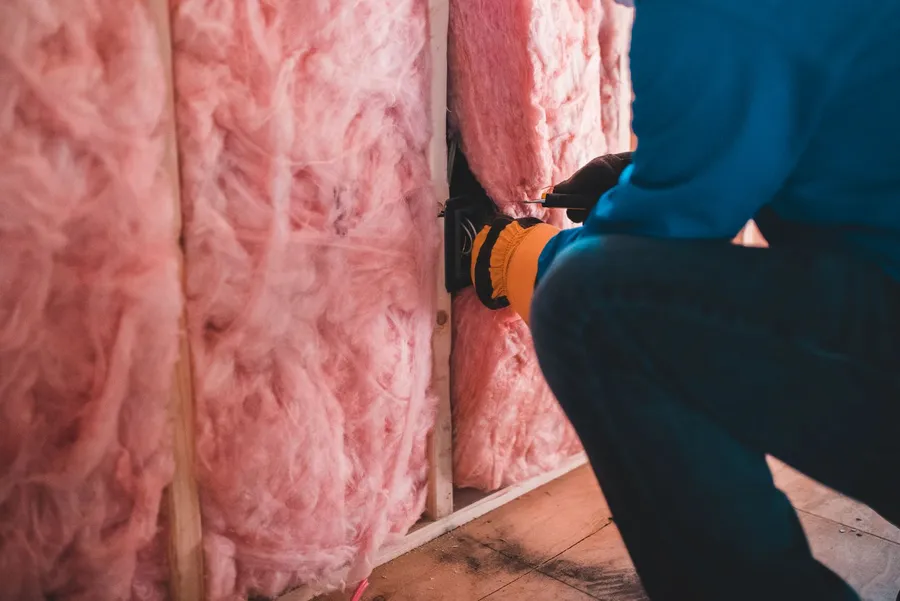
ITI fixes rigid insulation boards, or a stud frame with insulation between the studs, to the inside face of the wall, then finishes with plasterboard. It's faster to install, cheaper, doesn't touch the facade and needs no scaffolding, which makes it the practical choice for a protected building or an apartment where the exterior isn't yours to change. It costs you a few centimetres of room on every external wall, and window reveals, radiators and electrical points all need adapting. As above, it also disconnects the room from the wall's summer cooling effect, a loss that shows up on this coast every August.
For a stone bastide with generous wall thickness and a facade you're free to alter, ITE is usually the better long-term answer. For an apartment, a rental unit, or a house inside a protected perimeter where the facade can't be touched, ITI is often the only workable option, and it's still a meaningful upgrade on a wall that currently has none.
Get matched with vetted English-speaking installers in your area.
Get quotesWhat to budget
What does wall insulation cost per m²?
The figures below are realistic pre-subsidy ranges for installed work in the Alpes-Maritimes. ITE costs more because the price includes insulation boards, a full render system and scaffolding. ITI is cheaper because it's boards and a plasterboard finish fixed to an existing wall, with no facade work involved.
Figures are guidelines. Get a written devis before committing to either method.
Prices vary by wall condition, insulation thickness and finish.
Totals climb fast once you move from a single wall to a full house: 100m² of external wall at the low end of the ITE range is already 12,000 EUR before any grant is applied. That's why pairing ITE with a planned ravalement is worth considering: see our facade renovation page for how sharing one round of scaffolding between the two jobs changes the total.
Financial aid
Which grants still pay for wall insulation after the 2026 MaPrimeRénov' change?
Wall insulation lost access to MaPrimeRénov' par geste on 1 January 2026, a full year ahead of roof insulation and windows. The décret published in August 2026 confirmed that position instead of reopening it. If you read an English-language page claiming a MaPrimeRénov' grant for wall insulation on its own, it's out of date: that route is closed. The only path back into MaPrimeRénov' is a full rénovation d'ampleur project on a principal residence rated E, F or G, run through a Mon Accompagnateur Rénov', which is a different scale of project entirely and excludes second homes outright.
CEE is the route that's still open, under fiche BAR-EN-102, which requires the finished wall to reach R ≥ 3.7 m².K/W. CEE ignores where you spend the year: a holiday home qualifies on the same footing as a full-time one. Certificate prices float with the market (roughly 7-9 EUR per MWh cumac in September 2026), and your installer deducts handling and margin before quoting a figure, so treat any euro amount as illustrative and check the number that lands on your devis.
TVA réduite at 5.5% applies to wall insulation materials and labour on a dwelling completed more than two years ago; the RGE requirement sits on the grants alone and never reaches the tax rate itself. Éco-PTZ, the zero-interest loan, remains available: 15,000 EUR for a single measure such as wall insulation on its own, rising to 25,000 for two measures or 30,000 for three or more, repayable over up to 20 years, and the scheme currently runs to 31 December 2027.
Planning rules
Does external insulation need a permit and can the ABF refuse it?
Yes to both. ITE always changes the facade, because it adds thickness and a new render finish, and any change to a building's external appearance requires a déclaration préalable at the mairie, everywhere, including outside a historic centre. ITI, by contrast, leaves the facade untouched and generally doesn't trigger this requirement at all.
Where it gets harder is inside a protected perimeter, and a considerable share of the old town fabric on this coast sits inside one. In those zones, the Architecte des Bâtiments de France gives a binding opinion on the application: the ABF can refuse ITE outright on a facade considered of architectural or historic interest, or approve it only with specific render colours, textures or detailing that add cost. If your property is inside such a perimeter, it's worth asking the mairie before you commission any quotes: ITE may simply not be available to you, and ITI becomes the only realistic route to insulating the walls at all.
If ITE is approved and you're also due a ravalement (facade renovation), it's worth doing both in one project. Scaffolding is a real share of the ITE bill on its own, and putting it up once for both jobs instead of twice is a straightforward saving. Our facade renovation page covers what a ravalement involves and when the law requires one, which is less often than most French sites suggest.
Getting a written quote
What should a wall insulation devis include?
A vague quote is the biggest source of disputes on insulation jobs, because the difference between an adequate result and a wasted budget often comes down to details that never made it onto paper. Ask for all of the following in writing before you sign anything.
The insulation product and its thermal resistance. The devis should state the exact material, its thickness, and the resulting R value. For CEE eligibility under BAR-EN-102, the finished wall needs to reach R ≥ 3.7 m².K/W; if the devis doesn't state a figure, ask for one before work starts.
The exact area being treated, in m². Vague wording like "walls as discussed" leaves room for later disagreement about what was covered.
Surface preparation. Old rendered or rubble walls often need repair before insulation can be fixed, and that work should be itemised separately, not folded into a single lump sum.
Scaffolding, if it's an ITE job. It should appear as its own line, especially if you're combining the work with a ravalement, so you can see clearly whether it's being shared or duplicated.
RGE certification. Confirm the contractor's RGE certificate covers this specific type of insulation work; a general RGE label doesn't guarantee it. Without it, CEE eligibility is lost.
The TVA rate applied, shown as its own line. Energy renovation work should be billed at 5.5%, not the general 10% rate for repair and improvement work. A contractor mixing the two rates on a single line makes it hard to check they've got it right.
French terms
Key terms to know
Key French terms for this service
Questions
Frequently asked questions about wall insulation on the Cote d'Azur
If your question isn't here, send it with your request and we'll answer it directly.
Not on its own. Wall insulation lost that route on 1 January 2026, and it now only qualifies inside a full renovation project most second-home owners can't access. See our MaPrimeRénov' explainer for the detail. CEE and the 5.5% TVA rate are unaffected and carry no residence condition, so second-home owners qualify on the same terms as anyone else.
ITE (isolation thermique par l'exterieur) wraps the insulation around the outside of the wall, under a new render or cladding. ITI (isolation thermique par l'interieur) fixes insulation boards to the inside face and loses a few centimetres of room. The physics counts for more than the acronyms: ITE keeps the existing stone or rubble wall on the warm side of the insulation, so it still stores heat and releases it slowly, which is what keeps an old Riviera house liveable in August. ITI puts that same mass on the cold side of the insulation layer and cuts it off from the room, so you gain winter comfort but lose most of the summer benefit. ITE also touches the facade, which brings in planning rules that ITI mostly avoids.
Yes. ITE changes the appearance and the thickness of the facade, so it needs a déclaration préalable at the mairie in every case, everywhere, protected zone or not. Inside a secteur sauvegardé or another protected perimeter, which covers a good part of the old town fabric on this coast, the Architecte des Bâtiments de France gives a binding opinion and can refuse the project outright, or dictate the render colour and finish. If your property sits in such a perimeter, ask the mairie before you commission anything: it's entirely possible that ITE simply isn't available to you and ITI is the only realistic route. ITI leaves the facade untouched, so it doesn't trigger the same permission.
ITE runs roughly 120 to 270 EUR per m² of wall, because it includes new insulation boards, a reinforced render system and scaffolding. ITI runs roughly 30 to 90 EUR per m², since it's boards and finishing fixed to an existing internal wall with no facade work and usually no scaffolding. Scaffolding and render account for most of that gap; the insulation material itself costs about the same either way. If you're already planning a ravalement (facade renovation), doing ITE at the same time means paying for scaffolding once instead of twice: see our facade renovation page for how that combination works.
You can do the physical work yourself if you own the property, but you'll give up every grant if you do. CEE, and the rénovation d'ampleur route into MaPrimeRénov', both require the work to be carried out by an RGE-certified contractor for the R >= 3.7 m2.K/W insulation fiche to be claimed. The 5.5% TVA rate on materials and labour has no RGE condition of its own, but it only applies when a professional invoices the work, so a DIY job pays the standard rate on materials bought at a merchant. For most readers, an RGE contractor with a proper devis is the cheaper route once the grants are counted in.