Adding an en-suite or shower room on the Côte d'Azur
Four guests and one bathroom makes for a long queue every morning. A second shower room, a salle d'eau in French, fixes that. Where it can go depends on one pipe: the soil pipe the new toilet has to reach. Find out where that pipe runs before you draw the new room.
Need an English-speaking contractor to add an en-suite or shower room?
Get quotesOn this page9 sections
- Where can the waste pipe from a new en-suite run?
- Why a macerator toilet is a last resort in the Alpes-Maritimes
- A windowless en-suite still needs a fan or a duct
- Will one water heater keep up with two showers at once?
- Distance to the soil pipe drives the cost of a new en-suite
- A new bedroom with an en-suite on a septic tank: is the tank still big enough?
- Which permits and TVA rate apply when you add an en-suite?
- French terms for adding an en-suite or shower room
- Frequently asked questions about adding an en-suite on the Côte d'Azur
Drainage
Where can the waste pipe from a new en-suite run?
Waste water runs downhill. A new shower, basin and WC all have to drain into an existing soil pipe, and the pipe needs a steady fall over the whole distance. The further the new room sits from that pipe, the more floor or wall has to open up to carry it there.
The toilet is the hardest piece to place, because its pipe is the widest. A shower and basin take a smaller pipe and are easier to route. So the first question for the plumber is simple: where will the waste run, and how far is it to the soil pipe? That answer decides the layout. Bedrooms that back onto an existing bathroom, or sit above one, are usually the easiest to fit.
In a flat, the shared soil stack belongs to the copropriété (the building's co-ownership). Ask the syndic (the building's managing agent) before anything is connected to it. Cutting into the stack, or running a pipe through a shared floor, needs a vote at the AG (the owners' general meeting).
Macerator toilets
Why a macerator toilet is a last resort in the Alpes-Maritimes
A macerator toilet, the WC broyeur (a toilet with a grinding pump behind it), can send waste through a small pipe and even uphill. That makes it look like the answer when the soil pipe is far away. In the Alpes-Maritimes, the local health rules stand in the way.
The Alpes-Maritimes health rules forbid macerator toilets in new buildings. In existing homes they allow one only as an exception: an older home with no toilet at all, where no normal connection is technically possible. Even then, the health authority must give its opinion first. You'll read on many French and English websites that a macerator is fine as long as another WC in the house drains normally. The local rules don't say that, and an extra en-suite WC in a home that already has a toilet falls outside the written exception.
So before you plan around one, ask the mairie (town hall) whether it can be allowed in your house and who gives the health opinion. Then plan the extra WC on gravity drainage, and ask the plumber where it can connect.
In a flat there is a second hurdle. A macerator discharging into the shared stack touches the building's common pipes, and many buildings' rulebooks restrict or ban them. Read the règlement de copropriété (the building's rulebook) and ask the syndic before buying anything.
Ventilation
A windowless en-suite still needs a fan or a duct
Taking a shower room out of the corner of a bedroom often leaves it with no window. The local health rules don't allow any change to a home that creates a badly ventilated room, and that covers converting existing space as well as new building.
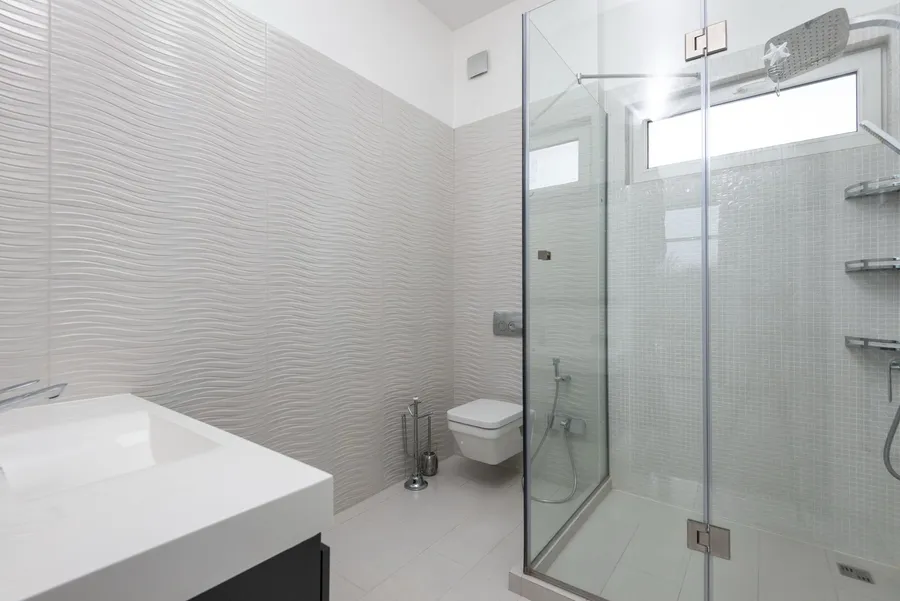
A shower room with a window that opens needs an extract vent high on the wall. One without a window needs a fresh-air inlet, plus extraction at high level by a vertical duct or a mechanical fan. In practice most windowless en-suites get a fan. Ask whether it will join an existing VMC (mechanical ventilation) or run on its own, and where the damp air will leave the building.
That last answer can bring in other rules. A new vent grille or window in an outside wall changes the facade, which needs a déclaration préalable (planning declaration) at the town hall. In a flat it also needs a vote at the AG. A fan connected to an existing shared duct is a question for the syndic.
Don't let the fan drop off the devis (written quote) to bring the price down. Steam with nowhere to go ends up as mould on the bedroom side of the wall.
Hot water
Will one water heater keep up with two showers at once?
A tank sized for one bathroom can run cold when two showers run back to back. You find out in August, with the house full.
Ask the plumber whether the existing water heater can serve both showers, and what a larger tank or a second heater closer to the en-suite would involve. A heater near the new room also cuts the wait for hot water at the tap. On this coast hard water scales up a heater's insides and shortens its life, so check the age of the one you have before deciding it can carry more. Our hot water systems page compares the options.
Get matched with vetted English-speaking installers in your area.
Get quotesBudget
Distance to the soil pipe drives the cost of a new en-suite
A shower room next to an existing bathroom can share its drains. One across the house means lifting floors, boxing in pipes or opening a ceiling below, and putting all of it back afterwards.
A missing window adds the fan and its duct, and sometimes a hole through a thick stone wall or the roof to get the air out. If that hole is in the facade, the planning declaration and, in a flat, the owners' vote come first.
Lifting an old floor can turn up rot or damp that has to be dealt with first. If the building's permit predates July 1997, old tiles or boards need an asbestos check before anyone breaks into them. The shower floor needs a waterproof layer under the tiles, which should be named on the devis as its own line. Add a bigger water heater if the old one can't keep up.
Get two written quotes for the same plan, each showing the drain route and the ventilation, so you can compare them line by line. What drives the price of any bathroom is on our bathroom renovation page.
Septic tanks
A new bedroom with an en-suite on a septic tank: is the tank still big enough?
Many hillside houses drain to their own septic tank. French rules size it by the number of main rooms, meaning bedrooms and living rooms. A bathroom doesn't count as one. The tank must hold at least 3 m³ for a home of up to five main rooms, plus at least 1 m³ for each room beyond that.
So an en-suite added to an existing bedroom doesn't change the count. A new bedroom with its own en-suite does. If the house was already at five main rooms, the tank may now be too small.
The building work itself rarely brings it to light. Extending a house doesn't call for a new certificate from the SPANC (the septic tank inspection service) unless the septic system itself is being rebuilt. The SPANC finds an undersized tank at its next routine inspection, and a buyer's report shows it at a sale. Ask whether the tank is still big enough before either of those happens. Our stone house page explains what a non-compliant report means for a buyer.
Permits and tax
Which permits and TVA rate apply when you add an en-suite?
Dividing a bedroom, or turning a box room into a shower room, creates no new floor area. That needs no planning declaration and triggers no taxe d'aménagement (one-off building tax). The paperwork starts when the outside changes: a new window or vent in an outside wall needs a declaration, and in a flat a vote too.
Converting a garage or a loft into the en-suite is a different case, because it can create floor area. The rules on declarations, the building tax and when an architect is compulsory are on our house extensions page.
For TVA (French VAT), fitted work inside a home over two years old is taxed at 10% when the firm supplies and fits it. A freestanding cabinet or mirror bought on its own stays at 20%. If the en-suite sits in an extension built onto the house, the extension's work is taxed at 20%. Ask for the rate on every line of the devis.
French terms
French terms for adding an en-suite or shower room
Key French terms for this service
Questions
Frequently asked questions about adding an en-suite on the Côte d'Azur
If your question isn't here, send it with your request and we'll answer it directly.
No. The Alpes-Maritimes health rule on macerators covers toilets only. A small pump that lifts water from a shower or basin is a different device. Ask the plumber how loud it is, where the pump box sits so it can be serviced, and what happens to the shower if the pump fails. In a flat, ask the syndic before it is connected to the shared pipe.
That is the one case the local health rules allow for. Even then, no gravity connection must be technically possible, and the health authority gives its opinion first. The macerator must discharge straight into a vented soil pipe of the right size, never into a rainwater pipe, and be insulated so the noise doesn't reach the neighbours. Ask the mairie (town hall) first.
No. The national rule on whole-house ventilation applies to new homes. The local health rules only require the new shower room itself to be ventilated. With a window that opens, it needs a high-level vent. Without one, it needs an air inlet plus a fan or vertical duct. The rest of the house can stay as it is.
It can be. French insurers judge it case by case, and the test is whether the leak makes the room or the rooms around it unfit for use. Water coming through a ceiling below usually meets it. Taps, the mixer and a new water heater don't: since a 2024 court ruling, equipment added to an existing home falls outside both the two-year and ten-year cover.
It depends on the commune. Each SPANC (the septic tank inspection service) has its own rulebook, and some ask to be told about new connections while others leave it to the next inspection. Ask yours before the work starts. If a bedroom is being added at the same time, ask about the tank's size in the same call.
Sources
Official sources for en-suite drainage, ventilation, septic tanks and TVA
- Préfecture des Alpes-Maritimes: Règlement sanitaire départemental The local health rules: a new shower room or WC must be ventilated (with a fan or duct if it has no window), and a macerator WC is allowed only as an exception, in an older home with no toilet, after the health authority’s opinion.
- Légifrance: arrêté of 7 September 2009 on septic systems, annexe 1 A septic tank must hold at least 3 m³ for a home of up to five main rooms, plus at least 1 m³ for each extra room.
- Sénat: written answer on SPANC checks when a house is extended (2015) Extending a house needs no new SPANC certificate unless the septic system itself is rebuilt; an undersized tank is picked up at the next inspection.
- BOFiP: reduced TVA rates on work in homes (BOI-TVA-LIQ-30-20-90-20) Fitted work in a home over two years old is taxed at 10% when the firm supplies and fits it; freestanding furniture stays at 20%.
- BOFiP: work excluded from the reduced TVA rates (BOI-TVA-LIQ-30-20-90-30) An addition built onto a house counts as new construction and is taxed at the normal 20% rate.
- Service-Public.fr: planning declaration (F17578) Work that changes the outside look of a building, such as a new window or vent opening, needs a déclaration préalable.
- Service-Public.fr: work in a copropriété (F31513) Work that touches the building’s common parts or changes its exterior needs a vote at the general meeting first.
Rules checked against these sources in October 2026.