Smart home installation on the Cote d'Azur, for properties you're not always in
A smart thermostat, a camera and a few sensors let you keep an eye on a Riviera home from another country. You don't need an expensive system. You need devices that work reliably and an app you can use from home.
Looking for an English-speaking installer on the Côte d'Azur? Get quotes →
The second-home context
Which smart devices earn their place in a Cote d'Azur second home?
This page covers the devices: thermostats, sensors, cameras, plugs and hubs, most of which fit into your existing wiring. For a wired system tying the whole house together, or motorising the shutters, see our home automation guide.
A thermostat with frost alerts. The coast rarely freezes, but the arrière-pays does in January. An empty house inland, especially one with exposed pipes, is at risk in a cold snap. Set a connected thermostat to 8°C frost protection and have it alert you if the temperature falls below that. The same alert tells you when the heating has failed.
Remote heating and cooling. Switch on the reversible heat pump two hours before you arrive and the house is comfortable when you walk in. If you left the heating up, you can turn it down from the airport.
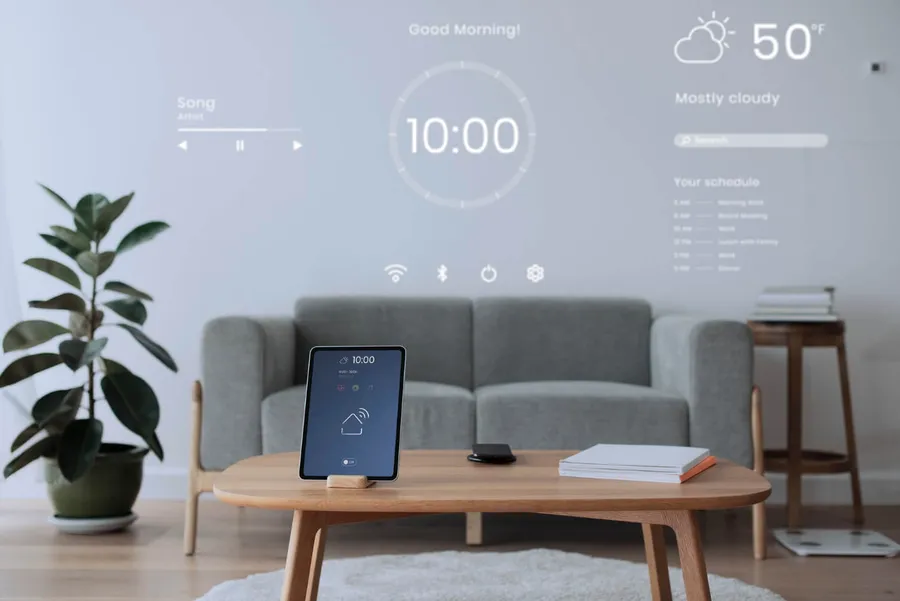
Shutter control. If your shutters already have Somfy motors, a TaHoma hub can close them through the hottest summer hours (roughly 1pm to 4pm) and again at sunset.
Alarm and cameras. You get a notification if someone breaks in and can look at the camera feed. Pair them with a smart lock or gate opener and you can let a cleaner in from abroad.
For the rest of the departure checklist (ventilation, water isolation, insurance clauses), see preparing your Côte d'Azur second home for a long absence.
The law
Is a programmable thermostat compulsory in French homes?
Yes, from 1 January 2030 for existing homes. The deadline was 2027 until a decree of December 2025 pushed it back; 2027 now applies only to new builds. The heating has to be programmable and regulated room by room, or zone by zone. It needs comfort, reduced, frost-protection and off settings.
A connected thermostat isn't required. A basic programmable system meets the rule. You're exempt if fitting one isn't technically and economically feasible, for example when the payback would take more than ten years. Keep the evidence. Stoves you feed by hand are also outside the rule.
Heating controls fitted by a firm in a home over two years old are taxed at 5.5%, with no RGE condition. That holds for a second home too. Some room-by-room systems also earn a small CEE grant.
System options
Zigbee, Somfy or Matter: which smart device standard fits your home?
Most smart devices talk wirelessly, but not all in the same language. The standard you pick decides which devices can join later. A wired KNX system is a different job, covered in our home automation guide.
Zigbee and Z-Wave
Wireless standards built for retrofits. Devices pass signals to each other and to a central hub, with no new wiring. Zigbee is open and widely supported. Z-Wave is more closed but has plenty of compatible devices. Both get through thick walls with repeaters. They suit apartments and existing houses.
Somfy TaHoma
The usual hub for shutters and blinds in France, because Somfy motors are so common here. It runs Somfy devices and can link to other smart home platforms.
Matter
The cross-brand standard backed by Apple, Google, Amazon and the big device makers. Devices from different brands work together. It's still maturing, but it's the sensible label to look for when buying new wireless devices.
Get matched with vetted English-speaking installers in your area.
Get quotesComing from abroad
How does smart home technology work differently in France?
UK
Nest is sold in France; Hive is rarely fitted by French electricians. French heat pump brands have their own connected controls, such as Atlantic Cozytouch and Daikin Onecta, which link straight to their units. Somfy TaHoma for shutters has no real UK equivalent.
US
Nest, Alexa, Google Home and Apple HomeKit all work in France. Alexa and Google Home take French commands too. US smart switches and dimmers won't fit: they're made for American wall boxes. Buy switches from European suppliers so they fit French boxes and standards.
Germany
KNX is common in Germany, and KNX certification is the same across Europe. Gira, Jung and Busch-Jaeger (ABB) switches work in French homes without modification. The local difference is Somfy, which runs most shutters here.
Choosing a contractor
What should you look for in a smart home installer on the Cote d'Azur?
Any competent electrician who knows your chosen platform (Somfy TaHoma, Zigbee, Netatmo) can fit wireless devices. Experience counts for more than a certificate here. Ask to see similar installs, ideally in homes like yours.
Check whether the installer can diagnose problems remotely. Suppose a sensor stops responding three months later and you're in another country. An installer who can often fix it online saves a wasted trip.
Ask what happens if the manufacturer's servers go down. Many apps route everything through the maker's cloud. If the company drops support, the device can stop working. Devices that also run locally, or fall back to local control, last longer in a house you'll own for decades.
French terms
French terms you'll meet when buying smart home devices
Key French terms for this service
Questions
Frequently asked questions about smart home systems on the Cote d'Azur
If your question isn't here, send it with your request and we'll answer it directly.
No. For existing homes the date moved to 1 January 2030 (décret of 26 December 2025). The 2027 date now applies only to new builds. The rule asks for heating you can programme and regulate by room or zone, with comfort, reduced, frost and off settings. A basic programmable system meets it. Nothing requires a connected one.
It depends on what you want to control. Somfy TaHoma is the usual choice for shutters and blinds. Netatmo (a French brand owned by Legrand) is well supported for heating. Legrand Céliane and Bticino are common for lighting. Zigbee devices such as Philips Hue work anywhere in Europe. For new devices, look for Matter, the cross-brand standard Apple, Google and Amazon back.
Yes. Wireless devices need no new wiring: smart switches fit the existing wall box, smart plugs go in existing sockets. The usual problem is signal. Thick stone walls block wifi and Zigbee, so budget for a repeater or mesh wifi. Check your heat pump model works with a thermostat before you buy one.
Only when a firm supplies and fits it in a home finished more than two years ago. Heating regulation and programming equipment is on the energy-improvement list at 5.5%, with no RGE condition. Buy the thermostat yourself in a shop and you pay the standard 20% on it. Ask for the reduced rate on the devis.
Start with a temperature alert: you want to know if the house drops below 8°C in winter, when pipes are at risk. Then remote heating and cooling, shutters that close in the afternoon sun, and an alarm with camera access. Add remote door or gate access if cleaners or guests come while you're away.
Sources
Official sources for the thermostat rule and smart heating TVA
- Légifrance: décret n° 2025-1343 du 26 décembre 2025 Keeps 1 January 2027 for new builds and sets 1 January 2030 for existing homes.
- Légifrance: décret n° 2023-444 du 7 juin 2023 Defines the required controls (room or zone, comfort, reduced, frost and off) and the feasibility exemption.
- Service-Public.fr: when the programmable thermostat obligation takes effect Says a connected thermostat isn't required and gives the ten-year payback exemption.
- BOFiP: BOI-TVA-LIQ-30-20-95, reduced TVA for energy-improvement work Puts heating regulation and programming equipment, fitted by a firm in a home over two years old, at 5.5%.
Rules checked against these sources in September 2026. Cost ranges are our own estimates and are not drawn from these sources.