Split AC installation on the Cote d'Azur, from English-speaking specialists
A split AC unit is the usual way to cool a room or two in a Riviera apartment or villa. One outdoor unit and one indoor wall unit, joined by a pipe and a cable through the wall. The fitting is simple when it's done well. Whether you'll rely on it for fifteen years comes down to the size, the brand's after-sales support here, and getting copropriété approval before anything is ordered.
Looking for an English-speaking installer on the Côte d'Azur? Get quotes →
How it works
What does a split AC installation involve on the Côte d'Azur?
The indoor unit sits high on an inside wall, so the cooled air falls into the room. The outdoor unit holds the compressor and goes on a wall bracket, a terrace or a roof. The installer drills one hole through the wall for the pipes, the cable and the drain, then connects and commissions the system.
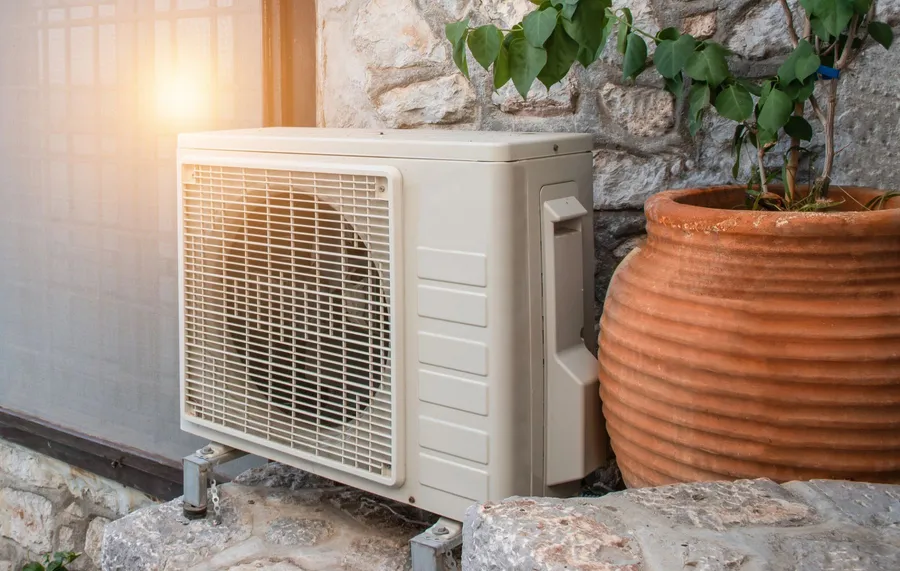
When the outdoor unit sits right behind the indoor one, the job takes 4-8 hours. A pipe that has to go round a corner, down a facade or across a roof adds time and cost. Every unit also has a maximum practical pipe length, so ask how long your run is and whether the price covers it.
Check where the drain goes. A badly run drain is one of the commonest causes of water damage from AC: the condensation drips inside instead of draining away outside. It should leave through the same hole as the pipes and end at a drain point or on the outside wall.
Getting the size right
How do you size a split AC unit correctly for a Côte d'Azur property?
Undersizing and oversizing both cause problems. An undersized unit runs flat out and never reaches the set temperature, so it wears faster and costs more to run. An oversized one cools the air quickly and switches off before it has taken out the humidity. The room hits the set temperature but feels cold and clammy, which is miserable on the Riviera in August.
As a rough guide, for a room with a standard ceiling (2.4-2.7m) and average insulation:
You'll need more for a south-facing room, poor insulation, a ceiling above 3m or big windows. A top-floor flat under a flat roof in Nice needs more cooling per square metre than a ground-floor stone flat in the same building.
A good installer looks at the room before naming a size. If a contractor quotes a size without visiting, treat it as a yellow flag. They may be right, but you've no way to check.
Equipment
Which AC brand should you choose for a French residential installation?
After-sales support (spare parts, local engineers, warranty claims) depends on how present a brand is in France. Global reputation counts for less, so the pecking order here differs from the UK, the US or Germany.
Daikin is the usual premium choice in France. It has a strong network of trained installers and service engineers in the Alpes-Maritimes and Var, and spares are well stocked. For a property you'll use for years, that network is worth the premium.
Mitsubishi Electric sits alongside Daikin at the top, with good after-sales in the region. Mitsubishi Heavy Industries is a separate company with different products, so check which one you're being quoted.
Toshiba and Fujitsu are solid mid-to-upper-range options with reasonable service cover here. They're the sensible step down if the top two are over budget.
Atlantic is a French manufacturer with strong local distribution and competitive prices, popular for rental properties. Its after-sales network is domestic, which can help.
Samsung and LG make capable units, but their installer and service networks in the Alpes-Maritimes are thinner. Fine for a spare room; less so as the main system in a house you rely on all year.
Get matched with vetted English-speaking installers in your area.
Get quotesWhat to budget
What does split AC installation cost on the Côte d'Azur?
Prices are for one split unit fully installed: both units, pipework, electrical connection and commissioning. They're before any subsidy.
Brand, capacity and pipe length move the price most. After that comes any extra electrical work, such as a dedicated circuit for the unit or a distribution board upgrade.
Financial aid
Are there subsidies for split AC installation in France?
Here, whether the unit also heats changes what you pay.
MaPrimeRénov' doesn't cover a cooling-only unit. Since January 2025 it hasn't covered a reversible air-air split installed as a single measure either, so leave it out of your budget.
CEE credits can still apply to a reversible split, but on the Côte d'Azur they come to only about 220-350 EUR. The unit must meet an efficiency threshold and be fitted by a professional installer, so ask them to confirm it qualifies. A cooling-only unit gets nothing.
TVA réduite at 5.5% has applied to reversible splits since 18 July 2026, if the unit meets an efficiency and connectivity spec. A reversible unit that misses it stays at 20% on the equipment and 10% on the labour. So does every cooling-only unit. Check which rate is on the devis.
Coming from abroad
What's different about split AC installation in France?
UK
Split AC is rare in British homes, so most British buyers have no feel for good work or a fair price. Some expect it to be hard to organise. In fact the French market is mature and competitive, and qualified installers are easy to find in the region. The adjustment is the devis process and knowing what to ask.
US
Americans know central HVAC and window units, but here the split system is the standard. French specs give capacity in kW, not BTU. The mains supply is different too, so North American equipment won't work. Your installer will assess the room and specify equipment from scratch.
Germany
Home split AC is less common in Germany than in France. The F-gaz rules on refrigerant handling are EU-wide, so they won't surprise you. What catches German buyers out is copropriété approval. Needing the syndic's consent before changing a facade is very French, and German apartment ownership has no direct equivalent.
Choosing a contractor
Which certifications should a split AC installer hold?
Ask for F-gaz certification (also written F-Gas or fluor). EU law requires it of anyone who charges, recovers or works on the refrigerant circuit. An installer who can't show it shouldn't be doing the job.
You don't need an RGE-certified installer to claim CEE on a split: the CEE rules for air-air units only ask for a professional installation. RGE (the QualiPAC label) matters if the same firm is also quoting an air-to-water heat pump, because MaPrimeRénov' requires it.
A good devis names the make and model of both units, their capacity in kW and the refrigerant they use. It states how much pipe is included, whether the electrical work is in scope, and the commissioning. Warranty terms should be listed separately for parts and labour. If the quote is one round number, ask for the breakdown.
Ask who handles warranty claims. Some installers are brand-authorised service agents and some aren't, and that matters when the unit fails in year two.
French terms
French terms on a split AC devis
Key French terms for this service
Questions
Frequently asked questions about split AC installation
If your question isn't here, send it with your request and we'll answer it directly.
Usually 4-8 hours for one unit, when the outdoor unit sits right behind the indoor one. A pipe run round a corner or up to a roof adds time. Most installers fit one unit per visit. A pre-charged system is normally commissioned the same day, so you'll often have cooling by late afternoon.
In a copropriété, probably yes: you'll likely need approval before an outdoor unit goes on the facade. Some buildings ban visible units on street-facing facades, others allow neat ones. Read the règlement de copropriété and ask the syndic before ordering anything. A house needs no syndic consent, but near a listed building or in an ABF zone, external changes may be restricted.
Not the refrigerant side. By law, anyone who charges, recovers or works on the refrigerant circuit needs F-gaz certification, and most units sold through installers can only be started up by a certified one. DIY-store "no-pipe" pre-charged kits exist, but their pipework is very limited. A certified installer also gets you a warranty, servicing and, on a reversible unit, CEE credits.
Yes, two kinds. CEE credits don't care whether it's your main home, and the 5.5% TVA rate covers a second home over two years old if the unit meets the spec. MaPrimeRénov' won't help: it excludes air-air splits and only funds a principal residence. Check that the devis shows the CEE deduction and the TVA rate.
Reversible, in most cases. It heats in winter from the same unit, can earn CEE credits of about 220-350 EUR on the Côte d'Azur, and gets 5.5% TVA if it meets the spec. A cooling-only unit gets no CEE and pays 20% TVA on the equipment and 10% on the labour.
Often yes, but it depends on the refrigerant gas inside. Ask a technician which one it uses and whether it can still be serviced. EU rules are phasing out older refrigerants in stages, with different dates for servicing and for new equipment, so the answer depends on the gas and the size of the unit. If the answer is no, plan the replacement before a breakdown forces it.
Sources
Official sources for split AC subsidy and TVA rules
- Service-Public.fr: MaPrimeRénov' (F35083) Who qualifies (principal residence only) and which heating systems the grant covers.
- Ministère de la Transition écologique: CEE standard operation sheets The CEE rules for air-air heat pumps (sheet BAR-TH-129), including the efficiency threshold and climate zones.
- Légifrance: arrêté of 13 July 2026 The spec a reversible split must meet to get 5.5% TVA from 18 July 2026.
- BOFiP: BOI-TVA-LIQ-30-20-95, reduced TVA on energy renovation work The reduced-rate conditions for homes over two years old, main or second home.
Rules checked against these sources in September 2026. Cost ranges are our own estimates and are not drawn from these sources.