Roofing and re-roofing on the Cote d'Azur
Terracotta tuiles canal, laid low-pitched across the coast, take a real beating every year from the violent autumn storms most English-language guides never mention. This guide covers what fails first on a Riviera roof, what a repair or a full réfection costs, and the one TVA distinction that catches almost every English-speaking owner out.
Looking for an English-speaking installer on the Côte d'Azur? Get quotes →
The local roof
What kind of roofs do Riviera houses have and what fails first?
Most older houses on the coast carry tuiles canal, the curved terracotta barrel tiles laid in overlapping rows on a low-pitch roof. It's a style built for hot, dry summers and mild winters, ill-suited to shedding snow, and it's everywhere from Menton to Cannes. Newer builds sometimes use flatter interlocking tiles, but canal tiles remain the dominant look on anything built before the 1980s and are often required inside historic centres regardless of what you'd prefer.
What you can see from the ground: tiles that have slipped or cracked, usually after one of the violent autumn storms the coast gets in September and October, or a winter gale. A row of tiles sitting slightly out of line, or a gap where one has slid or blown off, is worth acting on quickly, because a single displaced tile lets water into the structure below far faster than the small gap suggests.
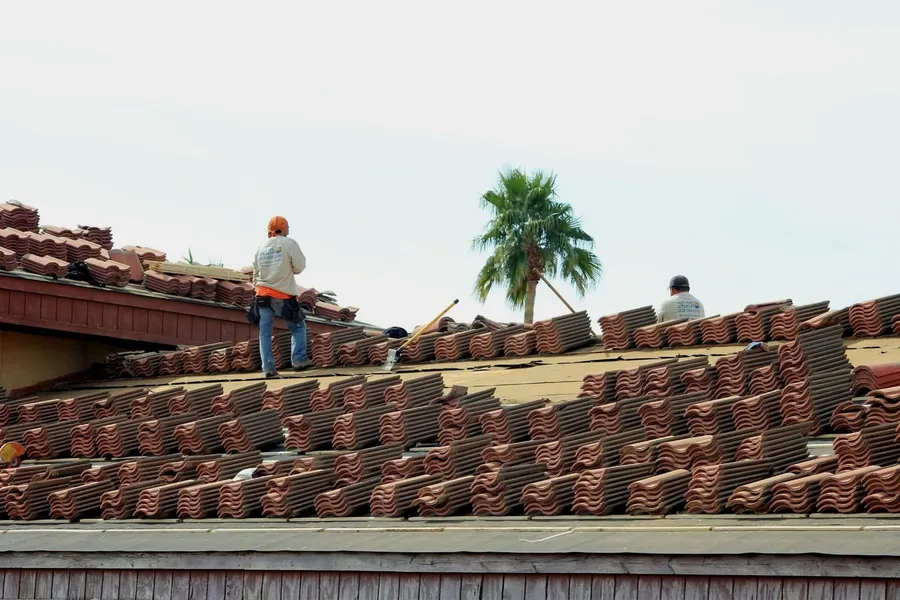
What you generally can't see: the underlay beneath the tiles, which degrades with UV and heat cycling over the decades and eventually stops doing its job as the tiles' backup barrier. Zinc gutters and flashings around chimneys and valleys corrode or were undersized to begin with, and that's usually where a "roof leak" starts, more often than in the tiles themselves. The ridge mortar (the pointing that seals the ridge tiles) also cracks and crumbles over time, and it's easy to miss unless someone's up there looking closely.
A roofer who does a proper inspection will check all four of these instead of just glancing at the tile field from a ladder. If your only diagnosis is "it's leaking somewhere," ask for a proper look before anyone commits to a repair plan.
Decision framework
Repair, full réfection, or réfection with sarking: which does your roof need?
Patch repair: slipped tiles, flashing and ridge mortar
The right call when the problem is localised: a handful of displaced tiles, a section of failed flashing, a cracked run of ridge mortar. It's the cheapest option and can extend the life of an otherwise sound roof by years. It doesn't touch the underlay or the structure, so it's not a fix for a roof that's failing broadly.
Full réfection
A complete strip and re-lay: the tiles come off, the underlay and battens get replaced, structural timber gets repaired where needed, and the tiles go back on (either the same ones, where they're sound enough to reuse, or new ones). This is the right move once the underlay has failed broadly or the roof is old enough that patch repairs are just delaying the inevitable.
Worth considering
Réfection plus sarking insulation
If you're already paying for scaffolding and for the labour to strip and re-lay the covering, adding sarking insulation (rigid panels fitted under the tiles, over the rafters) while the roof is open costs far less than doing it as a stand-alone job later, because the access and labour are already on the invoice. It's the biggest lever most owners overlook when planning a réfection, and CEE support (BAR-EN-101) covers rafter insulation at R 6 with no residence condition, so second-home owners qualify too. Our roof insulation page covers the technical requirements and current CEE figures. The trade-off: sarking adds a few centimetres to the roof height, which means you'll need a déclaration préalable for the insulated version even where a straight like-for-like re-tiling wouldn't have required one. Factor that into your timeline before you commit to scaffolding dates.
Get matched with vetted English-speaking installers in your area.
Get quotesWhat to budget
What does a new roof cost per m² in the Alpes-Maritimes?
The two figures below cover the two scopes described above. Where your roof falls between them depends on the state of the structure underneath, which you won't know for certain until a roofer has been up there.
Figures are guidelines and vary by contractor and access. Confirm current pricing with your installer before signing, and ask for the devis broken down by line instead of as one lump figure.
Costs are for the roofing work itself and do not include CEE, TVA adjustments or Éco-PTZ financing.
What moves the price most inside those ranges: how much structural timber needs replacing, roof access (a steep pitch or a tight street pushes scaffolding cost up), whether you're reusing the existing tiles or buying new ones, and whether sarking insulation is added while the roof is open. A typical Riviera villa roof runs 120 to 150 m², so a full réfection on a mid-size house can land anywhere from roughly 12,000 to 37,500 EUR depending on scope. That's a wide range on purpose: get at least two itemised devis before treating either end of it as your budget.
Planning rules
Do you need a déclaration préalable to replace roof tiles?
What you're changing decides the answer. Swap in the same tile, same type, same colour, and most communes wave it through without a déclaration préalable. Even then a handful of PLUs (plan local d'urbanisme) attach their own conditions to like-for-like work, so a quick call to the mairie before fixing a start date costs nothing and saves a headache later.
Any change to the tile type or colour does need a déclaration préalable, because it alters the building's external appearance. Adding sarking insulation also needs one, even with the same tile, because it raises the roof height. If your property sits inside a protected perimeter (common around the old towns here), the ABF has binding authority over the application and can dictate the exact tile, and sometimes the render colour too. The ABF's word here carries weight: it can and does refuse changes it doesn't like, so get their position before you order materials.
The rate that trips people up
Plain re-roofing is 10% TVA; only the insulation line gets 5.5%
Plain re-roofing, stripping the old covering and re-laying tiles, is classified as general renovation and repair work, and that sits at 10% TVA. This is the rate that applies to a full réfection with no insulation element, and it's the rate most roofing devis will show.
The 5.5% reduced rate only applies to the insulation element of a job: the insulation panels themselves, the HPV membrane if one's used, and the labour to fit them. Stripping and re-laying the tile covering stays at 10%, even on a job that also includes sarking insulation, unless that strip-and-relay is indispensable to the insulation work itself.
In practice this means a single roofer doing a combined réfection-plus-sarking job should be splitting the devis into at least two lines: one for the insulation at 5.5%, and one for the roofing and covering work at 10%. If your devis shows one undifferentiated line at 10% for a job that includes insulation, ask the installer to break it out. That line-by-line split is the difference between paying 5.5% and 10% on the insulation portion, and on a job with a meaningful insulation component, that's real money left on the table for no reason.
One thing worth saying plainly: don't measure this saving against 20%. Twenty percent was never the rate that would have applied to renovation work on a home over two years old; ten percent was. The saving from getting the insulation portion correctly billed at 5.5% instead of 10% is real, but it's smaller than a lot of French sites imply when they compare against the wrong baseline.
Before you sign
What should a roofing devis include?
Roofing is structural work. That makes the garantie décennale, the ten-year insurance cover for defects that affect the building's solidity, mandatory, and worth verifying before work starts. Ask for the attestation d’assurance décennale before any work starts, confirm it names the company you're contracting with, and confirm it covers roofing specifically.
Beyond that, a proper devis should specify: the exact scope (repair, full réfection, or réfection with sarking insulation), whether tiles are being reused or replaced and with what, the TVA rate applied to each line separately, the scaffolding and access plan, what happens to the waste, and the payment schedule. If sarking insulation is included, the devis should also flag that a déclaration préalable is needed and say who's filing it.
A contractor who won't itemise the devis, who quotes one lump sum for a job that clearly mixes insulation and roofing work, or who can't produce a décennale certificate on request, isn't someone to hand a roof to.
French terms
Key terms to know
Key French terms for this service
Questions
Frequently asked questions about roofing on the Cote d'Azur
If your question isn't here, send it with your request and we'll answer it directly.
Tile re-laying, where the existing structure and battens are sound and only the covering needs replacing, runs 60 to 90 EUR per m². A full réfection, including structural repairs, scaffolding and waste removal, runs 100 to 250 EUR per m². A full réfection on a typical Riviera villa roof of 120 to 150 m² therefore lands somewhere between 12,000 and 37,500 EUR depending on scope. Re-laying the same roof, if the structure is sound, is a different order of cost. Get at least two itemised devis before you commit to either figure.
It depends what you're replacing them with. Swapping tiles like-for-like, same type and colour, generally doesn't need a déclaration préalable, though your commune's PLU can still impose its own rules, so it's worth a call to the mairie before you start. Any change to the tile type or colour needs a déclaration préalable. Inside a protected perimeter around a historic centre, the ABF has binding authority and can dictate the tile itself, so check that status early.
Plain re-roofing, stripping and re-laying the covering, is general renovation work and sits at 10%, not 5.5%. The 5.5% rate only applies to the insulation element of a sarking job: the insulation panels, the membrane and the labour to fit them. If your installer adds sarking insulation while the tiles are off, ask them to split the devis into a 5.5% insulation line and a 10% roofing line. An undifferentiated 10% line on the whole job costs you the difference for no reason.
Usually, yes, if the tiles are already coming off. Once the scaffolding is up and the roofer is stripping and re-laying the covering, the marginal cost of adding sarking insulation underneath is far lower than paying for a separate insulation job later, because you're not paying twice for access and labour. The one thing to plan for is that sarking adds a few centimetres to the roof height, which means you'll need a déclaration préalable even where a like-for-like re-tiling wouldn't have required one.
Yes. A roof is structural, and French law requires any contractor doing this kind of work to hold garantie décennale, a ten-year insurance policy covering defects that affect the building's solidity or make it unfit for use. Ask for the attestation d’assurance décennale before work starts, and check the document names the company you're contracting with and covers roofing specifically. A contractor who can't produce it on request shouldn't be on your roof.