Facade renovation and ravalement on the Cote d'Azur
A French rule of thumb keeps circulating in English-language advice on facade renovation: that ravalement is legally due every ten years. That's a myth as a blanket rule. This page sets out what French law requires, which colours a commune can make you use, and what a facade job costs.
Looking for an English-speaking installer on the Côte d'Azur? Get quotes →
The rule everyone gets wrong
Is a ravalement de façade really compulsory every ten years?
Not in the way most sites describe it. Search for this topic in French and you'll find page after page stating flatly that a ravalement is "obligatoire tous les 10 ans." That's an oversimplification of a much narrower rule, worth understanding before you budget or schedule anything.
Article L132-1 of the Code de la construction et de l'habitation requires owners to keep the exterior of a building "constamment en bon état de propreté," constantly in a good state of cleanliness and repair. That's a continuous obligation. It doesn't create a ten-year deadline on its own.
The ten-year cycle comes from separate articles, L132-2 to L132-5, and those only apply in Paris and in communes that have specifically opted into the scheme, either through a prefectoral decree or a deliberation by the local council. Where a commune has adopted it, the mechanism in practice isn't an automatic countdown either: the mairie sends an injunction to the owner, and the owner then has a deadline, typically somewhere between 6 and 12 months, to carry out the work.
We looked for a list of Alpes-Maritimes communes that have adopted this rule and couldn't confirm one either way. That's not the same as saying no commune here has done it, only that we can't state it with confidence. If a ten-year deadline matters to your planning, the right move is a short call or email to your mairie's service urbanisme; skip the French blog posts claiming it applies everywhere.
None of this changes the underlying duty. If a facade is visibly cracked, stained or shedding render, a commune can act against it under the continuous good-repair rule at any point, ten-year cycle or not.
Colour and planning rules
Which colours can you paint a house on the Cote d'Azur?
Whichever colour you're picturing, check before you buy the paint. Many communes on the coast set an approved palette, a nuancier, through their Plan Local d'Urbanisme, so a render colour that's common two streets over might not be on the approved list for your street. Even where no formal nuancier exists, changing your facade's colour needs a déclaration préalable, a lighter planning filing than a full permis de construire, but a filing all the same.
The stakes rise sharply inside a protected perimeter, the zones drawn around historic centres and listed buildings. Menton's old town is the clearest local example: much of it sits inside a perimeter where the ABF, the Architecte des Bâtiments de France, has binding authority over colour, render texture and even window shutters. That's not a recommendation you can push back on the way you might with a planning officer's opinion elsewhere. If the ABF says ochre and you filed for blue, you repaint in ochre.
Practically, that means bringing a specific colour reference to the déclaration préalable, down to the exact shade code. Ask the mairie whether a nuancier applies to your address before you commission any sample panels, and if you're inside an old town core, budget real time for the ABF's review: it can take longer than the standard filing window.
Get matched with vetted English-speaking installers in your area.
Get quotesWhat to budget
What does a ravalement cost per m²?
Budget 40 to 150 EUR per m² of facade, depending on finish and the amount of repair needed underneath. A simple clean-and-repaint on a facade in reasonable condition sits at the low end. A full render replacement, with crack repair, re-rendering and a premium finish, sits at the top.
Figures are guidelines. Get a written devis before committing, and ask your contractor to itemise scaffolding separately from the render work.
Prices vary by finish, facade condition and access.
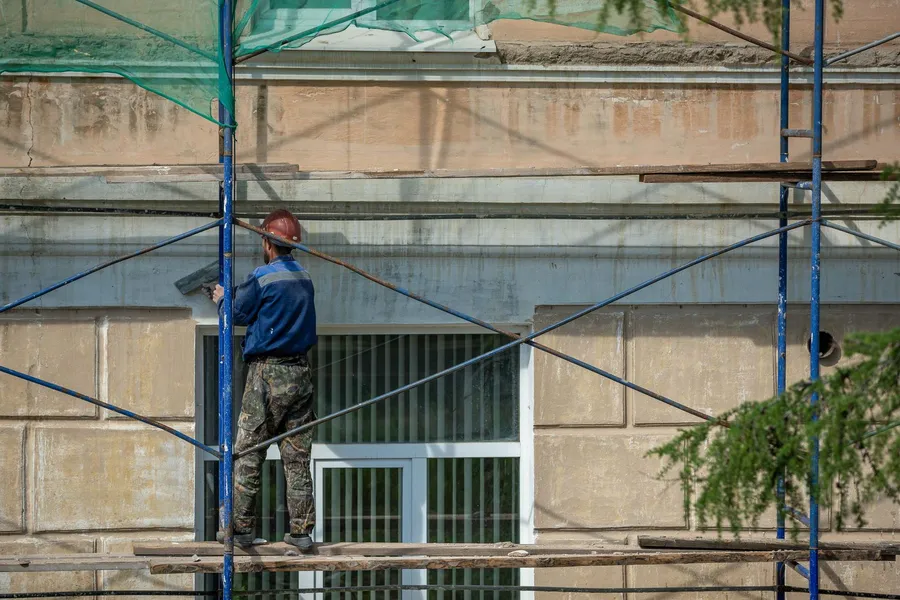
Scaffolding usually accounts for about a fifth of the total bill on a typical house. That's one of the reasons timing matters: if you're also planning external wall insulation, doing both jobs under one scaffolding hire is materially cheaper than paying for it twice a few years apart. The reduced 5.5% TVA rate applies to the insulation portion of combined work; the plain render and repaint portion stays at the general 10% renovation rate. Ask your contractor to split these lines on the devis so you're not paying 10% on work that qualifies for 5.5%.
Timing the work
Should you insulate the facade at the same time?
If your walls are solid stone or rubble with no cavity, which describes a lot of older Riviera construction, a ravalement is the moment to think about external wall insulation (ITE). The logic is straightforward: scaffolding is roughly a fifth of a facade bill, and it goes up once whether you're doing a repaint or a repaint plus insulation. Splitting the two jobs across separate years means paying for scaffolding access twice for no technical reason.
The catch is that ITE isn't a like-for-like repaint. It thickens the wall and changes its appearance, so it always needs the full déclaration préalable that a plain colour change sometimes escapes. Inside a protected perimeter, the ABF can refuse external insulation outright on a facade of architectural interest, since the added thickness alters window reveals, cornices and other details the ABF is there to protect. It doesn't rule ITE out everywhere on the coast, it just means the answer depends heavily on where the property sits.
CEE support for wall insulation remains available and doesn't carry a residence condition, so second-home owners qualify. Our wall insulation page covers current CEE figures, the technical requirements and how ITE compares with internal insulation for a property where the ABF says no to changing the exterior.
Permits and paperwork
Two permits for facade work: the DP and the permis de voirie
Two separate permissions can apply, and it's easy to only think about the first one.
The first covers the work itself. Any change to the facade's appearance, colour, render texture, added insulation, needs a déclaration préalable filed with the mairie. Stick to the identical colour and material and a straight repaint usually clears without one, but confirm against the commune's PLU first: some set their own conditions even on matching work. Processing typically takes a few weeks once the file is complete, longer inside a protected perimeter where the ABF has to weigh in.
The second, and the one people forget, is the permis de voirie (also called an autorisation d'occupation du domaine public) for scaffolding that stands on a public pavement or street instead of entirely on your own land. In dense old towns along the coast, where facades often sit right at the property line with no private space to erect scaffolding, this permit is unavoidable. It's issued separately from the déclaration préalable, sometimes carries an occupation fee for the period the scaffolding stands, and needs to be applied for with enough lead time that it doesn't delay a contractor who's already booked.
Build both into your schedule from the start. A contractor who has worked in old town centres before will usually flag the permis de voirie unprompted; if yours doesn't mention it and your street is narrow, ask directly.
Choosing a contractor
What should a facade devis include?
A proper facade devis should read like a specification, not an estimate. At minimum it should set out: the exact preparation work (cleaning method, extent of crack repair, treatment of damp or spalling areas), the product and finish specified by name and reference, the total surface area in m² that the price is based on, scaffolding as its own line item, and whether the price includes the déclaration préalable paperwork or leaves that to you.
If insulation is part of the job, the devis should separate the insulation line from the plain render and repaint line, since they attract different TVA rates and only the insulation portion may qualify for CEE support. A single blended line makes it hard to check either figure.
Ask whether the colour and product specified match what you'll submit in the déclaration préalable, or whether they're provisional pending the mairie's or ABF's decision. Changing colour after signing can mean a change order, so it's worth locking this down before work starts. Finally, check the warranty terms: render and coating work carries a garantie décennale where it affects the building's watertightness, and the shorter garantie biennale where it does not from the contractor, separate from any product manufacturer's warranty, and the devis should state which applies to which part of the job.
French terms
Key terms to know
Key French terms for this service
Questions
Frequently asked questions about facade renovation on the Cote d'Azur
If your question isn't here, send it with your request and we'll answer it directly.
No, only in specific circumstances. French law (Code de la construction et de l'habitation, article L132-1) requires owners to keep a facade in a constant state of good repair, which is an ongoing duty, not a countdown. A fixed ten-year cycle only applies in Paris and in communes that have specifically adopted it by prefectoral decree or their own council deliberation. Outside those places, a mairie can still order you to repaint or repair a facade that's visibly degraded, through a formal injunction with its own deadline, issued because the facade needs the work, whatever the calendar says. We couldn't confirm whether any Alpes-Maritimes commune has adopted the ten-year rule, so the honest answer is: ask your mairie's urbanisme department directly before assuming you're on a clock.
If a commune does issue an injunction, whether under the ten-year rule where it applies or simply because a facade has fallen into disrepair, it sets a deadline, typically somewhere between 6 and 12 months. Missing it can expose the owner to a fine and, in some cases, the commune arranging the work itself and billing you for it. If you receive a letter like this, don't ignore it: get quotes and start the déclaration préalable process straight away, since the paperwork alone can take a couple of months.
Only after checking first, in most cases. Many communes set an approved colour range, a nuancier, through their Plan Local d'Urbanisme, and changing your render colour needs a déclaration préalable regardless of whether a nuancier exists. In a protected perimeter, which covers large parts of Menton's old town and similar historic centres along the coast, the ABF's opinion on colour is binding. Submit your chosen colour reference with the application instead of picking one and hoping.
In most cases, yes, if your budget allows it. You only pay for scaffolding once if render repair and external wall insulation happen in the same campaign; splitting the two jobs years apart means paying for it twice. The complication is that external wall insulation always needs a déclaration préalable, since it changes both the facade's appearance and the building's footprint, and an ABF can refuse it on a facade of architectural interest. Our wall insulation page covers the technical side and current CEE support.
If the scaffolding stands on a public pavement or street, yes: you need a permis de voirie (also called autorisation d'occupation du domaine public) from the commune, separate from any permission for the facade work itself. This trips up a lot of owners in dense old towns like Menton or Antibes, where there's often no room to keep scaffolding entirely on private land. Apply early since processing takes time, and check whether the commune charges an occupation fee for the period the scaffolding is up.