Solar panel installation on the Cote d'Azur, with English-speaking specialists
The Cote d'Azur averages 2,700-2,900 sunshine hours a year, well ahead of northern France, the UK or Germany. The French rules for selling power, cutting the TVA and getting permission are not the ones most English-speaking owners know. This page gives you the short version and sends you to the detail. We also connect you with certified installers who work in English.
Looking for an English-speaking installer on the Côte d'Azur? Get quotes →
The solar resource here
How much do solar panels produce on the Cote d'Azur?
Paris gets around 1,800 hours of sunshine a year. The Cote d'Azur gets 2,700-2,900. South-facing panels here make roughly 1,300-1,500 kWh a year for each kilowatt installed, so the same roof earns noticeably more than it would up north.
Since June 2026 the sums are simple. Power you use yourself saves you the full price of grid electricity. Power you export earns 1.1 c EUR per kWh, and the one-off prime à l'autoconsommation no longer exists. So solar pays back through self-consumption. It works best when a heat pump, pool pump or car charger runs while the sun is up.
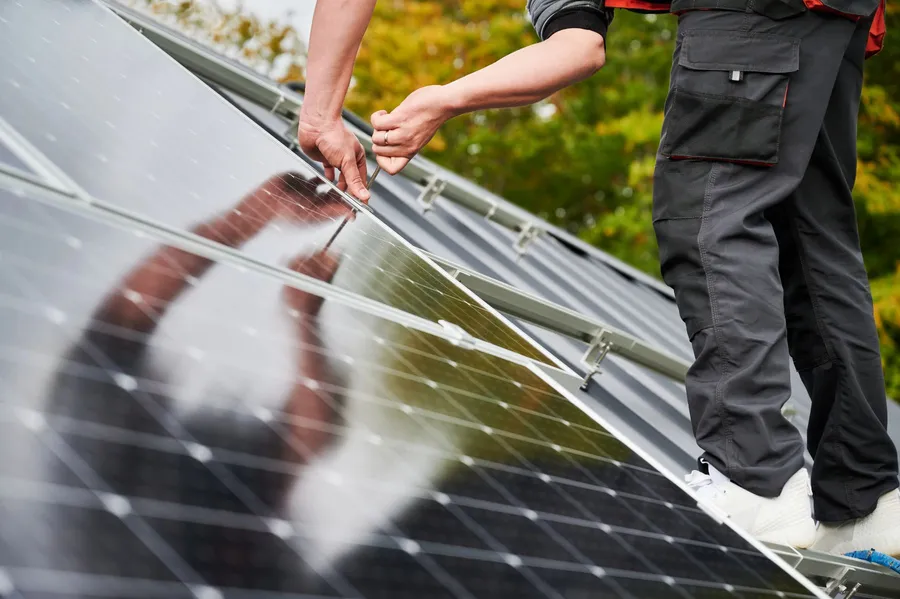
Most systems here are roof-mounted and grid-connected. A battery can shift midday surplus into the evening, which suits some second homes, but it changes the TVA (see below). Roof panels need a déclaration préalable at the mairie. Near a listed building, expect the Architecte des Bâtiments de France to review the file.
Services
Solar installations we cover on the Cote d'Azur
Anything from a small PV system on an apartment roof to panels and a battery on a villa. We cover Nice and the Cap d'Antibes coast through to Mougins, Valbonne and Sophia Antipolis.
Solar panels (PV)
Grid-connected panels for houses and villas. A system of 3 to 6 kilowatts covers a typical household's daytime use. On the Riviera each kilowatt of south-facing panels makes about 1,300-1,500 kWh a year.
Explore Solar panels (PV)Battery storage
Stores midday surplus for the evening and night. Home systems run from 5 to 20 kWh. Bought on the same invoice as the panels, a battery takes the whole job to 20% TVA.
Explore Battery storageSolar water heating
Roof collectors heat your hot water directly, and this climate suits them. MaPrimeRénov' par geste dropped them on 1 September 2026, but CEE still pays, with a boosted bonus on a devis signed before 1 January 2027. A family home usually needs 2-4 collectors.
Explore Solar water heatingEV solar charging
A wallbox that charges your car from your own panels during the day. If you have solar and an electric car, it's one of the easiest ways to use more of what you generate.
Explore EV solar chargingGet matched with vetted English-speaking installers in your area.
Get quotesFinancial aid
Which solar grants and tax rates still apply in 2026?
It depends on the technology, and most of the help shrank this year.
MaPrimeRénov' has never covered photovoltaic panels, so leave it out of a PV budget. Solar water heaters left its par geste list on 1 September 2026. They now qualify only inside a rénovation d'ampleur on a principal residence.
The prime à l'autoconsommation is gone. The arrêté of 1 June 2026 ended it for connection requests filed from 5 June 2026, and nothing replaced it. Systems already connected keep theirs. Surplus now sells at a flat 1.1 c EUR per kWh, indexed 2% a year. Both changes point the same way: design the system for what the house uses.
TVA at 5.5% applies to panels of up to 9 kilowatts on an existing home when three conditions are met. The panels must meet a low-carbon standard, an energy management system must be included, and since 1 March 2026 the installer must hold RGE QualiPV. Miss one, or go bigger, and the rate is 20%. A battery on the same invoice also puts the whole job at 20%. Check which rate the devis shows before you sign.
Solar water heaters still earn CEE through an installer with RGE QualiSol, and TVA is 5.5%. A boosted CEE bonus applies on a devis signed before 1 January 2027, as long as no gas or oil heating or hot-water equipment stays in the house. The figures are on our solar water heating page.
Coming from abroad
Selling solar power in France vs the UK, US and Germany
UK
Owners used to the Feed-in Tariff or the Smart Export Guarantee often expect to earn from export. France pays 1.1 c EUR per kWh for surplus, far below the retail price. Size the panels to your daytime use and don't add extra roof area for export.
US
Net metering doesn't exist in France. Exported power is credited at a small fraction of what you pay for grid electricity. A bigger array built to export won't pay back the way it might at home, so match the system to what the house uses while the sun is up.
Germany
If you know the EEG feed-in tariff, the French version will look thin. Export pays a flat 1.1 c EUR per kWh under a 20-year EDF OA contract, and the self-consumption premium ended in June 2026. Most of the return comes from the grid electricity you stop buying.
French terms
French solar terms you'll see on a quote
Key French terms for this service
Questions
Frequently asked questions about solar on the Cote d'Azur
If your question isn't here, send it with your request and we'll answer it directly.
The sun is there: 2,700-2,900 hours a year, and south-facing panels here make roughly 1,300-1,500 kWh a year for each kilowatt installed, against 800-900 kWh in northern France. Whether it pays depends on how much of that power you use yourself, since surplus now earns very little. A house lived in year-round, with a heat pump, pool pump or electric car running in the day, does well. A second home that sits empty most of the year pays back more slowly.
Panels on a roof need a déclaration préalable at the mairie, whatever the size of the system. For a ground-mounted array it depends on its power and height. Near a listed building or in a conservation area, the Architecte des Bâtiments de France reviews the file and can ask for changes. Ask the installer to file the paperwork for you.
Yes. An EDF OA contract buys the surplus your house doesn't use, for 20 years. Since June 2026 it pays a flat 1.1 c EUR per kWh, indexed 2% a year, which is a small fraction of what you pay for grid power. There is no net metering of the US kind. That is why installers here size a system to the daytime load of the house.
No. Nationality and residency make no difference. For panels, the help left is the 5.5% TVA rate, which the installer applies on the devis. The prime à l'autoconsommation was abolished in June 2026 with no replacement, and MaPrimeRénov' has never covered PV, so panels are not eligible for it. A solar water heater still earns CEE, which has no residence condition.
No. The abolition applies to connection requests filed from 5 June 2026. Systems already in the scheme keep their premium and their EDF OA purchase contract on the terms they signed.
Sources
Official sources for solar grant, TVA and resale rules
- Légifrance: arrêté of 1 June 2026 (solar purchase conditions) The prime à l'autoconsommation ends for connection requests from 5 June 2026, existing awards stay, and surplus sells at 1.1 c EUR/kWh for 20 years.
- BOFiP: BOI-TVA-LIQ-30-20-97, TVA on solar electricity equipment When panels up to 9 kilowatts qualify for 5.5% TVA, and why a battery on the same invoice puts the whole job at 20%.
- Légifrance: décret n° 2026-822 of 25 August 2026 Solar water heaters leave MaPrimeRénov' par geste from 1 September 2026; PV panels were never on the list.
- Légifrance: arrêté of 17 August 2026 on hot water CEE The boosted CEE bonus on a solar water heater, its 1 January 2027 deadline and the no-gas-or-oil condition.
- Service-Public.fr: solar panels on a roof (F36798) Roof panels need a déclaration préalable at the mairie.
Rules checked against these sources in September 2026. Cost ranges are our own estimates and are not drawn from these sources.