Pools, gardens, terraces and gates on the Riviera, from English-speaking contractors
A pool on the Cote d'Azur comes with a mairie filing, a safety norm, a tax declaration with a 90-day clock and, most summers, a préfecture order that says when you can fill it. The same goes, in smaller doses, for a raised terrace, a new gate or a garden you'd like to water in August. This page walks through those rules in English and explains what a proper devis should contain before you sign one.
Looking for an English-speaking installer on the Côte d'Azur? Get quotes →
Permits
What outdoor work needs a permit on the Cote d'Azur?
For a pool, the number that matters is the surface of the water. A basin of 10 m² or less needs no filing at all, unless you're in a protected sector. From 10 m² to 100 m², you file a déclaration préalable at the mairie and wait a month for a non-objection. Above 100 m² it becomes a permis de construire. A cover or pool house changes the sum: any shelter taller than 1.80 m pushes the project into permis de construire territory whatever the basin size, because it counts as a building.
Terraces split into two families. A terrace laid at ground level needs nothing outside a protected sector. A raised one (on pillars, or stepping down a slope, which is most Riviera plots) needs a déclaration préalable up to 40 m² in an urban zone with a PLU, 20 m² elsewhere, and a permis beyond that.
Fences and gates are the case where people get caught. Nationally a clôture needs no filing. In practice, many communes on the coast have voted a délibération that makes fences and gates declarable, and the PLU then sets height, materials and often the colour. Ask the service urbanisme before ordering, because the one you saw in a catalogue may come in a colour the commune doesn't allow.
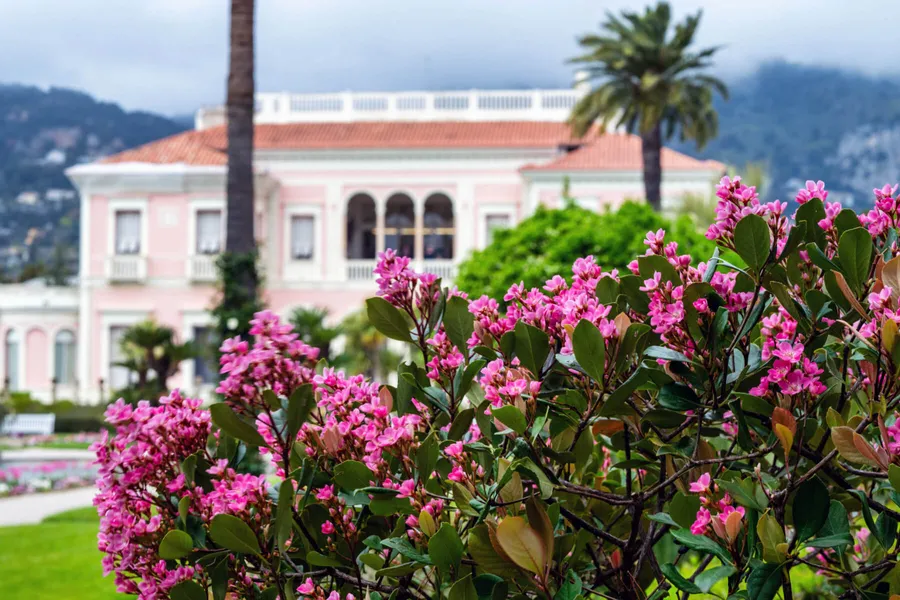
Then there is the Architecte des Bâtiments de France. Within the protected perimeter around a listed monument, and in a site patrimonial remarquable such as the old towns of Nice, Antibes or Menton, the ABF reviews every filing, the review period doubles to two months, and even a 9 m² plunge pool needs a déclaration. Our guide to French permits covers how to find out which of these applies to your address.
Services
Outdoor services we cover
Four kinds of outdoor work come up again and again with the second-home owners who write to us. The English-speaking contractors we work with cover them from the first site visit to the handover.
Pools
In-ground coque and concrete pools, renovation of a tired liner or coating, filtration and heating upgrades. On the coast a coque pool runs from about 15,000 to 30,000 EUR installed and a concrete pool of the same 8 x 4 m size from 25,000 to 50,000 EUR, before the déclaration, the safety device and the tax.
Gardens & landscaping
Planting that survives a Riviera August without a sprinkler running all night: olives, cistus, lavender, agaves and the native maquis. Drip irrigation, dry-stone restanques (the terrace walls that hold a hillside plot together), drainage on sloping plots and a maintenance plan for a house that is empty half the year.
Terraces
Stone, timber and composite terraces, including the raised and stepped ones that need a déclaration préalable. Falls and drainage matter more here than in northern Europe: a 60 mm autumn storm has to run off the terrace and away from the house.
Gates & access
Sliding and swing gates, motorisation to the EN 13241 standard, intercoms you can answer from abroad, and the déclaration préalable most coastal communes require. Fitted to work with the fence height and colour rules in your PLU.
Tell us what you're planning outside and we'll put you in touch with an English-speaking contractor who knows the local rules.
Get quotesSafety norm
Which safety device does a French pool legally need?
Since the loi 2003-9 of 3 January 2003, every private outdoor pool with an in-ground or semi-in-ground basin must have a standardised device to stop a small child drowning. That is article L134-10 of the code de la construction et de l'habitation, and it applies to a pool you inherit with a house just as much as to one you build. Above-ground and inflatable pools are outside it. Indoor pools are too.
You need one of four devices, each with its own NF norm: a barrier with a self-closing gate (NF P90-306), an immersion or perimeter alarm (NF P90-307), a safety cover (NF P90-308), or a closed shelter over the whole pool (NF P90-309). One is enough. Which one is a question of how you use the pool: a cover doubles as heat retention and keeps leaves out, a barrier is the one that still works when a guest forgets to reset the alarm.
The fine for a pool without a compliant device is up to 45,000 EUR under article L183-4 of the same code. Insurers also read that article. If a child is hurt in an unprotected pool, the criminal exposure sits with the owner, and the insurer has a reason to walk away.
Two practical points. The device must carry the NF mark, and the installer must hand you a written note describing it and how to use it. That note is your evidence, so keep it with the devis. And if you buy a house with an existing barrier, check the gate latch: the self-closing mechanism is the part that fails, and a barrier whose gate stays open no longer meets the norm.
Tax
How is a pool taxed after it is built?
Three things happen once the water is in. First, you have 90 days from completion to declare the pool to the tax office, online at impots.gouv.fr under "Gérer mes biens immobiliers" (or on paper form H1). Miss the window and you lose the two-year taxe foncière exemption on the new pool (granted unless your commune has voted to remove it), and you become a candidate for the back-tax letter described below.
Second, the one-off taxe d'aménagement. For a pool it is worked out on a flat value per square metre of water, set nationally each year: 251 EUR per m² in 2026. On that base the commune charges its own rate, anywhere from 1% to 5%, and the Alpes-Maritimes département adds 2.5%, the legal maximum. A 32 m² pool in a commune at 4% therefore owes 32 x 251 x 6.5%, or about 520 EUR. Under 1,500 EUR you pay it in one go; above that, in two instalments. You declare it in the same 90-day filing.
Third, taxe foncière. A pool raises the rental value the tax is calculated on, so the annual bill goes up for good once the exemption ends. The amount depends on the commune's rate and the size of the pool, and it is the reason so many older pools were never declared.
That last habit ended with the 2021-22 pilot of Foncier innovant, the tax office's aerial-photo detection tool, in nine departments including the Alpes-Maritimes. It taxed more than 20,000 previously undeclared pools in the pilot alone, worth close to 10 million EUR to the communes involved, and has covered the whole of mainland France since May 2023. If you buy a house here with a pool that doesn't appear on the taxe foncière, assume the letter is coming and declare it yourself.
Water and trees
What are the summer watering and tree rules in the Alpes-Maritimes?
Every summer the préfet issues drought arrêtés by river basin, and each basin sits at one of four levels: vigilance, alerte, alerte renforcée and crise. The whole department has been on vigilance since 1 June 2026, which asks for restraint and bans nothing. The arrêté of 13 August 2026 then put 49 communes on alerte, 46 on alerte renforcée and five on crise: Cagnes-sur-Mer, La Gaude, Saint-Jeannet, Saint-Paul-de-Vence and Vence in the Cagne basin. Antibes, Cannes and Grasse were among the alerte renforcée communes. That was the position under the 13 August arrêté; the list moves with every arrêté, so check the préfecture's page before you fill anything.
The rules per level in the July 2026 arrêté were: on alerte, filling a private pool is banned and gardens may only be watered between 8 pm and 8 am. On alerte renforcée, filling is still banned and watering lawns, borders and flower beds is banned day and night. On crise, even topping up a pool is banned, and so is watering a vegetable patch. Breaking a drought arrêté is a fifth-class contravention under article R216-9 of the code de l'environnement, up to 1,500 EUR. The préfecture reported 60 checks over the summer of 2026 and found 68% of them non-compliant.
The other rules come from the PLU. The Nice metropolitan PLUm, and many other coastal plans, set a minimum share of the plot that must stay as pleine terre, unpaved soil that rain can soak into; in some of its residential zones that share is 45%. A pool, a terrace and a paved drive all count against it, which is how a landscaping scheme that looked fine on paper gets refused at the déclaration stage.
Trees last. If part of your plot is an espace boisé classé on the PLU map, felling needs a déclaration préalable of its own, and the mairie can refuse it. Dead or dangerous trees are exempt. Outside an EBC, communes often protect individual specimens, and the coast's old olives and umbrella pines are the ones most often listed. A landscaper who has worked in your commune before will know which trees can be touched before the first plan is drawn.
Paperwork
What should a pool or landscaping devis include?
A devis in France becomes the contract the moment you sign it, so a thin one costs you later. These are the lines that should be on it before you agree a price.
Pool
A soil study on any sloping or clay plot, because a shell that moves is the defect that costs most to put right. The excavation and where the spoil goes. Drainage around the basin. The filtration spec with the pump's flow rate and the filter type. The coating: liner, reinforced membrane, tiles or polished render, with its guarantee period. The safety device by NF norm. Who files the déclaration préalable. The builder's garantie décennale insurer and policy number.
Garden
A plant list with species, quantities and pot sizes, since a 3-litre olive and a 15-year-old one are the same word in French. Soil preparation and any imported topsoil in cubic metres. The irrigation layout, the controller, and whether it can be run from your phone. Drainage and any retaining walls with their heights. A planting guarantee, typically one growing season. A maintenance handover: how often to water in the first summer, and what the plan is while you're away.
Terrace or gate
For a terrace: the sub-base, the fall in millimetres per metre, the material and its slip rating, the edge detail and where the water goes. For a gate: dimensions, material and RAL colour, the motor and its EN standard, photocells, the intercom and the electrical connection. Whether the déclaration préalable is included. Payment stages tied to visible progress, never more than 30% up front.
French terms
Key terms to know
Key French terms for this service
Related
Guides that pair with outdoor work
Questions
Frequently asked questions about pools and outdoor work
If your question isn't here, send it with your request and we'll answer it directly.
Yes, and on the coast it is the usual way to stretch the season into May and October. A pool heat pump is a separate unit from the one that heats your house, sized on the volume of water and the months you want to swim. It is not energy-renovation work, so the grants and reduced TVA that apply to a house heat pump don't apply here. Ask for the unit's output at a low air temperature, around 15°C, since that is closer to a Riviera April than the warm-weather figure printed on the box.
Under 5 m² of footprint, nothing, as long as it stands on its own and isn't in a protected sector. From 5 m² to 20 m² you file a déclaration préalable. Above 20 m² you need a permis de construire. A shed near a listed monument or in a site patrimonial needs a déclaration even under 5 m². The PLU can add rules on materials and colour, and some communes in the hills refuse anything that isn't stone or timber.
Listings with a pool are what most July and August tenants filter for, so a house without one competes on price. Against that, a pool adds a safety-device obligation with a fine of up to 45,000 EUR, a higher taxe foncière, the taxe d'aménagement on the way in, and weekly upkeep someone must do while you're abroad. The honest sum is the extra weekly rent over your season, minus maintenance and a caretaker's visits. For a coque pool at 15,000 to 30,000 EUR installed, run that sum before you sign. For a 50,000 EUR concrete pool it is a lifestyle decision.
As the owner, you carry the first line of responsibility for anything on your property that hurts a visitor, and an automatic gate is the classic case. The motorisation must meet the European gate standards (EN 13241 and EN 12453 on closing forces) and have working photocells and an obstacle stop. If the installer fitted it without those, or set the force wrong, liability shifts towards them, which is why you want the installation on a signed devis with the norm named. Keep the annual maintenance record. Your home insurer will ask for it.
From signing to swimming, plan for two to six months. The déclaration préalable alone takes a month at the mairie, two in a protected sector. Once digging starts, a coque shell goes in within about a week; a poured or sprayed concrete shell needs eight to twelve weeks because concrete has to cure before the coating goes on. Add one to two weeks for filtration, the technical room and the coping, then filling. Expect the good builders on the coast to be booked well ahead, so a pool for next summer is signed in autumn.