Guide
Is tap water safe to drink on the Côte d'Azur?
On this page6 sections
- Can you drink the tap water on the Côte d'Azur?
- Chlorine taste and old lead pipes: what to do at the kitchen tap
- Opening up a second home: run every tap before you drink or shower
- Is a jug filter worth buying, or an under-sink system?
- What Riviera hard water does to kettles, water heaters and showers
- When is a water softener worth it on the Côte d'Azur?
Yes. Tap water on the Côte d'Azur is treated, checked by the health authorities and safe to drink, and you can read the latest results for your own commune online. The two things worth your attention are in your own building: old lead pipes, and water that has sat in the pipes while the house was empty. A jug filter is a matter of taste, and the hard water matters more to your water heater than to you.
Can you drink the tap water on the Côte d'Azur?
French tap water is checked from the source to the tap by the regional health agency, the ARS. ANSES, the national food safety agency, calls it the most tightly controlled food product in France. Your water operator (shown on your bill) delivers it; the ARS samples it independently.
You can read the results for your own supply in three places:
- Online: the Ministry of Health's tap water results search. Pick the département (06 or 83), then your commune and network. Each result says whether the water met the limits.
- At the mairie: the mayor has to post the latest results there.
- With your water bill: once a year the bill comes with a one-page ARS summary (the infofacture), including health advice on lead, nitrates and fluoride.
PFAS, the "forever chemicals", have been tested more often since 1 January 2026, against a legal limit for the sum of 20 of them. The ARS reports that 96.6% of people in the region have always had water within that limit. Where a network has gone over, the ARS lists it by sector on its PFAS page, in case you want to look yours up.
Chlorine taste and old lead pipes: what to do at the kitchen tap
Operators add a little chlorine to keep the water free of bacteria on its way to you. If you can taste it, fill a glass jug or bottle and leave it open in the fridge. The smell goes within half an hour or so. Use glass or stainless steel, not plastic, and drink it within a day or two.
Lead is the real concern in older buildings. Homes built before 1949 can still have lead pipes, in the flat or in the building's shared supply. The legal limit at your tap is 10 micrograms per litre. The lead report (CREP) you received when you bought a pre-1949 property measures paint, not pipes, so it tells you nothing here.
To check, look at the pipe coming into your flat or house near the meter. Lead is dull grey, soft and bends easily; a scratch shows bright metal underneath. If you find some, or can't tell, ask a plumber. In a copropriété, lead in the shared risers is the building's job to replace, which means a vote at the general meeting.
Until it's gone, run the cold tap whenever water has stood in the pipes, from a few seconds to a minute or two, until it runs noticeably colder. Use cold water, never hot, for drinking and cooking, because hot water picks up more metal from the pipes.
Opening up a second home: run every tap before you drink or shower
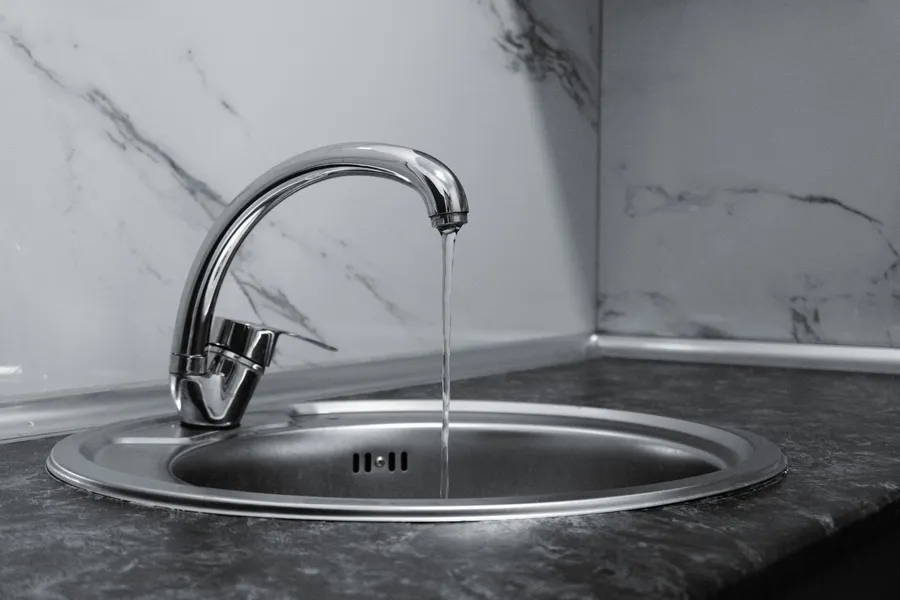
Water that sits in the pipes for weeks goes stale. It can pick up metal from old pipework, and warm water left standing is where legionella bacteria grow. The ARS advice after any long absence is to run the cold and the hot water at every tap and shower before you use them. Keep your face out of the shower spray while it runs, because the risk comes from breathing in the droplets.
Descale shower heads and tap aerators now and then, because scale gives bacteria somewhere to live. And check the water heater's setting: health advice is hot water between 50 and 60 °C at the kitchen tap. Our guide to leaving a second home empty covers turning the water off before you go.
Is a jug filter worth buying, or an under-sink system?
Your tap water doesn't need extra treatment to be safe. Filters mainly change the taste. The main options:
- Jug filter (carafe filtrante): the cheapest to buy, but the cartridges add up over a year. It cuts the chlorine taste and some metals, lead and copper included. Keep it in the fridge, drink the water within 24 hours and change the cartridge on time, usually every four weeks. An old cartridge can breed bacteria and leave the water worse than the tap.
- Under-sink filter: a kit with its own small tap. Cartridges usually last six to twelve months.
- Reverse osmosis (osmoseur): fitted by a plumber, with filters and a membrane to replace regularly. It removes nearly everything, minerals included, and sends several litres down the drain for every litre you drink.
None of these makes unsafe water safe, and none should be used for a baby's bottles: ANSES advises plain cold tap water, run first, for those.
What Riviera hard water does to kettles, water heaters and showers
Hardness is the calcium and magnesium dissolved in the water. It's harmless to drink, but it leaves limescale (calcaire) wherever water is heated or dries. On this coast there's plenty: water in Cannes and Nice is in the hard band. Your commune's figure is in the ARS results, listed as the titre hydrotimétrique (TH).
You'll see it first on the kettle and the shower screen, but the costly damage is inside the water heater. Scale coats the element and wears the anode of an electric water heater, and a heat-pump water heater's tank and backup element suffer the same way. Both need servicing more often than the maker suggests.
When is a water softener worth it on the Côte d'Azur?
A salt softener (adoucisseur) swaps the calcium for sodium. It suits a home you live in most of the year. For a house used a few weeks a year it's harder to justify, because it still needs salt and servicing while you're away.
The price depends on the size of the house, how many bathrooms the unit serves and how easily it fits where the water comes in. Salt and a yearly service follow whatever you pay up front, and skipped servicing lets bacteria grow in the unit. Get two written quotes that include the first year's servicing.
Three things to settle with the installer before you sign the devis:
- A minimum hardness. Ask the installer to set one. Very soft water attacks pipes, which is why French rules want tap water balanced or slightly scale-forming. It matters more with any lead pipework left in the building.
- An unsoftened cold tap in the kitchen for drinking and cooking, as the ARS recommends. Softened water carries extra sodium.
- Where it goes. The unit sits after the meter and needs a drain and a socket.
In a flat, a softener on your own supply is your call. One for the whole building is a copropriété decision voted at the general meeting. If you rent, you need the landlord's written agreement before plumbing one in. If you're the landlord, the servicing is yours to arrange.
Magnetic and electronic anti-scale boxes are sold as a cheaper option. They don't take the minerals out, and results are hard to check, so ask the seller for independent test results and a return period before paying.
Sources
Official sources for Côte d'Azur tap water quality and home treatment advice
- ARS Paca: tap water quality control Who tests the water in the region, where to look up your commune, and the yearly summary sent with the water bill.
- ARS Paca: PFAS in drinking water More frequent PFAS testing from 1 January 2026, the limit for the sum of 20 PFAS, and the share of the region always within it.
- ANSES: proper use of water filter jugs What a jug filter removes, why it lives in the fridge, and why an old cartridge can make the water worse.
- ARS Grand Est: legionella and hot water at home Running hot and cold water at every outlet after a long absence, and the 50 to 60 °C hot water setting.
- ARS Pays de la Loire: drinking water advice Keeping an unsoftened cold tap for drinking and cooking, and servicing home treatment devices.
- Service-Public.fr: tenant works and the landlord's consent Why a tenant needs the owner's written agreement before plumbing in a softener.
Rules checked against these sources in September 2026.