Home energy work in Grasse and the inland villages:
heating, heat pumps, solar and electrical
Twenty kilometres inland and three hundred metres up, the whole calculation changes. Here heating is the main job, and August cooling is the bonus.
Advice written for the coast, where winter barely registers and a system is bought for cooling, misleads in the arrière-pays. Grasse sits at around 350m, Cabris at roughly 410m and Saint-Vallier-de-Thiey higher still, and the housing stock is older, heavier and far less insulated than anything on the seafront.
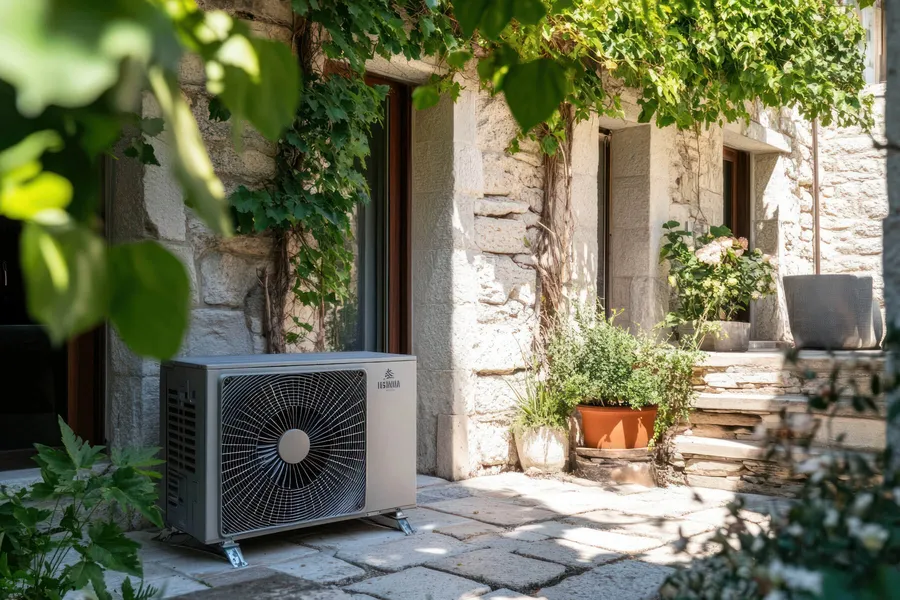
Why does heating matter more than cooling above 350m?
Temperature falls with altitude, and the sea that moderates the coast is too far away to help. Winter nights below zero are a normal occurrence inland rather than an event. That inverts the usual Riviera logic: the system is bought to heat the house through winter, and cooling in August is the secondary benefit.
It also changes which equipment is appropriate. A reversible split sized for coastal cooling will disappoint in a stone house in February. Our detailed guide to heat pumps in Grasse and the arrière-pays goes into the sizing question properly.
What replaces an oil boiler in an old Grasse stone house?
Oil remains more common inland than on the coast, partly because mains gas never reached many of these villages. The usual replacement is an air-to-water heat pump connected to the existing radiators or underfloor circuit.
Whether that works depends on the emitters. Radiators sized for a boiler running at high flow temperature may need replacing or supplementing to work efficiently at heat pump temperatures. Where the fabric or the budget will not stretch to that, a hybrid system keeps a backup for the coldest days. See also switching from a boiler to a heat pump.
Why headline SCOP figures mislead in the arrière-pays
SCOP is a seasonal average measured against a standard climate profile. It is a fair way to compare two machines and a poor way to predict what one will do at minus five on a January morning in Gourdon.
Ask instead for the manufacturer's published output and efficiency at low outdoor temperatures. Most modern inverter units keep running well below zero, but the output at that point is meaningfully lower than the headline, and sizing has to account for it rather than hope.
Does an uninsulated stone house suit a heat pump at all?
Thick stone walls behave differently from modern construction. They hold temperature well once warm and lose it steadily through single glazing, unsealed shutters and uninsulated roofs, which is the typical condition of an unrenovated village property.
Sizing a heat pump against that load produces a large, costly machine that becomes oversized the moment the fabric improves. Where the budget allows, insulation and glazing come first. Where it does not, be candid with the installer about it, because the specification should reflect the building as it actually is. Improving the rating also matters for resale, which our guide to improving a DPE rating covers.
Is solar a better bet inland than on the coast?
Often, for practical reasons. Inland properties are typically detached with their own roof and no assembly to consult, and plots are large enough that a ground-mounted array is possible where the roof faces the wrong way.
Against that, higher winter heating demand means more consumption in the months when generation is at its lowest, so self-consumption over the year is less neatly matched than a summer cooling load would be. Figures are in the solar panel cost guide, and solar in Mougins covers the neighbouring commune.
Which grants reach the villages that the coastal schemes miss?
The Département runs a grant for rural and mountain communes that the coastal strip is excluded from, worth 20% of the work up to 1,600 EUR. It carries no income ceiling and, unusually, no RGE requirement, which makes it one of the few grants you can use on an old stone house without first finding a certified installer willing to travel up. The commune list is fixed by an old deliberation rather than published as a map, so check whether yours is on it before counting on the money. Its bigger schemes, up to 25,400 EUR for a full renovation, apply here as they do on the coast, and we set them out in the Alpes-Maritimes grants guide.
From Grasse and Mougins to Saint-Vallier-de-Thiey: where we work
Grasse, Mougins, Mouans-Sartoux and Peymeinade, and up into the villages at Cabris, Spéracèdes and Saint-Vallier-de-Thiey. Past there the population thins and so does contractor availability, which we explain on areas we cover.
Common questions about home energy work in the arrière-pays
Do we have to remove the old oil tank when the boiler goes?
Decommissioning is the normal expectation rather than leaving a redundant tank in place, and it is specialist work: draining, degassing and cleaning before removal or neutralisation in situ where a buried tank cannot be lifted. Budget for it separately, because it is easy to leave out of a heat pump quote and it is not a small line.
How does frost affect an outdoor unit at altitude?
Air source units periodically reverse to clear ice from the outside coil, which costs a little efficiency each time and is entirely normal. It matters more inland because it happens more often. Siting matters too: a unit raised off the ground with clear drainage beneath it avoids standing meltwater freezing under the machine.
Is wood or pellet still worth considering above Grasse?
It is still used inland, and a pellet stove or boiler can suit a house with a high heating demand and poor insulation. Neither route is covered by MaPrimeRenov' par geste any more: boilers were dropped in January 2026, and stoves followed in September 2026. CEE subsidies remain the main route for either one. Our wood pellet heating page sets out where it still makes sense.
Will a heat pump cope in a house we only use in summer?
It will, though the case for one weakens. If the property is empty through winter you are buying mostly for cooling, which is the coastal calculation rather than the inland one. What still matters is frost protection for the plumbing while nobody is there, which our guide to winterising a second home covers.