Bathroom renovation on the Cote d'Azur
A bathroom job here looks like a bathroom job anywhere until something goes wrong: a leak into the flat below, a light fitting that should never have gone over the shower, a new mixer furred up by the water within a year. This page covers who is liable, what's allowed near the water, what hard water does, and what a bathroom should cost.
Looking for an English-speaking installer on the Côte d'Azur? Get quotes →
Budget
What does a bathroom renovation cost in the Alpes-Maritimes?
National trade figures put a full renovation of a standard bathroom around 5 m², strip-out, new waterproofing, tiling, sanitaryware and fitting, between 4,500 and 10,000 EUR TTC. There are no reliable Riviera-specific figures, so treat these as a starting point to check against two local devis. Priced per square metre, that's roughly 900 to 2,000 EUR/m², though some quotes run as high as 3,000 EUR/m² for a higher-end finish. A light refresh, new sanitaryware and re-tiling without moving any pipework, can start from around 400 EUR/m².
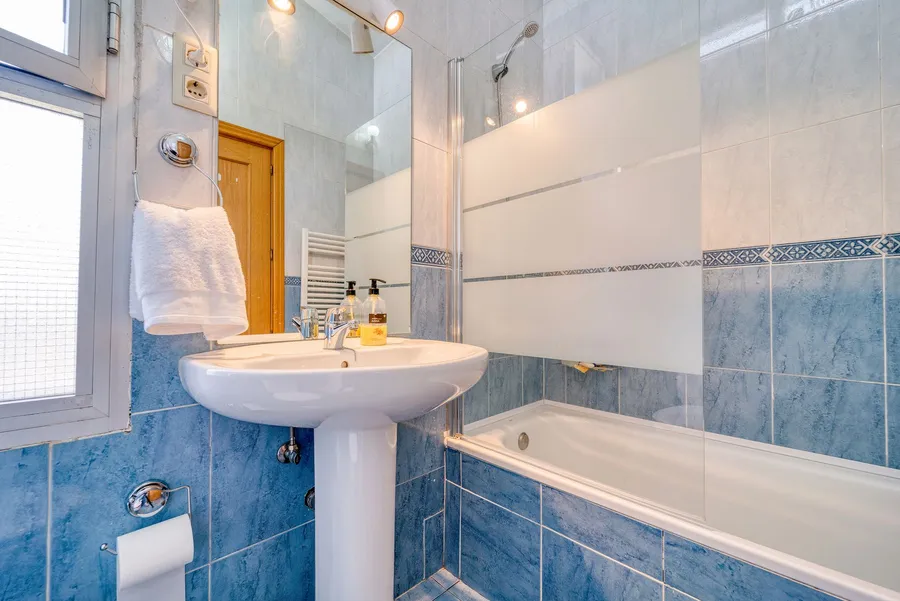
Labour usually makes up 30 to 55% of the total, and plumbers and tilers bill in the range of 40 to 80 EUR/h HT nationally. The biggest single cost driver is whether the layout changes: moving a shower tray, a bath or the WC means moving the waste and supply pipes, which is a different job to refitting the same footprint. Ask for an itemised devis by lot (plomberie, électricité, carrelage) instead of one lump sum, so you can see where the money is going and compare it against a second quote.
Get matched with vetted English-speaking installers in your area.
Get quotesElectrics near water
Which electrical zones apply in a French bathroom?
French wiring rules treat the space around a bath or shower as a set of safety zones that get stricter the closer you get to the water. Inside those zones, lighting and any fixed equipment (a heated towel rail, for example) needs to be rated for damp and splashing, run at low voltage, or both. Ordinary plug sockets aren't permitted inside the zones at all; they have to sit outside them, at a safe distance.
You don't need to learn the zone boundaries or the rating codes yourself; that's the electrician's job. What matters is asking the right question: does the lighting fixture over the shower, and the towel rail if it's heated, comply with the bathroom rules, and can you see that written down? The general rules are on our NF C 15-100 glossary entry. A contractor who brushes off the question, or wants to fit a standard bathroom light straight above the shower head, is one to push back on.
This is one area where an older Riviera property is more likely to fall short than a new one. A bathroom last rewired decades ago was built to a different, looser standard, so a full bathroom renovation is a natural point to bring the wiring in that room up to current rules instead of leaving the old circuit in place under new tiles.
Insurance and liability
Who pays when a new bathroom leaks into the flat below?
Tile grout does not keep water out. Grout is not a waterproofing layer, it's a joint filler. There has to be a waterproof layer under the tiles; ask what the tiler is using and make sure it's on the devis.
When something does go wrong, which guarantee applies depends on what failed. A shower mixer or a tap that fails is equipment you could unbolt without touching the building, so that's the two-year garantie biennale. Water getting under the tiles through a failed waterproofing layer, and coming through the ceiling of the flat below, is structural damage, and that's exactly what the ten-year garantie décennale is for. The contractor's décennale insurer is on the hook, which is why the insurer's name and policy number belong on the devis before work starts. Ask specifically what waterproofing product is going under your tiles and make sure it's a named line on the quote.
Steam and damp air need somewhere to go too. A working extraction fan or VMC in the bathroom isn't optional extra comfort, it protects the same waterproofing and the paint and plaster around it, so don't let it get dropped from the devis to save money.
Accessibility grant
Can MaPrimeAdapt' fund a walk-in shower for an older owner?
For most readers of this site, no. MaPrimeAdapt' only applies to a claimant's principal residence, so a Riviera second home doesn't qualify, whatever the owner's age or health. It isn't available to someone who lives here for part of the year and elsewhere the rest of it.
For an owner who does live here full time and sits in the two lower income bands, it pays 50% or 70% of the works up to a ceiling; a walk-in shower replacing a bath is a standard eligible project. The figures are in the box.
Water quality
How does Riviera hard water affect a new bathroom?
The Cote d'Azur runs hard water. Cannes measures 22.66 °f on the official hardness scale, well above the 15 °f threshold where water is classed as hard, and Nice is classified in the same hard-water band. That matters for a new bathroom because limescale builds up fastest exactly where you've just spent money: inside a new shower mixer, on a new glass screen, and inside a new water heater feeding the room.
None of this is a reason to change the design; ask about it at the devis stage. A shower head and mixer with an easy-clean or anti-scale coating cost little extra and save you descaling every few months. If the bathroom is getting a new water heater as part of the job, our hot water systems guide covers how calcaire shortens service intervals here and what to ask for.
Before you sign
What should a bathroom devis include?
The line to look for first on a bathroom devis is the waterproofing under the tiles, named as its own item and not folded into "carrelage". Beyond that, ask for the devis broken down by lot: plomberie, électricité, carrelage, each with quantities and unit prices, and the sanitaryware named by brand and reference so you can check the price yourself.
It should also show the TVA rate, the payment schedule, a start date and duration, and the contractor's décennale insurer and policy number. If you're in an apartment and the job touches the shared soil pipe or water riser, the contractor should flag that in writing too, since that can mean waiting for a vote at the building's AG before work starts.
French terms
Key French bathroom renovation terms
Key French terms for this service
Questions
Frequently asked questions about bathroom renovation on the Cote d'Azur
If your question isn't here, send it with your request and we'll answer it directly.
The contractor who fitted it, under the two-year garantie biennale. That guarantee covers equipment that can be removed without damaging the building: a tap, a shower mixer, a water heater. Tell the fitter in writing, with the date the job was finished, and keep a copy. The ten-year décennale is for the bigger failures, such as the waterproofing under the tiles.
Yes. France divides the space around a bath or shower into safety zones, and anything electrical inside them (lighting, switches, a heated towel rail) has to meet stricter waterproofing and voltage rules than a socket in the hallway. Ordinary plug sockets are not allowed inside those zones at all. This isn't something to check yourself: ask your electrician to confirm in writing that the fittings near the shower or bath comply, and keep that written confirmation with the house paperwork.
It depends on what failed. A tap or shower mixer that fails on its own is the two-year garantie biennale. Water getting under the tiles through failed waterproofing and coming through the ceiling below is structural damage, covered by the ten-year garantie décennale. Either way, declare it to your own home insurer straight away, get the cause written up, and tell the contractor in writing so the right guarantee can be triggered.
Yes, and it's the cheaper end of the budget range. A light refresh, new sanitaryware and re-tiling without moving the shower tray, bath or WC, avoids re-routing the waste and supply pipes, which is the single biggest cost driver on a bathroom job. National trade figures put that kind of refresh from around 400 EUR/m², against 900 to 2,000 EUR/m² for a full renovation that moves the layout. Get an itemised devis either way so you can see what you're paying for.
Only if it touches the building's shared parts, structure or common pipework. Moving a WC or shower usually means reconnecting to the soil stack or the water riser, and if that stack or riser is shared, the change needs a vote at the copropriété's annual general meeting before work starts. Work confined entirely to your own lot, with no change to shared pipework or the structure, doesn't need a vote.