Guide
AC installation costs on the Cote d'Azur: what to expect
Air conditioning is close to universal in new homes on the Cote d'Azur, and more and more older properties are being retrofitted. The price depends on the system type, how many rooms you're cooling, and how the property is laid out and built. This guide gives cost ranges for the main systems, what moves the price, and what to check when comparing quotes. The figures reflect installations in Nice, Juan-les-Pins, Antibes and Cannes, and inland in Mougins, Valbonne and Grasse.
Figures on this page are guidelines. Installation costs vary and subsidy rates change periodically.
Confirm current amounts with your installer before signing.
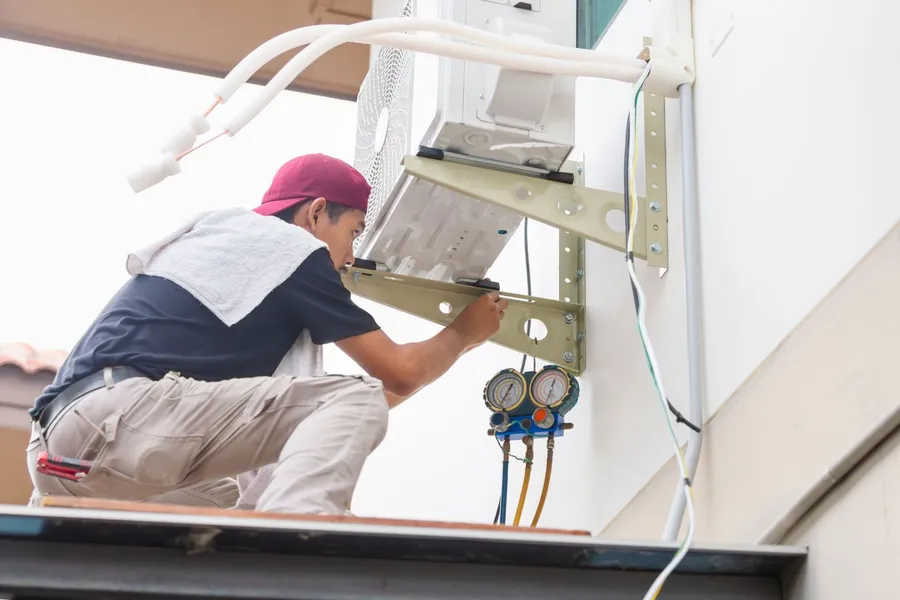
How much does AC installation cost on the Cote d'Azur?
Costs are quoted as total installed price including indoor unit, outdoor unit, refrigerant pipework, electrical connection, and commissioning. TVA at the applicable rate is included:
Single split system (one indoor unit, one outdoor unit):
- Cooling-only unit (2-3.5 kW): 1,800-3,000 EUR installed
- Reversible unit (heating and cooling, 2-3.5 kW): 2,500-4,000 EUR installed
- Reversible unit (larger, 5-7 kW): 3,500-5,500 EUR installed
Multi-split system (one outdoor unit, multiple indoor units):
- 2-zone multi-split: 4,000-6,500 EUR installed
- 3-zone multi-split: 5,500-8,500 EUR installed
- 4-zone multi-split: 7,000-11,000 EUR installed
- 5-zone multi-split: 9,000-14,000 EUR installed
These are ranges, not averages. Where you fall within each range depends on the factors described below.
What affects the price of an AC installation?
The variation within each range comes from several sources:
- Brand and equipment grade: premium brands (Daikin, Mitsubishi Electric) sit at the top of each range. Mid-tier brands (Atlantic, Fujitsu, Hitachi, LG, Panasonic, Toshiba) are reliable and cheaper. Budget brands cut the upfront price, but spare parts and after-sales support are less certain.
- Indoor unit type: wall-mounted units are the standard and lowest-cost option. Ceiling cassettes and floor-console units cost 300-700 EUR more per unit but suit different room layouts. Ducted units (concealed in ceilings) are the most expensive, used where wall or ceiling mounting is not aesthetically acceptable.
- Pipework run length and routing: each indoor unit needs its own pipe back to the outdoor unit. Long runs, runs through stone walls, or pipes buried in the plaster add labour and material cost. A 20-metre run adds roughly 300-600 EUR over a standard 5-metre run.
- Outdoor unit placement: ground-level placement on a bracket is lowest cost. Rooftop placement or placement requiring scaffolding adds 500-1,500 EUR.
- Electrical supply: each outdoor unit needs a dedicated circuit from the consumer unit. If the consumer unit is far from the outdoor unit or needs upgrading, this adds 300-800 EUR.
- Access and building type: stone-built villas, older apartment buildings, and properties with thick walls add labour time for drilling and routing. Modern builds with service ducts are faster and cheaper to fit.
What is the difference between a split system and a multi-split?
A single split system has one outdoor unit connected to one indoor unit. It is the right choice if you need cooling (or heating and cooling) in one room or zone.
A multi-split system has one outdoor unit connected to several indoor units, each in a different room. That outdoor unit is larger, but one of them is more compact and easier to fit than several separate units. Multi-split systems are common in apartments where terrace or wall space for multiple outdoor units is limited, and in villas where appearance matters.
The tradeoff: a multi-split outdoor unit is more expensive than a single-split unit, and all indoor units share the outdoor unit's total capacity. Running one zone of a multi-split is often slightly less efficient than a dedicated single split, because the system is sized for all its rooms. In most homes the difference is small, and the neater look and convenience outweigh it.
Does a reversible heat pump cost more than a cooling-only AC unit?
Yes, typically by 500-1,500 EUR for a single-split system. A reversible unit (known as a pompe a chaleur air-air reversible) provides both cooling in summer and heating in winter from the same equipment. On the Cote d'Azur, where winters are mild but heating is still required, a reversible unit is almost always the right choice.
The extra cost over a cooling-only unit is small. Heating with a heat pump costs less to run than electric heaters or gas. A reversible unit can also earn CEE subsidies and reduced TVA, which a cooling-only unit can't. In a main or second home, a reversible unit should be the default unless you have a specific reason to go cooling-only.
For a detailed comparison of reversible heat pumps and standard AC units, see the reversible heat pump vs AC guide.
Are there grants for AC installation in France?
Grants apply to reversible air conditioning units that qualify as heat pumps, but not to cooling-only AC equipment.
- MaPrimeRenov': since January 2025, standalone PAC air-air installations are excluded from MaPrimeRénov' par geste. The grant still covers air-to-water heat pumps (PAC air-eau), but not a reversible split installed as a single measure. It only ever applies to a principal residence.
- CEE: applies to qualifying heat pump installations, including reversible air-to-air units that meet an efficiency threshold. Energy companies pay it through your installer. There's no income test and no residence rule. The coast sits in the lowest-paying climate zone, though, so expect about 220-350 EUR for an air-air unit. Ask your installer what CEE contribution they can apply before signing.
- TVA depends on whether the unit reverses: since 18 July 2026 a reversible system can be charged at 5.5%, but only if the unit meets an efficiency and connectivity spec. Ask the installer to confirm it does. A reversible unit that misses the spec stays at 20% on the equipment and 10% on the labour. A cooling-only unit pays the same, because it isn't energy renovation work. Ask which rate is on your devis and why.
Cooling-only units get no reduced TVA and no CEE. That's another reason reversible units are the norm in new installations here.
What to check when getting AC installation quotes in France
When comparing AC installation quotes, check each devis specifies:
- Indoor and outdoor unit brand, model, and capacity (kW or BTU)
- Number of indoor units and their type (wall, cassette, floor)
- Refrigerant pipework length included in the quoted price
- Electrical connection included or separately priced
- TVA rate applied
- If claiming CEE: the CEE amount, shown as its own deduction
- If a CEE contribution is included: the amount clearly stated as a deduction
- Warranty on equipment and on the installation
Get at least three quotes for any multi-split installation. Contractors at similar prices often propose quite different equipment. Quotes most often diverge on pipework, electrical work and access costs.
More on AC costs, heat pumps and grants
- Heat pump installation on the Cote d'Azur
- Split AC installation: service page
- Multi-split AC installation: service page
- Reversible heat pump vs AC: which to install
- MaPrimeRenov' explained: who qualifies and how to claim
- CEE grants explained
- Devis: what your quote should contain
- Installing AC in a French copropriété: the approval process
Sources
Official sources for AC grant and TVA rules
- Service-Public.fr: MaPrimeRénov' (F35083) Who qualifies (principal residence only) and which heating systems the grant covers.
- Ministère de la Transition écologique: CEE standard operation sheets The CEE rules for air-air heat pumps (sheet BAR-TH-129), including the efficiency threshold and climate zones.
- Légifrance: arrêté of 13 July 2026 The spec a reversible unit must meet to get 5.5% TVA from 18 July 2026.
Rules checked against these sources in September 2026. Cost ranges are our own estimates and are not drawn from these sources.