Solar EV charging on the Cote d'Azur, from English-speaking specialists
Charging your car from your own solar panels is straightforward in principle. The execution — choosing the right charger, making sure it communicates with your inverter, timing the charge to match solar production — is where the details matter. We connect you with installers who understand both sides.
Looking for an English-speaking installer on the Côte d'Azur? Get quotes →
How it works
How do you charge an electric vehicle from rooftop solar?
Solar panels generate DC electricity, which your inverter converts to AC and feeds into the house. Any power the household isn't using at that moment either gets exported to the grid or, with the right setup, gets directed into your EV charger. On the Cote d'Azur, where panels can generate meaningfully from March through October, this works well.
The simplest version is timing-based: you know your panels produce most between 10am and 4pm, so you schedule your charger to run during those hours. It doesn't track real-time solar output but it captures most of the benefit. The more sophisticated version uses a smart charger that reads your inverter's live data and adjusts the charging rate to match actual solar surplus — charging faster when the sun is strong, slowing when it drops.
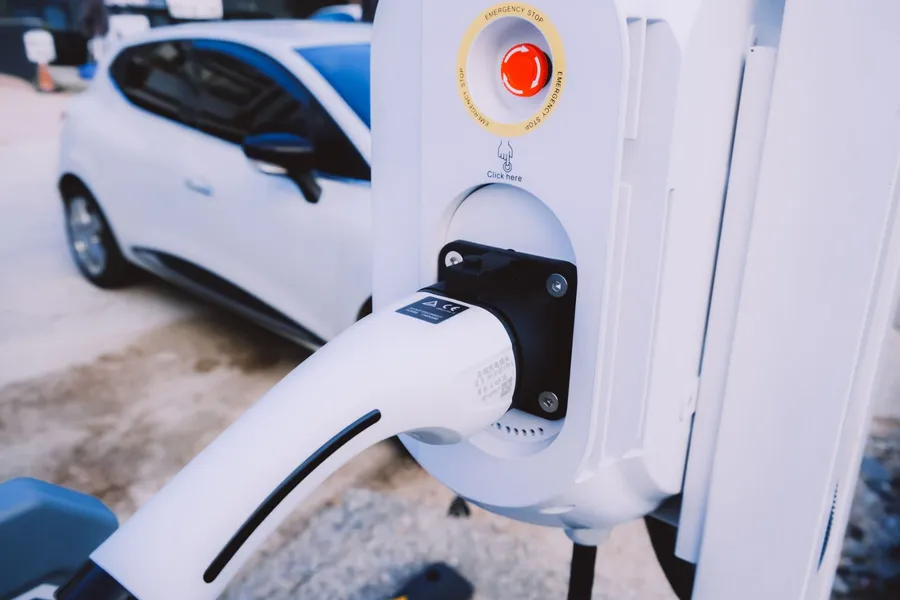
Either approach reduces what you draw from the grid. Over a year, a household with a 4 kWp solar system and an EV driven 15,000 km can cover a substantial share of charging needs from solar, especially during summer when you are likely using the car more and solar production is highest.
Equipment
Which charger type works best with solar panels?
Recommended for solar
Smart solar-optimised wallbox
A smart charger with solar optimisation reads real-time production data from your inverter and adjusts charging speed accordingly. When solar surplus is high, it charges at full speed. When production drops — cloud, late afternoon — it scales back rather than drawing from the grid. Brands like Wallbox Pulsar Plus, Ohme, and Myenergi Zappi are popular choices. Requires compatibility between the charger and your inverter's data interface.
Cost installed: typically 1,500-2,500 EUR. ADVENIR subsidy may apply.
Basic wallbox with timer
A standard 7.4 kW wallbox with a built-in scheduler. You set the charging window to match your typical solar production hours. Less precise than smart optimisation but effective if your schedule is predictable. Lower cost and works with any inverter. A reasonable choice if your solar system doesn't have an open data API or if budget is the priority.
3-phase 22 kW wallbox
For properties with three-phase supply and a car that supports 3-phase charging. Charges faster but requires more solar capacity to match the potential draw. Most useful when you need to charge a depleted battery quickly rather than for pure solar self-consumption.
Solar + battery + EV
Adding battery storage lets you accumulate solar surplus during the day and use it for overnight charging. Adds significant cost and complexity, but makes sense if you regularly need to charge overnight and want to maximise solar self-consumption. Requires careful sizing of both the battery and solar array.
Get matched with vetted English-speaking installers in your area.
Get quotesLocal conditions
Why does solar EV charging work so well on the Cote d'Azur?
The Cote d'Azur averages around 300 days of sunshine per year. A 4 kWp rooftop system in the Alpes-Maritimes produces roughly 5,500-6,000 kWh annually — substantially more than the same system would in northern France or the UK. That surplus matters when you are trying to run a household and charge a car from the same panels.
For second-home owners, the dynamics are different. If the property sits empty for long stretches, solar production during absence exports to the grid at a low rate. Adding EV charging that charges the car during weekends and holiday periods improves self-consumption and reduces the wasted export. Some owners use smart home systems to schedule the charger remotely, starting a charge cycle before arrival so the car is ready.
For apartment owners or properties with shared parking in a copropriété: installing a wallbox in a shared car park requires syndic approval under the droit à la prise rules, which give residents the right to install a charger at their own expense but require the syndic to be notified first. The process is usually straightforward but takes time. Your installer should be familiar with the procedure.
French electricity pricing through Enedis uses a base tariff (tarif de base) or time-of-use options. Combining solar self-consumption with a time-of-use tariff that has lower night rates can further reduce charging costs. Your installer should be able to model the expected self-consumption rate given your solar array size, household consumption, and typical driving patterns.
What to budget
What does solar EV charging cost on the Cote d'Azur?
Solar and EV charging are two separate installations, typically handled by two separate contractors. Costs below are for each component independently.
For maisons individuelles, ADVENIR does not apply to the EV charger — it covers collective housing only. The main national aid for a charger in an individual house is TVA at 5.5% on the installation. For the solar panels, CEE subsidies may apply. Check with your installer what currently applies to your situation before collecting quotes.
French terms
Key terms to know
Key French terms for this service
Questions
Frequently asked questions about solar EV charging
If your question isn't here, send it with your request and we'll answer it directly.
A typical electric car uses around 15-20 kWh per 100 km. On the Cote d'Azur, a 3 kWp solar system produces roughly 4,500-5,000 kWh per year — enough to cover the annual charging needs of a car driven 25,000-30,000 km, with electricity left over for the house. In practice, you won't always be charging exactly when the sun is shining, so a smart charger that schedules charging around solar production hours makes a meaningful difference. A 3-6 kWp system is the range most households find practical for combining home use and EV charging.
Not strictly, but a smart charger makes the combination substantially more effective. A basic wallbox charges your car at whatever rate it draws from the supply — it doesn't know or care whether that power comes from your panels or the grid. A solar-optimised charger (or one connected to your inverter's energy management system) can read real-time solar production and adjust the charging rate to match what the panels are generating. Some systems can throttle the charger down to minimum draw when solar production drops and increase it again when the sun returns. The cost premium for a smart charger over a basic one is typically 300-600 EUR — usually worth it when solar is involved.
Not directly — solar panels produce nothing at night. To charge at night from solar energy you would need a battery storage system large enough to store the day's excess production and release it overnight. Battery storage systems add significant cost and complexity, and the economics depend on electricity tariffs and how much excess solar you have. Most households on the Cote d'Azur charge primarily during the day (when the car is parked at home during holidays or when working from home) and accept that some overnight charging comes from the grid. This is still substantially cheaper than charging entirely from the grid.
Two separate subsidy streams apply to the different parts of the system. For the EV charger in a maison individuelle, the main national aid is TVA at 5.5% on the installation. ADVENIR does not cover individual houses — it applies to collective housing and shared car parks. For the solar panels, CEE subsidies may apply; MaPrimeRénov' does not cover solar PV. The two systems are installed and subsidised independently, which means you typically work with two contractors: an IRVE-certified installer for the charger, and an RGE-certified solar installer for the panels. Both certifications should be confirmed before signing devis.
For basic charging with no solar optimisation, no — any wallbox works independently of your inverter. For smart solar charging, where the charger adjusts its output based on real-time solar production, the charger and inverter need to communicate. This is done either via a shared energy management system (some manufacturers offer integrated solar plus EV ecosystems) or via a third-party energy manager that sits between the inverter and the charger. Common combinations include Fronius or SMA inverters paired with a Wallbox Pulsar Plus or Ohme, using the inverter's data API. Your installer should confirm compatibility before ordering equipment.