Solar battery storage on the Cote d'Azur, with English-speaking specialists
Battery storage lets you use your solar generation after the sun goes down, or while you're away. On the Cote d'Azur, where second-home owners want properties that manage themselves and where electricity prices have been rising, the case for storage is becoming more compelling. Here's what the French system allows, what systems are available, and what to budget.
Looking for an English-speaking installer on the Côte d'Azur? Get quotes →
How it works
What battery storage does and doesn't do in France
A solar battery stores surplus generation that would otherwise be exported to the grid. When your panels produce more than you're using at that moment (typically around midday), the excess charges the battery. When generation drops off (afternoon, evening) or stops (night), the battery discharges and supplies your home, extending the period of self-consumption.
In countries with time-of-use electricity tariffs, batteries can also charge from cheap overnight grid electricity and discharge during expensive peak hours, adding a financial layer to self-consumption optimisation. France's standard residential tariff (Tarif Bleu or Heures Pleines / Heures Creuses) is less favourable for grid arbitrage than some markets, so this benefit is more limited here.
Under current French autoconsommation regulations, you cannot feed stored battery electricity back to the grid. Batteries are strictly for self-consumption optimisation. This is a meaningful constraint: it means the financial return from a battery in France comes entirely from the electricity you avoid buying from the grid, not from export payments. The calculation is: kWh shifted from export to self-consumption, multiplied by the retail electricity price you avoid.
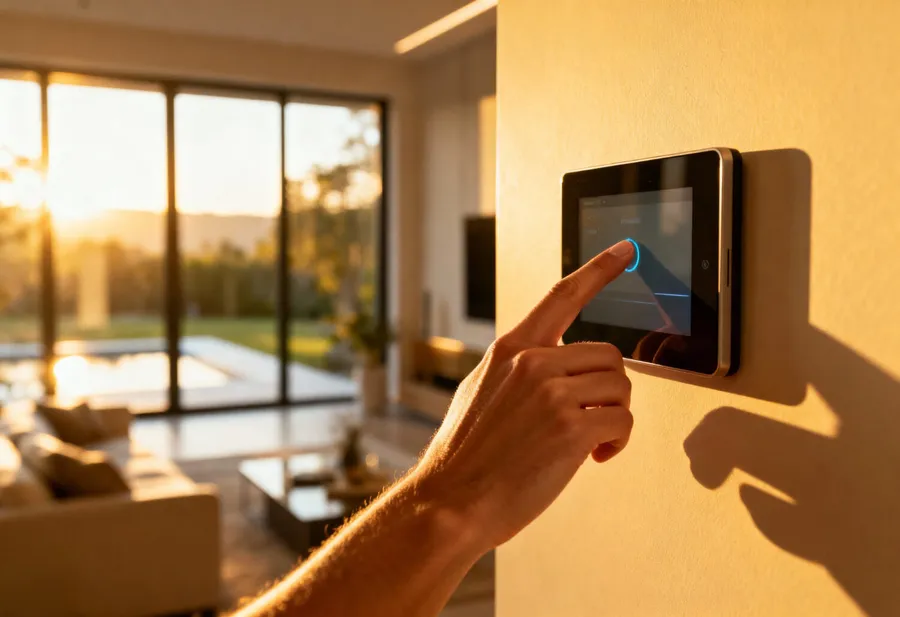
For second-home owners, the case for batteries extends beyond pure financial return. A battery-equipped solar system can keep the property's basic systems running during grid outages, maintain temperature control while the property is unoccupied, and reduce dependence on grid supply during the summer peak season when you're actually there. These are genuine quality-of-life and property-management benefits that don't appear in a simple payback calculation.
Systems and sizing
Battery systems available and how to size them
The residential battery market has consolidated around a few well-proven systems. The main options available through French installers on the Cote d'Azur:
Enphase IQ Battery is an AC-coupled system that works with any solar installation, making it straightforward for retrofits. Enphase's microinverter platform also supports whole-system monitoring. Available in modular capacity increments, which allows future expansion.
SolarEdge Energy Bank is DC-coupled and integrates tightly with SolarEdge inverters and power optimisers. More efficient than AC-coupled systems when paired with a SolarEdge installation, but requires SolarEdge inverter compatibility for existing systems.
BYD Battery-Box is widely used in Europe and available in several capacity ranges. Modular design, good track record, and compatible with multiple inverter brands through an AC-coupling interface.
Tesla Powerwall 2 (10kWh usable) is well known internationally and available in France through certified installers. Good monitoring software and backup capability. Note that Tesla's installer network is smaller in France than in the UK or US, which affects service access.
Sizing rule of thumb: for a 3-4 person household with typical evening consumption, 5-10 kWh is usually sufficient to cover overnight needs from a 3-6kWp solar system. Larger properties with heat pumps or EV charging running into the evening may benefit from 10-20 kWh.
Get matched with vetted English-speaking installers in your area.
Get quotesWhat to budget
Battery storage costs in France
Prices below are for battery systems installed and commissioned. Adding a battery to a new solar installation costs less than a standalone retrofit because some installation costs are shared. Prices are pre-subsidy.
The financial case: with current French electricity prices, and assuming a battery shifts 2,000-3,000 kWh per year from export to self-consumption, the annual saving is roughly 400-600 EUR (at 0.20-0.25 EUR/kWh retail price). At these rates, simple payback on a 6,000 EUR battery is 10-15 years, which is within or just beyond the warranty period. As electricity prices rise, payback periods shorten. For second-home owners, the non-financial benefits (autonomy, property management) often tip the decision.
Financial aid
Subsidies for battery storage in France
There is currently no specific MaPrimeRénov' grant for battery storage systems installed on their own. Batteries are not on the MaPrimeRénov' qualifying works list.
When a battery is installed together with a photovoltaic solar system as part of an autoconsommation setup, it may attract the same TVA rate as the PV system, meaning TVA at 10% for qualifying residential installations rather than 20%. Your contractor applies the rate that covers the whole installation. Ask them to confirm on the devis.
The prime à l'autoconsommation from EDF OA applies to the solar PV element of the installation and is not increased by adding a battery. The battery improves your self-consumption rate, which improves the financial return from the PV system, but the premium payment is calculated on panel capacity, not battery capacity.
The practical financial argument for batteries in France is narrower than in some other markets. The case is strongest for properties where energy autonomy, second-home management, or backup power capability have independent value beyond the electricity cost savings.
Coming from abroad
What's different from back home
UK
The UK has time-of-use tariffs (Octopus Agile, Go, etc.) that make battery arbitrage (charging cheap overnight, discharging at peak evening rates) financially attractive. France's standard residential tariffs don't work this way. The Heures Creuses / Heures Pleines tariff has an off-peak rate but the spread is narrower, and feeding stored electricity back to the grid isn't permitted under the standard autoconsommation contract. The financial model for batteries in France is simpler: avoid buying from the grid by using your own stored solar generation.
US
American homeowners in states with net metering may be used to battery systems that both optimise self-consumption and participate in grid services or export. Neither is currently available under standard French autoconsommation contracts. Virtual power plants and grid services from residential batteries are an emerging area in France but not yet available to residential customers in this region. For now, treat batteries purely as a self-consumption tool.
Germany
Germany has a well-established market for home battery storage, partly because the feed-in tariff for solar has dropped significantly and self-consumption is now more valuable than export. The French situation is similar in direction: low export rates make self-consumption the priority, and batteries extend that self-consumption into the evening. The specific grant structures differ, but the underlying economic logic is the same. German buyers familiar with Sonnen or E3/DC batteries will find comparable products available in France.
Choosing a contractor
What to look for in a battery storage installer
For a new solar-plus-battery installation, the same criteria apply as for solar panels alone: RGE QualiPV certification is required for the solar element, and you want an installer who handles the EDF OA application as part of the commissioning process.
For a battery retrofit to an existing solar system, confirm that the installer has specific experience with your existing inverter brand. AC-coupled batteries are more flexible, but DC-coupled systems require precise compatibility with your existing equipment. An installer who proposes a battery without asking about your current inverter hasn't done the compatibility check.
Ask about the monitoring and control system. Most modern batteries come with app-based monitoring, but setup and configuration vary by brand. A good installer will commission the monitoring system and show you how to use it, including how to see your self-consumption rate and battery state of charge.
For second-home owners specifically, ask whether the battery can be configured for automatic operation when the property is unoccupied: self-consumption optimisation, low-charge protection in winter, and remote monitoring alerts. Most systems support this, but the configuration needs to be set up correctly at installation.
French terms
Key terms to know
Key French terms for this service
Questions
Frequently asked questions about solar battery storage
If your question isn't here, send it with your request and we'll answer it directly.
It depends on your situation. The financial case for batteries in France is not as strong as in countries with time-of-use tariffs or generous export rates, because the French grid export rate under autoconsommation is already low. Batteries don't dramatically improve the economics compared to self-consuming directly — you're shifting self-consumption from midday to evening, which saves you the retail electricity rate on those evening kWh. With French electricity prices rising, this gap is widening and battery payback periods are coming down. For second-home owners, the case is different: batteries provide energy independence and allow the property to manage itself while unoccupied, which has value beyond the financial calculation.
Yes, in most cases. Retrofit battery storage is possible for most grid-connected solar systems, though the compatibility depends on your existing inverter. AC-coupled batteries (like the Enphase IQ Battery or Tesla Powerwall) can connect to almost any existing solar system through the AC side — these are the easiest to retrofit. DC-coupled systems (like some SolarEdge Energy Bank configurations) integrate more tightly with the solar inverter and may require an inverter upgrade if your existing equipment isn't compatible. Your installer should assess your existing setup before recommending a battery.
For a 3-4 person household with typical evening consumption (cooking, lighting, some appliances), a 5-10 kWh battery covers most overnight needs from solar generation. Properties with heat pumps running overnight or EV charging may benefit from 10-15 kWh. For larger properties with significant overnight loads, 15-20 kWh is the typical range. Oversizing a battery that won't be fully charged in a day wastes capital. Your solar installer should run through your consumption profile before recommending capacity.
Under current standard autoconsommation contracts in France, no. Battery systems are for self-consumption optimisation: you store your own generation and use it yourself. You cannot feed stored battery electricity back to the grid under the standard EDF OA contract. This means batteries are purely a self-consumption tool, not a grid arbitrage tool. The regulatory situation could change, but as of now, batteries are designed to maximise your own solar self-consumption rather than to trade electricity.
Most modern lithium iron phosphate (LFP) batteries are warranted for 10 years or a specified number of cycles, whichever comes first. Typical warranties guarantee at least 70-80% of original capacity remaining at the end of the warranty period. In practice, LFP chemistry degrades more slowly than earlier lithium-ion types, and real-world lifespans of 12-15 years are realistic for well-managed systems. The Cote d'Azur climate is generally benign for battery storage — lithium batteries perform best in moderate temperatures, and while summer heat is a consideration, outdoor-rated battery enclosures handle this adequately when correctly specified.
Ready to get quotes from English-speaking solar specialists on the Côte d'Azur?
Tell us what you need and we'll connect you with vetted, English-speaking tradespeople in Nice, Antibes, Cannes and across the Côte d'Azur.