Solar panel installation on the Cote d'Azur, with English-speaking specialists
The Cote d'Azur averages 2,700-2,900 sunshine hours per year. Solar panels here generate significantly more than in northern France, the UK or Germany. The French autoconsommation system for grid-connected solar, the subsidy structure and the permit rules are all different from what English-speaking homeowners are used to. We explain what's involved and connect you with certified installers in the region.
Looking for an English-speaking installer on the Côte d'Azur? Get quotes →
The solar resource here
Why the Cote d'Azur is one of the best locations in France for solar
France has a wide range of solar resources across its territory. Paris averages around 1,800 sunshine hours per year. The Cote d'Azur averages 2,700-2,900. That's a significant difference in energy output for the same panel installation. A 3kWp system installed in Nice will generate roughly 3,600-4,200 kWh per year; the same system in Rennes would generate around 2,700-3,000 kWh.
This matters because solar's financial case in France is based primarily on self-consumption: you use what you generate, which offsets electricity you'd otherwise buy from the grid. The more you generate, the more you offset. Higher generation means faster payback and better long-term return.
The French solar market operates under the autoconsommation framework. You install panels, connect to the grid, use your generation directly, and sell surplus through an EDF OA contract. You receive a prime à l'autoconsommation (self-consumption premium) paid over five years, and a small per-kWh payment for surplus sold. The economics favour using as much of your own generation as possible: pairing solar with a heat pump, EV charger, or pool pump that runs during daylight hours significantly improves the return.
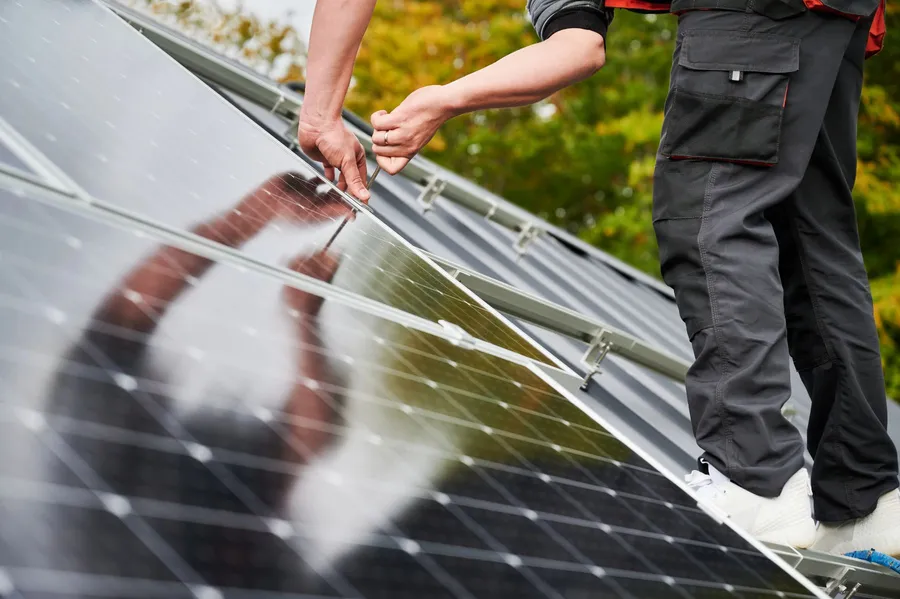
Most installed systems in the region are grid-connected and roof-mounted. Battery storage is growing as prices fall, and for second-home owners who want the property to manage its own energy while unoccupied, it adds a layer of autonomy. The French permit rules are straightforward for standard residential installations, though protected zones require care.
Services
Solar installations we cover on the Cote d'Azur
From a small grid-connected PV system on an apartment roof to a full solar-plus-battery setup for a villa, the systems below cover the main applications for residential solar on the Riviera.
Solar panels (PV)
Grid-connected photovoltaic systems for houses and villas. A 3-6kWp system covers a typical household's daytime electricity consumption. South-facing panels at 30-35 degrees generate 1,200-1,400 kWh per kWp per year on the Riviera.
Learn moreBattery storage
Store surplus solar generation for use at night or during cloudy periods. Increasingly popular for second-home owners who want the property to manage its own energy while unoccupied. Systems from 5-20 kWh for residential use.
Learn moreSolar water heating
Solar thermal panels heat domestic water directly. Mature technology with good return in this climate. Qualifies for MaPrimeRénov' unlike photovoltaic systems. Typically 2-4 collectors for a family household.
EV solar charging
Pairing a solar PV system with an EV charger (wallbox) lets you charge your car from your own generation during daylight hours. For properties with solar and an electric vehicle, this is one of the most effective ways to increase self-consumption rate.
Get matched with vetted English-speaking installers in your area.
Get quotesFinancial aid
Subsidies for solar in France
The French subsidy landscape for solar is specific to the technology type. Knowing which support applies to which system avoids disappointment.
MaPrimeRénov' covers solar thermal (water heating panels) but does not apply to photovoltaic (electricity-generating) panels. If you're installing PV panels, don't factor MaPrimeRénov' into your budget calculations.
Prime à l'autoconsommation is the financial support specific to PV. Under the EDF OA scheme, systems up to 500kWp receive a premium payment spread over five years. The amount depends on system size and is set at the time of application. Your installer will apply for this as part of the grid-connection and commissioning process. It's not a large amount relative to system cost, but it's reliable and guaranteed over the five-year period.
TVA réduite applies to PV installations under 3kWp on existing residential buildings. The VAT rate is 10% rather than 20%. For larger systems, TVA réduite may also apply depending on the specific work scope. Your contractor applies the correct rate on the devis.
Solar thermal (chauffe-eau solaire) qualifies for MaPrimeRénov' and CEE credits. If water heating is your main goal, solar thermal is the financially stronger option in terms of grant access. The installer must hold RGE certification for solar thermal work.
Coming from abroad
What's different from back home
UK
The UK's Feed-in Tariff (FIT) and Smart Export Guarantee (SEG) are structurally different from France's autoconsommation model. In France, the emphasis is firmly on self-consumption, with surplus sale rates set well below retail electricity prices. British homeowners used to the FIT model sometimes expect to generate primarily for export. That's not how the French system is designed. The economics here reward pairing solar with high daytime electricity loads, not maximising panel size for export.
US
Net metering, which credits solar owners at the full retail rate for electricity exported to the grid, doesn't exist in France. The French autoconsommation system credits surplus at a lower rate than you pay for grid electricity. This changes the financial model significantly: oversizing your system to export as much as possible doesn't improve the return the way it might under US net metering. Optimising for self-consumption matters here. The permit rules are also simpler than in many US states, particularly for residential installations under 3kWp.
Germany
German homeowners are familiar with solar subsidies through the EEG (Erneuerbare-Energien-Gesetz) and its Einspeisevergütung feed-in tariff. The French system operates differently: the support mechanism is an autoconsommation premium rather than a feed-in tariff on all generation, and the administrative process runs through EDF OA rather than the local grid operator. The German subsidy culture around solar is strong, which is helpful background knowledge, but the specific French mechanisms need separate understanding.
French terms
Key terms to know
Key French terms for this service
Questions
Frequently asked questions about solar on the Cote d'Azur
If your question isn't here, send it with your request and we'll answer it directly.
The resource is genuinely excellent. With 2,700-2,900 sunshine hours per year, south-facing panels on the Riviera generate roughly 1,200-1,400 kWh per kWp annually — compared to 800-900 kWh in northern France and around 1,000 kWh in the UK south. The financial case depends on your electricity consumption, whether you're there year-round or seasonally, and how much of your solar generation you can actually use yourself (self-consumption). For properties with high daytime electricity use (heat pumps, pool pumps, EV charging), the return is strong. For a second home that's empty most of the year, the self-consumption rate is lower and the payback period longer.
For systems under 3kWp installed on an existing roof, you need to file a declaration préalable des travaux (prior declaration) with your local mairie rather than full planning permission. For systems over 3kWp, a declaration préalable also applies in most cases. New structures or ground-mounted systems typically require a permis de construire. Properties in protected zones — near listed buildings, in an ABF conservation area, or in a classified landscape — may face additional restrictions. Your installer should handle the administrative filing as part of the installation process.
Yes, through the autoconsommation avec vente du surplus system. Under an EDF OA (obligation d'achat) contract, you sell excess generation to the grid at a regulated price and receive a prime à l'autoconsommation (self-consumption premium) paid over five years. This is different from net metering as it exists in the US and some UK tariffs — you receive a lower rate for surplus than you pay for grid electricity, so the economics strongly favour maximising self-consumption rather than generating for export.
No. The prime à l'autoconsommation from EDF OA is available to any property owner with a qualifying solar installation, regardless of nationality or residency. The TVA réduite applies to the installation work. MaPrimeRénov' covers solar thermal (hot water) but not photovoltaic panels — for PV, the relevant financial support is the autoconsommation premium and the reduced TVA rate. Your installer should handle the EDF OA application as part of the commissioning process.
Ready to get quotes from English-speaking solar specialists on the Côte d'Azur?
Tell us what you need and we'll connect you with vetted, English-speaking tradespeople in Nice, Antibes, Cannes and across the Côte d'Azur.