Guide
Reversible heat pump vs AC: which one to install on the Cote d'Azur
When you get quotes for cooling a property on the Cote d'Azur, contractors will often propose a reversible system rather than a standard AC unit. The two look identical from the inside, the installation process is similar, and the indoor units are the same. The difference is in what the outdoor unit can do: a reversible system runs the refrigerant cycle in both directions, so it heats in winter as well as cools in summer. A cooling-only AC unit runs in one direction only.
For most properties on the Cote d'Azur, reversible is the right choice. Here is why, and the cases where it isn't.
What "reversible" means in practice
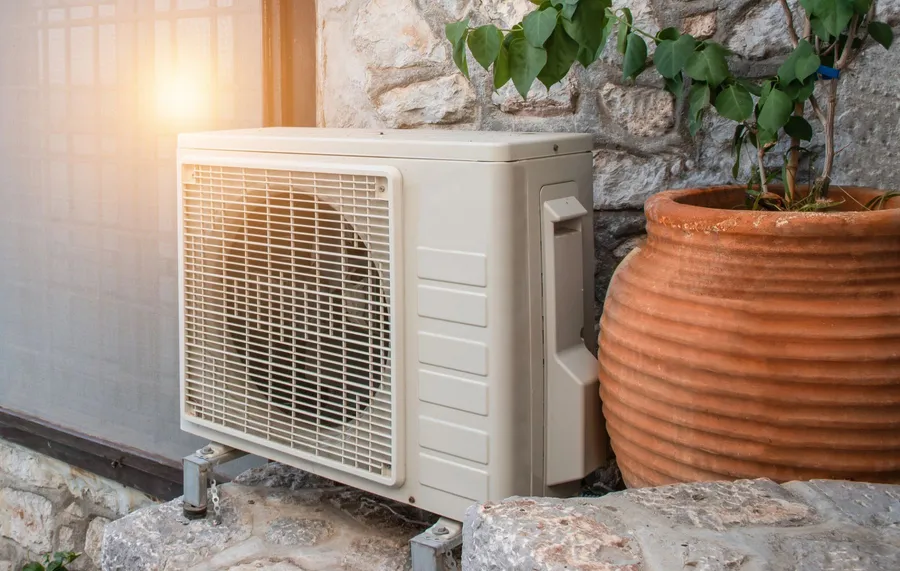
A reversible heat pump (PAC air-air reversible in French) uses the same outdoor unit and indoor split unit to heat or cool, depending on the season. In cooling mode it works identically to a standard AC. In heating mode it extracts thermal energy from outdoor air and moves it inside. Even at 5-6°C, outdoor air contains enough energy to run the system efficiently.
A cooling-only unit, known in French as a climatiseur non-reversible, only runs in one direction. It cools a room but cannot heat it.
The cost difference between reversible and cooling-only units at the same capacity has narrowed. For most brands, a reversible unit costs 10-20% more than the equivalent non-reversible model. Given winters here where heating is needed from November to March, that premium is almost always worth paying.
Efficiency comparison
Both types are rated for cooling efficiency using SEER (Seasonal Energy Efficiency Ratio): cooling energy delivered per unit of electricity consumed. Reversible units have an additional heating rating: SCOP (Seasonal Coefficient of Performance).
For quality residential split systems, typical ratings are:
- SEER (cooling): 6 to 8 for mid-range brands; 8 to 10 for premium
- SCOP (heating): 3.5 to 4.5 for most residential systems in the south of France climate
An SCOP of 4 means for every 1 kW of electricity consumed, the system delivers 4 kW of heat. That is far more efficient than a gas boiler (roughly 0.9 kW of heat per kW of input energy) and makes heat pumps the lowest running-cost way to heat most properties when electricity is used efficiently.
Cooling-only units have no heating SCOP. If you install one and want winter warmth, you need a separate heating system.
Cost comparison
For a standard single-zone installation in a typical villa or apartment on the Cote d'Azur:
- Cooling-only split unit, fully installed: 1,800-3,500 EUR for a room up to 25 m²
- Reversible split unit, fully installed: 2,200-4,500 EUR for the same room
For a multi-zone system covering a larger property, the differential is proportionally similar. The reversible option costs more upfront, but running cost savings on winter heating typically recover that difference within one to three heating seasons.
If you already have a separate, efficient heating system (a recently installed air-to-water heat pump, for example), adding reversible capability may not be worth the extra cost. Adding cooling to an existing heating setup, where the heating works well, can make a cooling-only system a reasonable choice.
Subsidy eligibility
This is where the two types diverge most clearly from a financial perspective.
A reversible heat pump qualifies for MaPrimeRenov' grants and CEE subsidies as a heating system. A cooling-only AC unit does not qualify for any energy renovation grant, because grants target heating efficiency, not cooling comfort.
MaPrimeRenov' and CEE combined can significantly reduce the net installed cost of a qualifying reversible heat pump. The reduction depends on your income band and current rates. Check the simulator at maprimerenov.gouv.fr for a current figure before collecting quotes.
To access the subsidies, your installer must hold RGE certification (specifically QualiPAC for heat pump work), and the application must be made before work starts. Ask your contractor to confirm this before signing a devis.
When a cooling-only unit might make sense
There are legitimate cases where a non-reversible unit is the right choice:
- You have a recently installed, efficient central heating system: if the property has a new PAC air-eau or gas boiler, adding reversible split units duplicates the heating function. A cooling-only unit for summer comfort at lower cost makes sense.
- Budget is a hard constraint: if immediate summer cooling is the priority and heating can wait, a cooling-only unit is cheaper upfront. You lose the option to claim heating subsidies later on the same unit.
- Copropriete restrictions: in some apartment buildings, the syndic may restrict outdoor unit types. If the building has communal heating, a cooling-only unit may be all that's practical.
Outside these cases, the reversible option is the better investment for a property on the Cote d'Azur.
What to ask your contractor
When getting quotes, ask each contractor to include both options on their devis so you can compare directly. Confirm the SEER and SCOP ratings for the reversible unit proposed. Check that the quote covers RGE certification, the subsidy application process, and the TVA rate applied (10% for heat pump installation on properties over 2 years old).
If a contractor is proposing a cooling-only system without explaining why reversible doesn't make sense for your situation, that is worth questioning.
Related pages
Ready to get quotes from English-speaking cooling specialists on the Côte d'Azur?
Tell us what you need and we'll connect you with vetted, English-speaking tradespeople in Nice, Antibes, Cannes and across the Côte d'Azur.