Wood pellet heating on the Cote d'Azur
Pellet boilers are a renewable heating option, and the right choice for larger inland properties with space for a storage silo. They work with existing radiator circuits and produce lower emissions than gas or oil. We connect you with English-speaking contractors holding RGE Qualibois certification across the region.
Looking for an English-speaking installer on the Côte d'Azur? Get quotes →
How it works
How does wood pellet heating work?
A wood pellet boiler burns compressed wood pellets to heat water, distributing it through a standard wet heating circuit. The pellets feed automatically from a storage silo into the combustion chamber via an auger. The boiler controls the feed rate to match the thermostat's demand. In practice, the system operates with minimal daily intervention: loading the silo is done once or twice per season, and the boiler handles the rest automatically until it needs its annual clean.
For a property already on a gas or oil central heating system, a pellet boiler is a like-for-like replacement at the boiler. The existing radiators, pipework, and controls can usually be kept. What changes is the fuel source, the boiler unit itself, and the addition of a pellet storage silo. For larger properties where significant structural work would be required to install a heat pump, or where the existing radiator system runs at high temperatures that a heat pump cannot comfortably match, a pellet boiler offers a clean switch to a renewable fuel without rebuilding the distribution side.
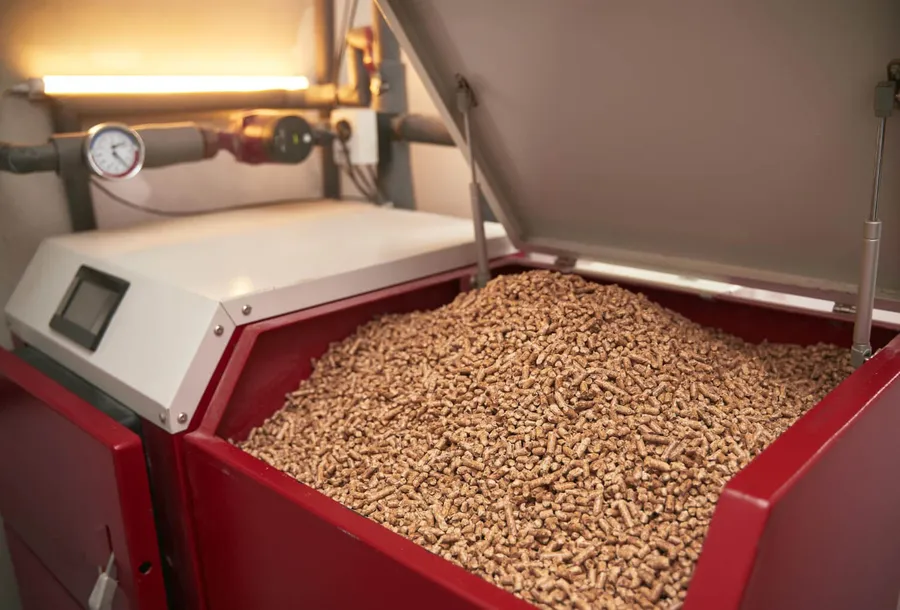
Pellets sold in France must conform to the EN ISO 17225-2 standard (formerly EN 14961-2). The ENplus A1 grade is the most widely available and is the recommended specification for residential boilers. Using the correct grade matters: lower quality pellets with higher ash content reduce combustion efficiency and increase maintenance requirements. Your installer will specify the correct grade for your unit and confirm the local suppliers in your area.
System options
Which pellet heating system suits your property?
Most common for full-house heating
Pellet boiler with storage silo
The standard full-house solution: a pellet boiler connected to your existing radiator circuit and hot water cylinder, fed automatically from an indoor or outdoor silo. Suitable for properties where a heat pump is not practical due to space, planning, or existing high-temperature radiator systems. The silo size is calculated based on the property's annual heat demand — typically 3-6 tonnes for a family house in the Alpes-Maritimes. A full installation including boiler, flue, silo, and connections typically costs 10,000-20,000 EUR before subsidies.
Pellet stove (supplementary heating)
A standalone room heater with a small integrated hopper, burning pellets to radiate heat directly into one room. Not connected to a central heating circuit. Practical as a supplementary heat source in a living room, farmhouse kitchen, or studio. Much lower upfront cost than a pellet boiler (2,000-4,500 EUR installed), but limited to one zone. CEE subsidies are available for qualifying pellet stoves; MaPrimeRénov' par geste no longer covers biomass heating as of January 2026.
Pellet boiler with solar thermal
Combining a pellet boiler with solar thermal collectors covers domestic hot water from solar for most of the year, with the pellet boiler as the heating source in winter. A sensible combination for larger properties with good roof exposure in the arrière-pays. Reduces pellet consumption by handling summer and shoulder-season hot water without burning fuel.
Hydro pellet stove
A larger pellet stove that also heats water for a small number of radiators — typically 4-8 in a small house. A middle ground between a standalone stove and a full pellet boiler. Suitable for smaller properties or as a primary heat source in a secondary residence where a full boiler installation would be disproportionate. Less common than either a standard stove or a full boiler, but worth considering for the right property size.
Get matched with vetted English-speaking installers in your area.
Get quotesLocal context
Where does pellet heating make most sense on the Cote d'Azur?
Pellet heating is more common in the arrière-pays than on the coast. Inland properties around Grasse, Valbonne, Mougins, the Var villages, and the higher-altitude communes have colder winters than the coastal strip, longer heating seasons, and more space for the storage infrastructure that a pellet system needs. A mas or bastide with a barn or cellar is well suited; a two-bedroom apartment in Nice is not.
Coastal and urban properties are generally better served by reversible heat pumps, which can be installed with minimal structural work, serve as both heating and cooling from a single system, and benefit from the mild coastal winters where heat pump efficiency is particularly high. For those properties, a pellet boiler would add complexity without a meaningful advantage.
Pellet supply is well established in the PACA region. Granulés de bois in 15 kg bags are available at most bricolage stores; bulk delivery in tonnes by pneumatic truck is the practical and economical option for a full pellet boiler. Your installer will confirm local suppliers and typical delivery lead times for your area. Deliveries are generally scheduled before the heating season to avoid the period of highest demand.
What to budget
What does wood pellet heating cost to install on the Cote d'Azur?
All figures are for full installation including appliance, flue, connections, and silo or hopper. Annual pellet costs are a separate ongoing expense.
CEE subsidies are the main funding route for pellet boilers and stoves. MaPrimeRénov' par geste no longer covers biomass heating installations as of January 2026, though pellet systems may still qualify as part of a broader rénovation d'ampleur project in an E, F or G-rated property. TVA réduite at 10% applies to qualifying installation on residential properties over 2 years old. RGE Qualibois certification is required on the contractor for CEE grants to apply.
French terms
Key terms to know
Key French terms for this service
Questions
Frequently asked questions about wood pellet heating on the Cote d'Azur
If your question isn't here, send it with your request and we'll answer it directly.
A wood pellet boiler burns compressed wood pellets (granulés de bois) to heat water, which is then distributed through radiators or underfloor heating in the same way as a gas or oil boiler. Pellets are fed automatically from a storage hopper (silo) into the combustion chamber by an auger. The boiler thermostat controls the feed rate to match demand. Modern pellet boilers achieve efficiencies of 85-95% and can run largely automatically between manual cleaning sessions. A pellet boiler is a direct replacement for a gas or oil boiler in terms of the heat distribution system, which is why it is popular as a switch option in properties that already have a wet radiator circuit.
A pellet boiler (chaudière à granulés) heats water for a central heating circuit and hot water cylinder, and is connected to the whole house's radiators or underfloor heating. It requires a dedicated boiler room and a pellet storage silo. A pellet stove (poêle à granulés) is a standalone room heater that radiates heat directly into one room, with a small integrated pellet hopper. A pellet stove cannot heat multiple rooms via a wet circuit without a dedicated hydro model. For full-house heating on the Cote d'Azur, a pellet boiler is the relevant option. Pellet stoves are more common as supplementary or zone heating in a specific room.
As of January 2026, wood pellet boilers and stoves are no longer covered by MaPrimeRénov' as standalone (par geste) works. Biomass heating was removed from the MaPrimeRénov' par geste scheme at the start of 2026. CEE subsidies from energy suppliers remain the main funding route and can be meaningful, typically 1,500 to 4,000 EUR depending on household income. Pellet systems may still qualify if they form part of a larger rénovation d'ampleur project in an energy-inefficient property (rated E, F or G on the DPE). TVA réduite at 10% still applies to the installation on qualifying residential properties over 2 years old. If you are comparing a pellet boiler with a heat pump on subsidy grounds alone, note that MaPrimeRénov' for heat pump installations is still active. Check current schemes and amounts with your contractor before finalising your decision.
The boiler unit itself is similar in size to a large gas boiler, but the pellet storage silo adds significant space requirements. A typical residential silo for a family house holds 3-6 tonnes of pellets, which is roughly one winter's supply. The silo can be a dedicated room, a textile silo inside a garage or cellar, or an outdoor underground tank. The minimum practical storage for most Riviera installations is around 6-8 m2 of floor area, though this varies with silo design. Rural properties with barns or outbuildings are well suited. Urban apartments and small terraced properties are generally not suitable — pellet heating works best where there is space for proper storage.
On the Cote d'Azur, a heat pump will typically have a lower running cost per kWh of heat delivered, because the mild climate allows heat pumps to operate at high efficiency (COP of 3-4) through most of the heating season. Pellets cost more per kWh of useful heat than a heat pump running on standard electricity tariffs, though the exact comparison depends on current pellet and electricity prices. The case for pellets is stronger for properties where a heat pump installation is difficult (limited outdoor space, planning restrictions), where the owner wants independence from electricity, or where existing radiators run at temperatures better suited to a high-temperature system. For most standard Riviera properties, a heat pump will offer lower running costs.