Reversible heat pump installation on the Cote d'Azur
A reversible heat pump (PAC réversible) heats your home in winter and cools it in summer, from a single unit. On the Cote d'Azur, this is the standard residential choice. The mild winters mean it handles heating well, and the hot July and August temperatures mean the cooling function isn't optional. Most expats arriving from the UK are surprised to find one system does both jobs. We connect English-speaking homeowners with vetted RGE-certified installers who can explain the options clearly.
Looking for an English-speaking installer on the Côte d'Azur? Get quotes →
English-speaking specialists
Why it helps to have an installer who speaks your language
The decisions involved in specifying a reversible heat pump are more nuanced than they might appear. You're choosing a system that will run in two different modes across two seasons, and getting the sizing right for both heating in January and cooling in August requires a contractor who understands the local climate and your specific property.
British homeowners, in particular, often underestimate the cooling requirement. In the UK, an air-source heat pump is a heating-only system because summers don't typically require mechanical cooling. On the Cote d'Azur, July and August see sustained temperatures of 30-35°C with high humidity. A house that gets to 28°C indoors on a still August afternoon is not a comfortable place to be, and opening windows brings in hot air at that time of year. Cooling is not a luxury here.
Discussing these requirements with a contractor in a second language, without shared technical vocabulary, leads to mismatched expectations. The most common outcomes are systems sized for heating only (inadequate in summer) or systems sized for peak summer cooling that run inefficiently in winter. A contractor who works regularly with English-speaking clients has had these conversations many times and knows which questions to ask.
There's also the subsidy paperwork. MaPrimeRénov' applications need to be initiated before work starts, and the documentation requirements are specific. Contractors who deal regularly with English-speaking expats are familiar with the process and can guide you through it without relying on you to interpret French bureaucratic language.
The climate argument
Why reversible heat pumps dominate on the Cote d'Azur
The Cote d'Azur climate creates a specific set of requirements that make reversible heat pumps the obvious choice. Understanding the climate in detail explains why this technology has become so dominant here, to a degree you won't find in the UK or Germany.
Winter temperatures: Nice averages 12-15°C during the day in December and January, dropping to 5-8°C at night. This is warm enough that an air-source heat pump operates at high efficiency throughout winter. A COP of 3.5-4 is achievable on the coldest nights. There's almost never a situation where the outdoor temperature drops low enough to challenge the heat pump's capacity. The coastal strip from Menton to Saint-Tropez sits in the warmest zone; go 20km inland and temperatures are 2-4°C colder, but still mild by northern European standards.
Summer temperatures: July and August on the Cote d'Azur regularly reach 30-35°C. Heatwaves push it higher. The combination of temperature and humidity, particularly in apartments in Nice or Cannes where there's little natural shade, makes indoor cooling a genuine comfort requirement rather than a luxury. A well-installed reversible heat pump with an appropriate SEER rating (look for 6+) can maintain a comfortable 24-25°C indoors even during a 35°C peak day.
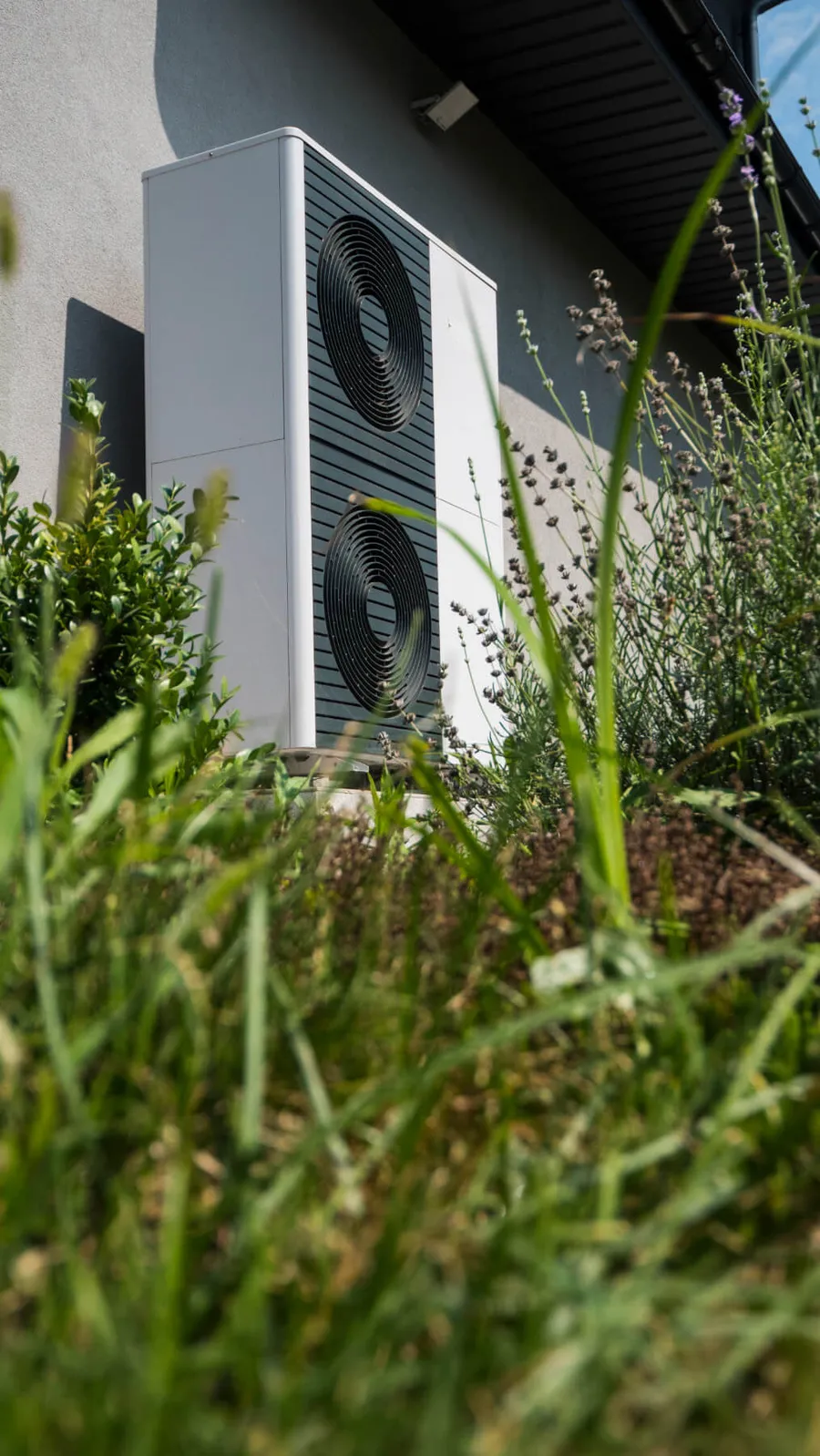
The comparison with northern Europe: In the UK, summers rarely require mechanical cooling. A heat pump is a heating-only system. That means a homeowner wanting both heating and cooling in England buys a heat pump and a separate AC unit. On the Cote d'Azur, one reversible unit handles both. The cost of one well-specified reversible system is substantially less than two separate systems, and there's only one outdoor unit taking up space on the terrace.
The transition seasons: October and November can swing between warm days (20°C+) and cool evenings (10°C). The same is true of April and May. A reversible heat pump switches between modes as needed, which a heating-only system obviously can't do. In practice, most homeowners use their reversible unit for light cooling in May and September as well as more intensive use in July and August.
System types
Types of reversible heat pump system
Most common
Wall-mounted split unit
The standard choice for apartments and smaller villas. One outdoor compressor unit connects to a single wall-mounted indoor unit (the "cassette" or "évaporateur mural"). The indoor unit sits high on the wall and distributes conditioned air across the room. These systems are efficient, quiet in modern models, and relatively straightforward to install. A typical installation covers a large open-plan living space or up to two connected rooms.
Brands commonly installed on the Cote d'Azur include Daikin, Mitsubishi Electric, Atlantic, Panasonic and Toshiba. There's a significant quality range. Discuss brand and model with your installer rather than accepting whatever they have in stock.
Multi-split system
One outdoor unit connected to multiple indoor units, each serving a different room or zone. This is the standard whole-house solution for villas on the Riviera. Each zone can be controlled independently, which is a common requirement for second homes where different rooms are used at different times. See our multi-split AC page for more detail on this configuration.
Cassette unit
A ceiling-mounted unit that distributes air in four directions. More common in commercial spaces but sometimes used in larger residential rooms. Requires a suspended ceiling or significant ceiling depth. Less visible than wall-mounted units when installed well.
Ducted system
Air is distributed through concealed ductwork, with grilles in each room. More expensive and disruptive to install, but completely invisible in use. Popular in higher-end renovations and larger properties where the aesthetic of wall-mounted units is undesirable. Requires good attic or ceiling void access.
Get matched with vetted English-speaking installers in your area.
Get quotesWhat to budget
Reversible heat pump costs on the Cote d'Azur
Costs below are realistic pre-subsidy installed prices in the Alpes-Maritimes and Var. They cover equipment, installation labour and standard electrical connections. They don't include major structural work, tableau upgrades or difficult access situations.
The main price drivers: number of indoor units (each adds cost), refrigerant pipework distance and complexity (running pipes through walls or floors adds labour), brand and model (Daikin and Mitsubishi premium brands carry a 20-30% premium over mid-range), and whether electrical supply needs upgrading.
For eligible installations, MaPrimeRénov' and CEE credits can significantly reduce the net cost. The exact reduction depends on your income bracket and current grant rates. The reduced TVA rate (5.5% or 10%) also applies to the whole installation (verify on your devis). Ask your contractor to include current subsidy estimates. A contractor who handles these applications regularly should be able to give you a realistic indication.
Financial aid
Subsidies for reversible heat pump installation in France
The same subsidy schemes that apply to standard heat pumps apply to reversible systems: MaPrimeRénov', CEE credits and the reduced TVA rate.
MaPrimeRénov' covers qualifying heat pump installations where the contractor holds RGE certification. For reversible systems, the relevant RGE label is typically QualiPAC or equivalent. The grant amount depends on your income category. France uses four brackets, with the highest grants going to lower-income households, but middle and upper income brackets still receive meaningful amounts. Apply through anah.gouv.fr before work starts.
CEE credits can often be combined with MaPrimeRénov'. Your contractor may arrange these directly, effectively bundling them into the overall cost reduction. The credits are funded by energy suppliers and the amounts vary based on current energy policy.
TVA réduite at 5.5% or 10% applies to qualifying residential energy renovation work. Your contractor includes this automatically on a compliant devis if the installation qualifies.
One point worth noting: for a reversible heat pump that serves both heating and cooling purposes, the subsidy is generally calculated on the basis of the heating function, which is the energy-saving element that the French scheme targets. The cooling capability is, from the subsidy perspective, a bonus.
For more detail, see our MaPrimeRénov' guide and the RGE certification glossary entry.
Coming from abroad
What's different from back home
UK
The concept of a reversible heat pump is largely foreign to UK homeowners. Heat pumps in the UK are for heating; air conditioning units are a separate, usually avoided purchase. Arriving on the Cote d'Azur and discovering one unit does both is a genuine revelation for most. The other difference: UK heat pumps are often connected to a wet distribution system (radiators and hot water), whereas the most common reversible systems on the Riviera are air-to-air, distributing conditioned air directly. This is simpler to install but means your hot water supply is handled separately.
US
Americans are more familiar with the concept of a combined heat-and-cool system, similar to what the US HVAC industry calls a "heat pump" in the dual-function sense. The French version uses different refrigerants (phasing out R410A in favour of lower-GWP alternatives), runs on 230V/50Hz, and uses different sizing conventions. Air-to-air reversible units on the Cote d'Azur are conceptually similar to mini-split heat pumps marketed in the US, but the brands and specifications differ.
Germany
German homeowners are familiar with Wärmepumpen for heating and often also with Klimaanlagen for cooling, but typically as separate systems. The French PAC réversible combines both in a way that's common in France and southern Europe but less standard in Germany. The subsidy comparison: BAFA covers heat pumps in Germany; MaPrimeRénov' is the French equivalent, but the application process is different and the amounts are calculated differently. The general principle is the same: a government incentive for switching from gas or oil.
Choosing a contractor
What to look for in a reversible heat pump installer
For reversible heat pump installation, most of what applies to heat pumps generally also applies here: RGE certification, local references, a proper devis. A few things are specific to reversible systems:
Check the system is genuinely reversible. Some contractors install heating-only units and assume you don't need cooling, or quote a reversible unit but install a heating-only version because it was cheaper or in stock. Ask specifically for the model number and check whether it's listed as reversible (réversible) in the manufacturer's specification.
Verify the outdoor unit noise level. Many Riviera communes have rules about noise from HVAC equipment, particularly regarding neighbour distance and db(A) limits. Modern inverter units are much quieter than older models, but it's worth checking the spec. A good installer will measure the installation position against local rules before recommending a unit.
Confirm you get a single controller for both modes. Some installations leave heating and cooling on separate remotes or separate control systems, which is inconvenient. Ask specifically how you'll switch between modes and what the control interface looks like.
Ask about maintenance. Reversible units should be serviced annually: filters cleaned, refrigerant pressure checked, and condensate drain cleared. Some installers include the first service in the installation price; ask what the ongoing maintenance arrangement is and whether they offer a contract.
French terms
Key terms to know
Key French terms for this service
Questions
Frequently asked questions about reversible heat pumps
If your question isn't here, send it with your request and we'll answer it directly.
A reversible heat pump (PAC réversible) works on the same refrigeration cycle as a standard heat pump, but with a reversing valve that allows it to run in either direction. In winter, it extracts heat from outside air and transfers it inside — just like a standard heat pump. In summer, it reverses the process, extracting heat from inside the property and releasing it outside, exactly like an air conditioner. The unit itself is physically the same either way; the mode is typically switched from a remote control or thermostat. On the Cote d'Azur, where both winter heating and summer cooling are genuine requirements, a reversible unit handles both for roughly the same cost as buying just one of those systems separately.
For most properties on the Cote d'Azur, yes. A reversible split system costs around 8,000-15,000 EUR installed for a standard residential property — compared to perhaps 12,000-20,000 EUR if you installed a separate heat pump and a separate multi-split AC system. You also only have one set of equipment to maintain and service. The one scenario where separate systems can make sense is if you already have a working gas or oil heating system and only need to add cooling — in that case, a cooling-only split AC unit is a simpler and cheaper addition. But for new installations or full replacements, reversible units are almost universally the right choice on the Riviera.
Very efficient in both modes. In heating mode, a well-specified air-source reversible heat pump on the Cote d'Azur coast typically achieves a COP (coefficient of performance) of 3.5-4 in winter, meaning it produces 3.5-4 kWh of heat per kWh of electricity consumed. In cooling mode, the equivalent metric is the EER (energy efficiency ratio) or SEER (seasonal EER), and modern inverter units commonly achieve SEER ratings of 6-8. For context, a cheap portable AC unit might have a SEER of 2-3. The combination of mild winters and hot summers means both functions are in regular use, and the economics of running costs favour modern inverter reversible units strongly over direct electric or older refrigerant-cycle systems.
Yes, with the right system design. A single wall-mounted split unit will typically heat one large room or two connected rooms effectively. For whole-house heating, you need either a multi-split system (one outdoor unit driving multiple indoor units, one per room or zone) or a ducted system that distributes air through the property. Multi-split systems are the most common whole-house solution on the Cote d'Azur — they're relatively straightforward to install and allow independent control of each zone. For larger or older properties with existing radiator systems, a different approach using a heat pump connected to the wet system may be more appropriate. The right answer depends on your property — your installer should assess this before recommending a configuration.
Sizing depends on the heat loss of your property, which varies with floor area, insulation, ceiling height, window area and orientation. As a rough guide, a 100-120m2 villa in good condition on the Cote d'Azur coast typically needs around 6-8kW of heating capacity. In cooling mode, the same property might need 5-6kW of cooling capacity (the two requirements are often similar in this climate). For inland properties at altitude — Grasse, Valbonne, Tourrettes-sur-Loup — use more conservative figures because winter temperatures are lower. A proper heat loss calculation, done by the installer on-site, is the only reliable way to size a system. If a contractor quotes you without visiting the property, the sizing will likely be wrong.
Ready to get quotes from English-speaking heating specialists on the Côte d'Azur?
Tell us what you need and we'll connect you with vetted, English-speaking tradespeople in Nice, Antibes, Cannes and across the Côte d'Azur.