Hot water systems on the Cote d'Azur, from English-speaking specialists
Most properties here run on a standard electric water heater that is ten or more years old. Replacing it with a heat pump water heater or solar thermal system cuts running costs substantially and may qualify for grants. We connect you with RGE-certified contractors who can advise on what makes sense for your property.
Looking for an English-speaking installer on the Côte d'Azur? Get quotes →
The basics
What hot water setup is typical in French homes on the Cote d'Azur?
The standard hot water setup in a French residential property is a cumulus — an electric storage water heater, typically 200 or 300 litres, mounted on the wall in a cupboard or utility room. It heats water using an electric resistance element and keeps it at temperature. Simple, reliable, widely installed, and expensive to run relative to the alternatives.
Most cumulus units sold before around 2015 are significantly less efficient than current options, and many are approaching or past the end of a reasonable service life. If yours is over 10 years old, an anode check is worth doing. If it is over 12-15 years old, replacement planning makes sense before a failure forces a rushed decision. The Cote d'Azur has hard water in many areas — calcaire (limescale) accumulates on the heating element and depletes the anode faster than in softer-water regions, so service intervals here are often shorter than the manufacturer's standard guidance.
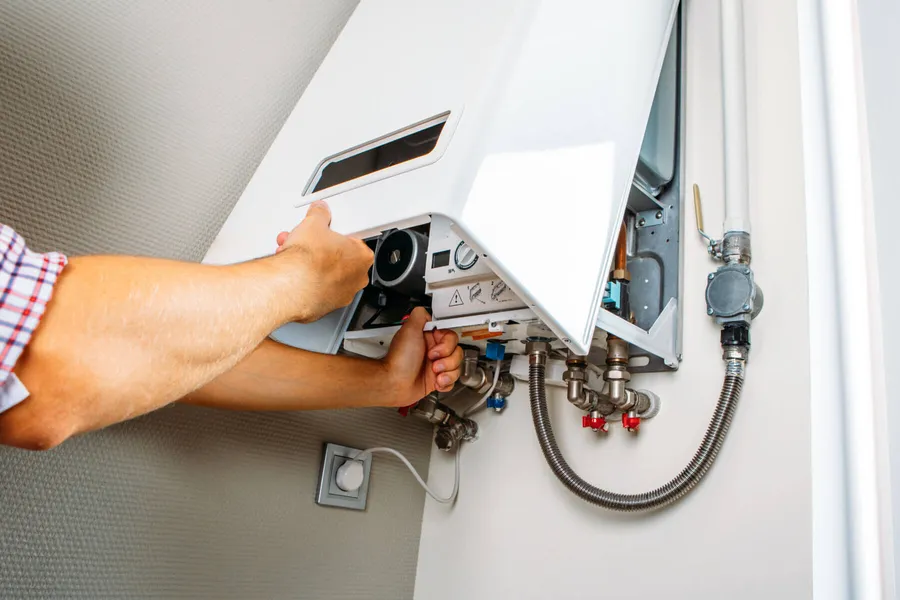
The alternatives to a standard cumulus are meaningfully more efficient. A heat pump water heater uses the same refrigerant-cycle principle as a heat pump for space heating: it extracts thermal energy from surrounding air and uses it to heat water, consuming 2.5-3.5 times less electricity than a resistance element for the same output. Solar thermal goes further, using roof collectors to heat water directly from sunlight and covering the majority of annual hot water needs on the Cote d'Azur. Both qualify for French energy grants in a way a basic cumulus replacement does not.
Your options
Hot water system types on the Cote d'Azur
Most popular upgrade
Heat pump water heater (chauffe-eau thermodynamique)
Extracts heat from surrounding air to warm water, using around 70% less electricity than a standard electric cumulus. COP of 2.5-3.5 depending on ambient temperature. Requires a well-ventilated space of at least 20 m3 — a garage or large utility room works well. Qualifies for MaPrimeRénov' and CEE subsidies, which can significantly reduce the net cost. The most cost-effective upgrade for most households replacing an ageing cumulus.
Cost installed: 1,500-3,500 EUR before subsidies.
Solar thermal (CESI)
Roof-mounted collectors heat a fluid that transfers heat to a storage cylinder. On the Cote d'Azur, a correctly sized system covers 65-80% of annual hot water demand from solar energy. Requires good south-facing roof exposure. Higher upfront cost, lowest long-term running cost. Qualifies for MaPrimeRénov'. Best suited to owner-occupied primary residences or frequently used holiday properties.
Standard electric cumulus
Direct electric resistance heating. Lowest upfront cost, highest running cost. Appropriate as a like-for-like replacement when budget is the overriding constraint, or in a rental property where you want the simplest maintenance profile. Does not qualify for energy grants. Lifespan 10-15 years with anode maintenance.
Instantaneous gas water heater
Heats water on demand rather than storing it. Common in older French properties, particularly apartments. No standby heat loss, but dependent on gas supply and less efficient than heat pump options. Relevant if you are replacing an existing gas system and solar or heat pump options are not practical for the property configuration.
For apartment owners specifically: a heat pump water heater requires around 20 m3 of ventilated space — most apartments don't have a suitable location. Solar thermal requires roof access and co-ownership (copropriété) approval, which is not always straightforward. For apartments, instantaneous gas or a compact electric cumulus are often the only realistic options. Confirm any installation that affects shared infrastructure with your syndic before proceeding.
Get matched with vetted English-speaking installers in your area.
Get quotesLocal conditions
What makes solar thermal particularly effective here?
The Cote d'Azur averages around 300 days of sunshine per year, with useful solar radiation from March through October and moderate production even in winter. A solar thermal system that would cover 45-55% of annual hot water needs in Paris can cover 65-80% here, because the resource is both stronger and more evenly distributed across the year.
For second-home owners the economics of solar thermal are different. A CESI system produces most during the months you are least likely to be at the property. If it sits empty from April to July, the solar production goes largely unused. A heat pump water heater set to a maintenance setpoint during absence avoids this problem: it draws minimally and keeps the system in good condition without the stranded-production issue.
For properties that already have solar PV, a diverter device can route surplus electricity into the water heater rather than exporting it to the grid at a low rate. This works with most standard cumulus units and doesn't require replacing the tank. It is a cost-effective first step for anyone who already has panels and wants to improve self-consumption without a full system change.
One consideration specific to properties left empty for extended periods: French regulations require domestic hot water storage to reach 60°C periodically to prevent Legionella bacteria from developing in the tank. Most modern units have a programmable anti-Legionella cycle. If the unit has been switched off or set to a low temperature during a long absence, run a full heat cycle before using the hot water again. Before leaving for several months, check the timer is configured to run a weekly cycle at 60°C.
What to budget
What does a hot water system cost on the Cote d'Azur?
All figures below are fully installed, including removal of the old unit where applicable.
MaPrimeRénov' and CEE apply to heat pump water heaters and solar thermal systems. The combined subsidy can cover a meaningful share of the installed cost depending on your income band. Apply at maprimerenov.gouv.fr before work starts. TVA réduite at 5.5% applies to qualifying heat pump water heater and solar thermal installation on residential properties over 2 years old.
French terms
Key terms to know
Key French terms for this service
Questions
Frequently asked questions about hot water systems on the Cote d'Azur
If your question isn't here, send it with your request and we'll answer it directly.
A well-maintained cumulus typically lasts 10-15 years. The limiting factor is usually the anode sacrificielle, a magnesium rod inside the tank that corrodes to protect the tank wall from the same process. When the anode is depleted, the tank itself starts to corrode. Annual or biennial checks and anode replacement every 3-5 years extend the lifespan significantly. Signs a cumulus is nearing end of life: discoloured hot water, a persistent sulphur smell, visible rust around connections, or a tank that takes much longer than usual to reheat. If yours is over 12 years old and the anode hasn't been checked, it's worth doing before you need an emergency replacement.
Generally yes, particularly for primary residences. A heat pump water heater has a COP of 2.5-3.5, meaning it delivers 2.5-3.5 kWh of heat per 1 kWh of electricity consumed. Compared to a standard electric cumulus (COP of 1), running costs are typically 60-70% lower. The upfront cost is higher — 1,500-3,500 EUR installed versus 400-900 EUR for a standard cumulus — but MaPrimeRénov' and CEE subsidies can meaningfully reduce the net cost. For a property used year-round, payback is typically 4-7 years depending on electricity tariffs and hot water consumption. For a second home used only occasionally, the case is weaker: the unit needs adequate space to operate, and efficiency drops in cold ambient temperatures, which matters less if the property is empty in winter.
It can go in a garage, provided the space is large enough. The unit needs a minimum volume of around 20 m3 to extract heat from the surrounding air without over-cooling the space. In a small enclosed cupboard it would rapidly exhaust the available heat and efficiency would fall significantly. Garages in the south of France are generally warm enough that the unit runs efficiently year-round. The unit cannot go in a heated living space where its heat extraction would counteract your space heating. Unheated utility rooms work if they are large enough. The unit also needs a condensate drain connection. Your installer will assess the proposed location before installation.
Yes, they are completely different technologies. Solar thermal (chauffe-eau solaire individuel, or CESI) uses roof-mounted collectors to heat a fluid that circulates to a hot water cylinder — it directly produces domestic hot water from sunlight. Solar PV generates electricity, which can then power a water heater among other things. Solar thermal is more efficient at producing hot water per square metre of roof space than using PV to power an electric heater, but it only produces hot water — it can't power anything else in the house. On the Cote d'Azur, a properly sized CESI system can cover 65-80% of annual hot water needs. MaPrimeRénov' covers solar thermal (CESI) for qualifying installations; it does not cover solar PV panels.
MaPrimeRénov' covers heat pump water heaters and solar thermal systems. The amount depends on your household income band and the specific technology. CEE subsidies from energy suppliers stack on top. Neither applies to replacing a standard electric cumulus with another standard electric cumulus — the grants are for systems that improve energy performance. TVA réduite at 10% applies to qualifying installation work on residential properties over 2 years old. Apply at maprimerenov.gouv.fr before work starts — applications made after the fact are not eligible.