Smart home installation on the Cote d'Azur, for properties you're not always in
For second-home owners on the Riviera, smart home systems are less about convenience and more about managing a property from a distance. Temperature monitoring in winter, shutters that close automatically in summer heat, alarm systems with remote access, and the ability to turn on heating before you arrive. The right system doesn't need to be expensive or complicated. It needs to be reliable and easy to use from your home country.
Looking for an English-speaking installer on the Côte d'Azur? Get quotes →
The second-home context
What smart home systems do for a property you're not always in
A property left empty for weeks or months has specific needs that don't apply to a primary residence. The smart home applications that matter most for second-home owners on the Riviera are:
Temperature monitoring and frost protection. The Cote d'Azur coast rarely freezes, but the arrière-pays can drop to -3°C to -5°C in January. An unheated property at altitude, particularly with exposed pipes, is at risk during cold snaps. A connected thermostat set to 8°C frost-protection mode, with an alert if the temperature drops below that threshold, is inexpensive insurance. You can also monitor if something is wrong: a broken window, a boiler failure, a heating system that's stopped working.
Remote heating and cooling control. Being able to turn on the reversible heat pump two hours before arrival (so the property is at temperature when you get there) is one of the most frequently cited benefits by expat property owners. It works the other way too: if you've left and forgotten to turn the heating down, or want to reduce consumption while away, you can manage it remotely.
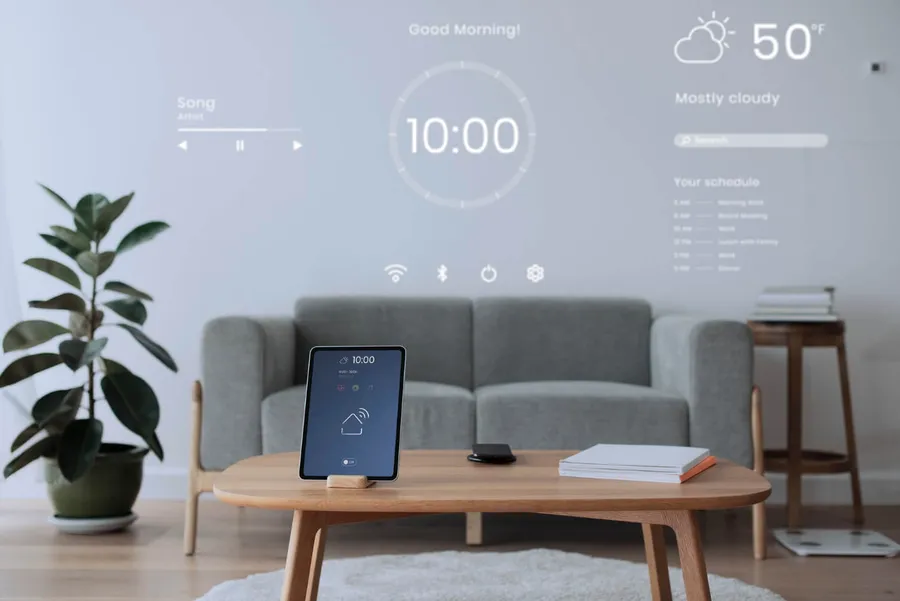
Smart shutters. Programmed to close during the hottest afternoon hours (typically 1pm-4pm in summer), shutters reduce solar gain and keep the property cooler without requiring action. They can also be set to close at sunset for security. Somfy TaHoma is the dominant system for this in France.
Alarm and camera access. Remote notification of intrusion, and the ability to view a camera feed from the property, are standard applications. Combined with smart gate or door access, they allow you to let in a cleaner or maintenance contractor without being present.
System options
Smart home protocols and what they mean in practice
The smart home market divides into wired and wireless systems, and within wireless, into several competing protocols. Understanding the differences helps when choosing an installer and a system.
KNX is a wired bus protocol used in full building automation systems. All devices connect to a dedicated KNX cable running throughout the property. The result is highly reliable, doesn't depend on wifi, and can control everything from lighting to heating to blinds from a single programmable interface. Cost: 15,000-40,000 EUR for a full installation. Requires a KNX-certified installer. Suited to new builds and major renovations, not to retrofits.
Zigbee and Z-Wave are wireless mesh protocols for retrofit installations. Devices communicate with each other and with a central hub. No new wiring required. Zigbee is open and widely supported; Z-Wave is more proprietary but has good device compatibility. Both work through thick walls with appropriate repeater devices. Suitable for apartments and existing properties.
Somfy TaHoma is the dominant platform for shutter and blind control in France, because Somfy motors are in a large proportion of French properties. TaHoma is a proprietary hub that controls Somfy devices over the RTS or IO-Homecontrol protocol. It can also integrate with third-party smart home platforms via API.
Matter is the emerging cross-brand standard backed by Apple, Google, Amazon and the major device manufacturers. It promises interoperability between devices from different brands. Still maturing but increasingly the sensible choice for new wireless devices as of 2024-2025.
Get matched with vetted English-speaking installers in your area.
Get quotesComing from abroad
What's different from back home
UK
Hive and Nest are the dominant smart thermostat brands in the UK market and are recognisable to British homeowners. Nest (Google) is available in France, and French heating brands like Atlantic and Daikin have their own connected thermostat products (Atlantic Cozytouch, Daikin Onecta) that integrate directly with their heat pumps. Hive is not widely used by French contractors. For shutters, the Somfy TaHoma system has no direct UK equivalent. It's specific to the French market but very well-established.
US
Nest is familiar in France as well as the US, and works on European voltage standards. Amazon Alexa and Google Home both operate in France and support French-language commands. Apple HomeKit is available. Where the US experience doesn't translate is in the specific devices: US smart switches and dimmers are designed for NEMA wallboxes, which are a different physical format from French/European backboxes. Any smart switches in a French property must be sourced from European suppliers and fit French electrical installation standards.
Germany
KNX originated in Europe and is particularly well-established in Germany. German homeowners and installers are often more familiar with it than their British or American equivalents. The KNX installer certification process is consistent across Europe, so a German KNX-certified installer's qualifications are valid in France. German smart home brands like Busch-Jaeger (ABB), Gira and Jung are European standard and work in French properties without modification. The main local difference is the prevalence of Somfy for shutter control, which is specific to the French market.
Choosing a contractor
What to look for in a smart home installer on the Cote d'Azur
The right installer depends on the system type. For a full KNX installation, look for a KNX-certified installer. KNX Association maintains a register of certified professionals. This is a meaningful certification: KNX programming requires specialist training and software, and a general electrician without KNX certification will not be able to correctly program the system.
For wireless retrofit systems, any competent electrician with smart home experience and familiarity with the specific platform (Somfy TaHoma, Zigbee, Netatmo) can do the work. What matters more than formal certification here is demonstrated experience: ask to see similar installations they've done, particularly in properties of a similar type to yours.
For second-home applications, it's worth checking whether the installer supports remote configuration and troubleshooting. If a device stops responding three months after installation and you're in another country, an installer who can diagnose and often resolve issues remotely is considerably more useful than one who requires an on-site visit.
Ask about system longevity and independence. Cloud-dependent systems (where the app communicates via the manufacturer's servers) are convenient but vulnerable to the manufacturer discontinuing support or going out of business. Systems that run locally, or that can fall back to local control, are more resilient for a property you'll own for decades.
French terms
Key terms to know
Key French terms for this service
Questions
Frequently asked questions about smart home systems on the Cote d'Azur
If your question isn't here, send it with your request and we'll answer it directly.
Yes. Remote property control is one of the most practical smart home applications for Riviera homeowners, particularly those with second homes. A smart thermostat (Nest, Netatmo, Atlantic Cozytouch) gives you remote temperature control and scheduling from your phone. Smart plug adapters let you switch appliances on and off remotely. A smart alarm system with camera access lets you monitor the property. For a more complete setup, a hub system (Somfy TaHoma for shutters, or a broader system like Home Assistant on a local hub) can coordinate multiple devices. The investment for a basic remote control setup is modest — 500-2,000 EUR — and the practical value for a property left unoccupied for weeks at a time is significant.
It depends on what you want to control. For shutters and blinds, Somfy TaHoma is the dominant system in France — Somfy products are in a large proportion of French homes and their TaHoma hub integrates with most Somfy motors. For heating control, Netatmo (a French brand now owned by Legrand) has strong integration with French heat pump brands and is well-supported locally. For lighting control, Legrand's Céliane and Bticino systems are widely used by French electricians. For a cross-category wireless retrofit, Zigbee-based devices (Philips Hue, IKEA Tradfri, many others) work anywhere in Europe and can be integrated with an open-source hub. Matter, the cross-brand standard backed by Apple, Google and Amazon, is becoming more relevant for new installations.
Probably not, unless you're building new or doing a major renovation where the wiring cost is already committed. KNX is a wired bus system that requires dedicated cabling throughout the property. Retrofitting it into an existing property means significant wall chasing and plastering work. The resulting system is excellent — highly reliable, fully programmable, no dependence on cloud services — but the cost (15,000-40,000 EUR for a full installation) is hard to justify for a property you use seasonally. For a holiday home, a wireless retrofit approach (Zigbee, Somfy TaHoma, smart thermostats) delivers most of the practical benefits at a fraction of the cost.
Yes. Wireless protocols — Zigbee, Z-Wave, Somfy RTS/IO — are designed for retrofit. They require no new wiring. Smart switches replace existing switches in the same backbox. Smart plugs work in existing sockets. Smart thermostats replace existing thermostats. The main constraint in older properties is wifi or Zigbee signal coverage through thick stone walls, which may require a repeater or mesh wifi to reach every room. For shutters, existing Somfy motors can usually be connected to TaHoma without modification. For reversible heat pumps, check that your specific heat pump brand and model has a compatible smart thermostat integration before buying.
The priorities for a second home are different from a primary residence. The most valuable applications are: temperature monitoring and alerts (get notified if the property drops below 8°C in winter, which risks pipe damage, or rises above a threshold in summer); remote control of heating and cooling (pre-heat or pre-cool before arrival, manage energy while away); smart shutter control (programmed to close during peak afternoon sun, protecting furnishings and keeping the property cooler); alarm and camera access (monitor for intrusion, flood or other issues); and remote gate or door access for cleaners, maintenance visits, or guests. A system that handles all of these doesn't need to be expensive — a well-configured mid-range setup is 3,000-8,000 EUR for a typical villa.
Ready to get quotes from English-speaking electrical specialists on the Côte d'Azur?
Tell us what you need and we'll connect you with vetted, English-speaking tradespeople in Nice, Antibes, Cannes and across the Côte d'Azur.