Electrical contractors on the Cote d'Azur, for English-speaking homeowners
General electrical work on older Riviera properties typically involves bringing wiring up to the current NF C 15-100 standard, upgrading the tableau electrique, adding circuits for heat pumps or EV chargers, and handling CONSUEL certification where required. Finding an electrician who can explain what's needed in plain English and provide a clear written devis makes the whole process considerably less stressful.
Looking for an English-speaking installer on the Côte d'Azur? Get quotes →
Scope of work
What general electrical work involves on the Cote d'Azur
General electrical work covers the full range of household electrical installation and modification: rewiring, distribution board (tableau électrique) upgrades, adding circuits, installing sockets and lighting points, compliance work to meet NF C 15-100, and diagnostic checks to establish what a property needs.
For English-speaking homeowners, the most common scenarios are: buying an older property that needs electrical updating before or after purchase; adding circuits for a heat pump or EV charger; upgrading an outdated tableau électrique that doesn't have adequate circuit protection; and carrying out renovation work that requires electrical modifications as part of a broader project.
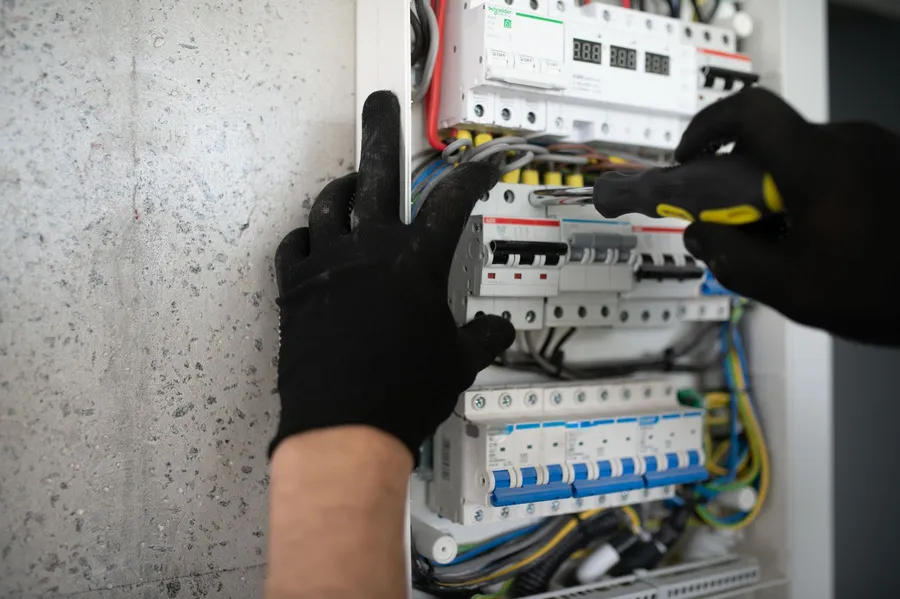
In older Riviera properties, the most frequently found issues are aluminium wiring (used in the 1960s-1970s, higher resistance than copper and more prone to connection faults), missing earth conductors, inadequate differential protection, and distribution boards that predate modern standards. A diagnostic check before any significant renovation identifies what's there and what needs addressing.
Any new electrical work in a property (adding a circuit, moving a socket, installing new protection) must comply with the current NF C 15-100 standard regardless of when the rest of the installation was done. Your electrician will assess compliance requirements as part of the devis.
The distribution board
Tableau electrique: what it is and when to upgrade
The tableau électrique is the consumer unit: the distribution board that contains the main breaker, individual circuit breakers (disjoncteurs), and differential protection (interrupteurs différentiels or disjoncteurs différentiels with earth leakage protection). In French properties, it's typically wall-mounted in a corridor or utility area.
Modern tableaux under NF C 15-100 are required to have separate differential protection (30mA RCD) for groups of circuits, particularly for circuits serving bathrooms, kitchen sockets, and outdoor supplies. They must have individual circuit breakers sized appropriately for each circuit. Older properties may have a tableau with a single main disjoncteur and a row of cartridge fuses, or an older telerrupteur-based lighting system that uses centralised switching rather than individual circuit breakers.
Typical upgrade cost for a tableau in a standard house: 1,200-2,500 EUR, including the new board, all protection devices, labelling, and the installer's work. This does not include re-running circuit wiring. If the existing wiring is old aluminium or missing earth conductors, a partial or full rewire will be quoted separately.
When a new heat pump, EV charger, or high-draw appliance is being installed, the tableau upgrade is often combined with the main installation work. Adding a dedicated circuit for a heat pump typically requires the tableau to have available breaker positions and adequate total supply current. If the existing board is full or the supply is undersized, it needs addressing as part of the job.
Certification
CONSUEL: what it is and when you need it
CONSUEL is France's electrical safety certification scheme for residential installations. An attestation from CONSUEL confirms that an installation meets the required safety standards. It is not a routine requirement for all electrical work. It's required in specific circumstances:
When you apply for a new electricity connection from Enedis (the grid operator). When you substantially modify an existing installation, particularly replacing a tableau électrique. When Enedis requires attestation as a condition of reconnecting supply after a significant modification or following a safety issue.
The process: your installer files the attestation application with CONSUEL, providing documentation of the installation. A CONSUEL inspector visits the property to check the installation against the application. If compliant, the attestation is issued. If issues are found, the installer must resolve them and the installation is reinspected.
Your electrician handles this process. It is not something you manage independently. When requesting a devis for work that will require CONSUEL attestation, confirm explicitly that the cost and process of CONSUEL attestation is included in the quote. An installer who leaves this as "not my responsibility" is not the right choice for this type of work.
Get matched with vetted English-speaking installers in your area.
Get quotesComing from abroad
What's different from back home
UK
Part P in England and Wales requires notifiable electrical work to be certified by a registered electrician or notified to building control. France uses NF C 15-100 as the technical standard with CONSUEL attestation as the certification mechanism for larger works. The French system doesn't have a direct equivalent of Part P self-certification. All CONSUEL attestation involves an independent inspection. British homeowners used to using a Part P registered spark are in familiar territory in terms of the principle; the specific process and documentation differ.
US
American electrical systems use NEMA outlets (the two or three-pin receptacles), 120V/240V split-phase power, and are governed by the National Electrical Code (NEC). None of this applies in France: 230V single-phase, CEE 7 outlets (the round-pin European type), and NF C 15-100. No American electrical equipment will work without a voltage converter or transformer, and American RCBO equivalents work on different standards. Any electrical work in France starts from scratch with French standards and French equipment.
Germany
German electrical standards (DIN VDE) and French NF C 15-100 are both European in character but differ in specifics around distribution board layout, protection device requirements, and cable colour coding (French and German colour coding converged on the EU standard in 2004, so newer installations are similar). The CONSUEL certification process is specific to France; Germany uses different certification pathways. German tradespeople working in France need to register with French authorities and work to French standards.
Choosing a contractor
What to look for in an electrician on the Cote d'Azur
The baseline: any electrician doing work on your property should be a properly registered French business with a valid SIRET number, professional liability insurance (responsabilité civile professionnelle), and decennale insurance for work that falls under the 10-year construction warranty. Ask for these documents before signing a devis.
For work that will require CONSUEL attestation, confirm that the installer handles the CONSUEL application and inspection process and that this is included in the devis. An installer who won't or can't handle CONSUEL is not the right choice for significant electrical work.
QUALIFELEC certification is the RGE label for electrical contractors in France. It covers electrical work related to energy performance: heat pump electrical supply, EV charging installation, and related work. If any of these applications are relevant to your project, look for QUALIFELEC on the qualirenovation.fr register. Standard electrical work (rewiring, tableau upgrade) doesn't require QUALIFELEC but it's a useful indicator of a contractor who works to high standards.
Red flags: offering to do work without a written devis (common among informal workers in the region); inability to provide SIRET and insurance documents; vague answers about NF C 15-100 compliance; no explanation of whether CONSUEL attestation will be required or included.
French terms
Key terms to know
Key French terms for this service
Questions
Frequently asked questions about electrical work on the Cote d'Azur
If your question isn't here, send it with your request and we'll answer it directly.
A full rewire of a 3-bedroom house — replacing all circuits, updating the distribution board and bringing everything to current NF C 15-100 standard — typically costs 8,000-15,000 EUR. The range reflects property size, the complexity of the existing installation, ceiling height, wall construction (concrete, placo, stone), and the number of circuits required. Partial rewires (a single floor, a kitchen and bathrooms) are proportionally less. Consumer unit replacement alone, without touching the circuit wiring, costs 1,200-2,500 EUR for a standard house. Adding a single dedicated circuit for a heat pump, EV charger or large appliance: 500-1,500 EUR depending on the cable run length.
CONSUEL (Comité National pour la Sécurité des Usagers de l'Electricité) is a French certification body that issues attestations confirming an electrical installation meets safety standards. The attestation is required in specific circumstances: when you apply for a new electricity supply connection; when you substantially modify an existing installation (a new tableau électrique, or significant new circuit work); and when Enedis requires it as a condition of reconnection. The CONSUEL inspector visits the property and inspects the installation. Your installer handles the filing and manages the inspection appointment — it's part of completing the job properly.
The tableau électrique is the French consumer unit — the distribution board that contains the main breaker, circuit breakers (disjoncteurs) and differential protection (interrupteur différentiel or disjoncteur différentiel) for all the circuits in the property. French distribution boards are typically DIN-rail mounted in a plastic or metal enclosure and laid out to specific NF C 15-100 requirements. Older properties may have a tableau with a single main disjoncteur and a few fuses rather than individual circuit breakers, or may have a telerrupteur system for lighting control that predates modern standards. Upgrading the tableau is often the first step in any electrical renovation.
French law doesn't require a certified professional for all electrical work in your own home. But minor work still needs to meet NF C 15-100 if it involves any circuit work, and anything that requires CONSUEL attestation (connection, significant modification) needs a certified installer. For EV charger installation, there are subsidies (ADVENIR scheme) that require a certified installer. For heat pump electrical work where RGE or QUALIFELEC certification opens subsidy access, you need a certified contractor. In practice, for anything beyond replacing a socket or light fitting, using a qualified electrician is the sensible route.
The key certification to look for is a properly registered French business (SIRET number, insurance), familiarity with NF C 15-100, and experience with CONSUEL applications. For work linked to energy subsidies (heat pump electrical supply, EV charging), look for QUALIFELEC certification, which is the RGE label for electrical contractors. You can search the qualirenovation.fr register. Getting three written quotes (devis) from different contractors before commissioning any significant work is standard practice in France. If a contractor doesn't want to provide a written devis, don't use them.
Ready to get quotes from English-speaking electrical specialists on the Côte d'Azur?
Tell us what you need and we'll connect you with vetted, English-speaking tradespeople in Nice, Antibes, Cannes and across the Côte d'Azur.