Solar carports on the Cote d'Azur, designed and installed by English-speaking specialists
A solar carport keeps the sun off your car and puts it to work generating electricity. On the Cote d'Azur, a south-facing 6 kWp system produces 8,000-9,000 kWh per year. We connect you with RGE-certified contractors who understand local planning requirements and can combine solar generation with EV charging.
Looking for an English-speaking installer on the Côte d'Azur? Get quotes →
How it works
What is a solar carport and how does it work?
A solar carport is a covered parking structure with photovoltaic panels mounted on the roof. It does two things: it keeps rain and sun off your vehicle, and it generates electricity from the solar panels above. The panels connect to a grid-tied inverter in exactly the same way as a rooftop solar installation, feeding electricity to the property first and exporting any surplus to the grid.
The structure is typically steel or aluminium, designed to support the weight of the panels and meet local wind load requirements. Single-car carports range from 15 to 22 m2. Double-car carports typically run 25 to 45 m2. Most double carports use 3 kWp (single) to 6 kWp (double) of panels, though larger installations are possible if the site allows.
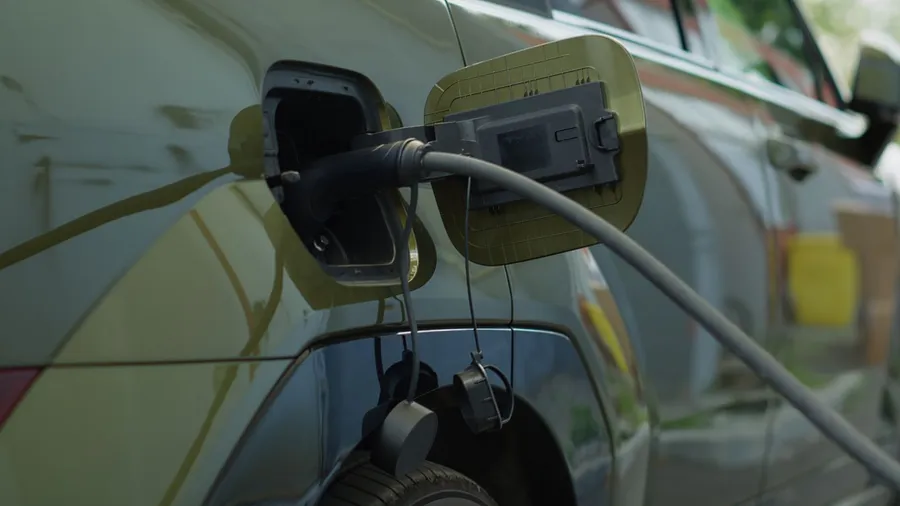
When combined with an IRVE-certified EV charge point, the system can prioritise solar-generated electricity for charging your electric car. Smart charge points read real-time solar production and adjust the charging rate to match available solar output, minimising grid draw during daylight hours.
Configurations
Which solar carport configuration suits your property?
Most popular choice
Solar carport with EV charging
The most common setup: solar panels above, IRVE-certified charge point mounted to the carport post or a nearby wall. A smart charger reads live solar production and throttles the charge rate to match, so the car draws from panels first and the grid only when production drops. On a sunny summer day, a midday charge session can be entirely solar-powered. This setup works well for households with one or two EVs and a moderate daily mileage.
Cost installed: 14,000-22,000 EUR for a double carport with 6 kWp and a 7 kW smart charger, before any applicable subsidies.
Solar carport with battery storage
Panels above, a home battery system inside the property, EV charger optional. Midday solar production charges the battery; the battery then powers the home in the evening. Useful when grid electricity is expensive off-peak, or when export tariffs are poor. Battery storage adds 6,000-12,000 EUR to the carport cost depending on capacity. Most practical for primary residences with consistent daily electricity use.
Solar carport, grid-tied only
Panels generate electricity, surplus is exported to the grid under the obligation d'achat tariff. No battery, no smart charger — just solar production reducing your bill and earning an export payment. The simplest configuration and the lowest upfront cost. Works well when the main goal is reducing electricity costs rather than self-powered EV charging.
Standalone or island system
Off-grid configuration with battery storage, typically used for secondary outbuildings, poolhouses, or rural properties with no grid connection. The carport panels charge a battery bank that powers lighting, a pump, or low-consumption equipment. Not suitable as a primary electricity supply for a house, but useful for outbuildings where a grid connection would be disproportionately expensive.
Get matched with vetted English-speaking installers in your area.
Get quotesLocal rules
What planning rules apply to solar carports on the Cote d'Azur?
Most double-car solar carports have a footprint above 20 m2, which means a permis de construire is required before work begins. The application is submitted to your local mairie and typically takes 2-3 months to process. Work cannot start until the permit is granted. Your installer will prepare the technical drawings and documents needed for the application.
Some municipalities along the Cote d'Azur have additional aesthetic requirements, particularly for properties in classified zones or near protected heritage areas. Alumininium structures in a colour matching the existing property, and panels flush with the carport roof, tend to satisfy most local requirements. If the property is in a Plan Local d'Urbanisme (PLU) zone with restrictions on outbuildings or new structures, your mairie can tell you what applies.
For properties in a copropriété with shared outdoor spaces, the carport structure may require syndic approval before work begins. This applies even for carports on a private parking space within a shared residence. Your installer can advise on how to frame the request to the syndic.
The electrical connection from the carport panels to the main consumer unit inside the property must comply with NF C 15-100, the French residential wiring standard. This work must be carried out by a qualified electrician. If the property does not have a three-phase supply and the installation is large, upgrading the incoming supply with Enedis may be worth considering — your installer will flag this at the survey stage.
What to budget
What does a solar carport cost on the Cote d'Azur?
Costs cover structure, panels, inverter, electrical connection, and installation labour. Planning application preparation is typically billed separately.
TVA on solar panels is 5.5% (if qualifying conditions met) or 20%; structural and installation labour may be at 10% TVA. ADVENIR does not apply to individual houses. MaPrimeRénov' generally does not cover carport structures. The obligation d'achat tariff from EDF OA allows surplus electricity to be sold to the grid. Your installer will clarify which elements attract subsidies at the devis stage.
French terms
Key terms to know
Key French terms for this service
Questions
Frequently asked questions about solar carports on the Cote d'Azur
If your question isn't here, send it with your request and we'll answer it directly.
It depends on the footprint. A carport up to 5 m2 typically needs no planning application. Between 5 and 20 m2, you need a déclaration préalable de travaux — a lightweight notification submitted to your local mairie. Above 20 m2, a permis de construire is required. Most double-car solar carports fall in the 20-40 m2 range, so a permis de construire is the usual requirement. Processing time is typically 2-3 months. If the property is in a classified zone or the Côte d'Azur Protected Area, your mairie or an architecte des Bâtiments de France may have additional requirements. We can help you understand what applies to your specific property.
Yes, and this is one of the main reasons people choose a solar carport over a standard roof installation. The panels are right above the parking space, making direct EV charging straightforward to set up. A smart IRVE-certified charge point can prioritise solar energy for charging when production is available, reducing grid draw to near zero on sunny days. For a 7 kW home charger and a 6 kWp carport, sunny afternoon charging in summer is largely self-powered. A battery storage system can also buffer midday production for evening charging if the car is plugged in overnight. Your installer will size the charge point and any storage to match your car's consumption and daily mileage.
A south-facing 6 kWp carport on the Cote d'Azur produces roughly 8,000-9,000 kWh per year, based on the region's 2,700-2,900 sunshine hours annually. A single-car carport with 3 kWp produces around 4,000-4,500 kWh per year. The exact figure depends on panel tilt, shading from trees or buildings, and how much of the roof area is usable. Carport panels are typically mounted at a lower pitch than roof installations, which can reduce output slightly compared to an optimally tilted roof system. Your installer will calculate a realistic production estimate based on site conditions before you commit.
Solar carports are treated as ground-mounted or structure-mounted solar installations under French regulations, not as building-integrated roof solar. MaPrimeRénov' generally applies to roof-mounted solar on your primary residence; carports often fall outside this scope. Surplus electricity fed to the grid can be sold under the obligation d'achat (OA) tariff managed by EDF OA, which applies to installations up to 500 kWp. TVA on the solar panel installation is 5.5% if qualifying conditions are met (low-carbon panels, ≤9 kWp, energy management system) or 20% otherwise. Structural and installation labour may be at 10% TVA as general renovation work. Note that ADVENIR does not apply to individual houses; it covers collective housing and shared car parks only. Your installer will confirm what applies to your specific setup at the devis stage.
Rooftop solar is usually more efficient per euro spent, because you are not paying for a carport structure — you are adding panels to a surface that already exists. A carport involves both the panel cost and the structural steelwork, which adds 3,000-6,000 EUR to a typical installation. The carport makes sense when you need covered parking anyway, when the roof is north-facing or heavily shaded, or when the roof structure cannot support panels. On the Cote d'Azur, summer heat on an uncovered car is a real inconvenience, so the shade benefit has genuine value beyond just electricity generation. If your roof has good south-facing exposure and you don't specifically need a carport structure, roof panels will give you a better financial return.