Electrical work on the Cote d'Azur, with English-speaking contractors
British and American homeowners buying older properties on the Riviera often find the existing wiring doesn't meet current French standards. NF C 15-100 specifies everything from circuit layout to socket positioning to earthing. Getting work done correctly requires an electrician who knows the standard, can explain what needs doing and why, and will handle the CONSUEL certification if required. We connect English-speaking homeowners with vetted electrical contractors across the region.
Looking for an English-speaking installer on the Côte d'Azur? Get quotes →
The French standard
NF C 15-100 and what it means for older properties
NF C 15-100 is France's comprehensive residential electrical standard. It covers how many circuits a distribution board must have, where sockets must be positioned relative to water sources, what type of protection is required on each circuit, earthing requirements, and much more. The current edition, updated in 2010, is significantly stricter than the version it replaced.
Older properties (built or last wired before the 1990s) commonly have electrical installations that don't meet the current standard. The most frequent issues in the Riviera's older stock: aluminium wiring (higher resistance, more prone to faults at connections than copper), missing earth conductors on circuits, under-specified distribution boards with too few circuits, and missing or inadequate differential (RCD) protection.
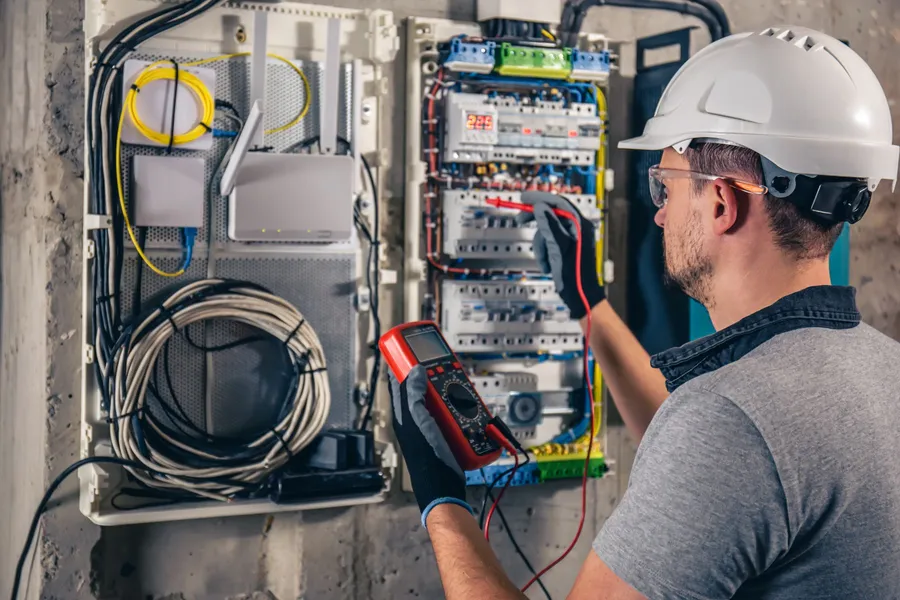
When you buy an older property in France, the mandatory electrical diagnostic identifies these issues. But the diagnostic is an observation report, not a compliance certificate. It tells you what anomalies exist; it doesn't require the seller to fix them before sale. If you're buying a property with significant electrical issues flagged in the diagnostic, budgeting for a full or partial rewire is worth doing before exchange.
When you carry out any electrical work (adding a circuit for a heat pump, installing EV charging, upgrading the distribution board) the new work must comply with the current NF C 15-100 standard. This is true even if the rest of the property predates it. The installer will assess what's required and include compliant work in the devis.
Services
Electrical services we cover on the Cote d'Azur
From consumer unit upgrades and compliance work to smart home installation and EV charging, the electrical work English-speaking homeowners most commonly need is covered below.
General electrical work
Rewiring, distribution board upgrades, adding circuits, socket and lighting installation, and NF C 15-100 compliance work. The starting point for most properties that need electrical attention before or after purchase.
Learn moreSmart home systems
Remote control and automation for heating, cooling, shutters, lighting, security and access. Particularly useful for second-home owners who want to manage and monitor the property while away. Wireless retrofit systems to full KNX wired installations.
Learn moreElectrical for heat pumps
Heat pump installation requires a dedicated circuit with adequate capacity from the distribution board. Older properties often need board upgrades or new circuit runs. QUALIFELEC certification is relevant for this work.
EV charging
Wallbox installation for electric vehicles at home. Requires a dedicated circuit, appropriate cable run to the garage or parking space, and a suitable charging point. Subsidies are available for residential EV charger installation in France.
Carports with solar
Solar carport installations combine covered parking with photovoltaic panels overhead, generating electricity while protecting the vehicle. Increasingly popular for villas with available outdoor space and good sun exposure.
Home automation
Centralised control of lighting scenes, blinds, heating and security through a single interface or app. Ranges from simple app-controlled switches to full multi-room KNX systems. Particularly relevant for new builds and major renovations.
Get matched with vetted English-speaking installers in your area.
Get quotesComing from abroad
What's different from back home
UK
In England and Wales, domestic electrical work in certain categories must be carried out by a registered electrician under Part P of the Building Regulations, or notified to building control. There's no direct French equivalent. France has NF C 15-100 as the technical standard, but enforcement happens through CONSUEL certification for new or substantially modified installations and through the mandatory diagnostic at point of sale. British homeowners sometimes assume the French system is less rigorous; it isn't, it's just structured differently. The devis culture and CONSUEL process are the quality controls.
US
American electrical systems run at 120V/60Hz (split-phase). France runs at 230V/50Hz single-phase (or three-phase). No American equipment will work directly in France. Circuit protection standards differ: the US National Electrical Code (NEC) and French NF C 15-100 have different requirements for breaker types, grounding, and socket design. American NEMA outlets and French CEE 7 outlets are incompatible. For homeowners doing any renovation or electrical work, US experience with contractors and permits doesn't translate directly to the French context.
Germany
German electrical standards (DIN VDE standards) and French NF C 15-100 are both rooted in European norms but differ in specifics, particularly around distribution board layout, circuit protection types and socket standards. German homeowners are generally familiar with the European approach to electrical safety, which reduces some of the adjustment. The main difference in practice is the CONSUEL certification process, which is specific to France and has no direct German equivalent.
French terms
Key terms to know
Key French terms for this service
Questions
Frequently asked questions about electrical work on the Cote d'Azur
If your question isn't here, send it with your request and we'll answer it directly.
An electrician from the EU can work in France, provided they register with the relevant French authorities and their qualifications are recognised under EU professional recognition rules. Practically, most foreign electricians working on the Cote d'Azur are doing so informally or under subcontract arrangements with French-registered businesses. The key issue for homeowners is not the electrician's nationality but whether the work meets NF C 15-100 standards, whether CONSUEL attestation can be obtained if required, and whether the contractor is properly registered (RCS number, professional liability insurance). A British or German electrician working casually without French registration cannot provide CONSUEL attestation or be named on a compliant devis.
NF C 15-100 is the French standard that governs low-voltage electrical installations in residential buildings. It specifies how circuits must be laid out, how distribution boards must be configured, what circuit protection is required, where sockets must be positioned relative to water sources, earthing requirements, and more. The standard has been updated several times and the current version (since 2010) has stricter requirements than older editions. Properties built or rewired before 2010 may not comply with the current edition. When you renovate or add new circuits, any new work must comply with the current standard, even if the rest of the property predates it.
Yes. An electrical diagnostic (diagnostic électrique) is a mandatory part of the DDT (Dossier de Diagnostics Techniques) that sellers must provide. For properties with electrical installations over 15 years old, the diagnostic is required before sale. It identifies anomalies relative to the current standard but is an observation report, not a compliance certification — it doesn't mean the work has been done to rectify the issues. Buyers should read it carefully and, where the report flags significant anomalies (particularly earthing problems, missing differential protection, or aluminium wiring), factor remediation costs into their offer.
French law does not prohibit homeowners from doing their own electrical work in their own property. However, any substantial modification or new installation requires CONSUEL attestation before the electricity supplier will connect or reconnect supply. CONSUEL attestation is issued only by a certified professional who inspects and certifies the installation. So while you can legally do the work yourself, you need a certified professional to verify it and sign off before it can be used. For work involving RGE-certified contractors (for subsidy access) or F-gaz certification (for any refrigerant-related work), self-installation is simply not an option regardless of French law.
Ready to get quotes from English-speaking electrical specialists on the Côte d'Azur?
Tell us what you need and we'll connect you with vetted, English-speaking tradespeople in Nice, Antibes, Cannes and across the Côte d'Azur.