Split AC installation on the Cote d'Azur, from English-speaking specialists
A split AC unit is the standard solution for cooling a room or two in an apartment or villa on the Riviera. One outdoor compressor, one indoor wall unit, connected by refrigerant pipe and an electrical cable. The installation is straightforward when done correctly. Getting the sizing right, choosing a brand with decent after-sales support, and understanding the copropriete rules before ordering makes the difference between a system you'll rely on for fifteen years and one you're arguing about.
Looking for an English-speaking installer on the Côte d'Azur? Get quotes →
How it works
What a split AC installation involves
A split AC system has two main components: the indoor unit, which mounts on an interior wall and circulates cooled air into the room, and the outdoor unit, which contains the compressor and condenser and sits outside the building. They connect via a refrigerant pipe and an electrical cable, which runs through a hole drilled in the wall.
Installation involves mounting the indoor unit on the wall at the correct height and position (typically high on a wall, above head height, so the cooled air distributes downward), drilling a core hole through the wall for the refrigerant pipe and drainage, running the pipework to the outdoor unit, and mounting the outdoor unit on brackets, a terrace, or a roof structure. The circuit is then commissioned and charged with refrigerant.
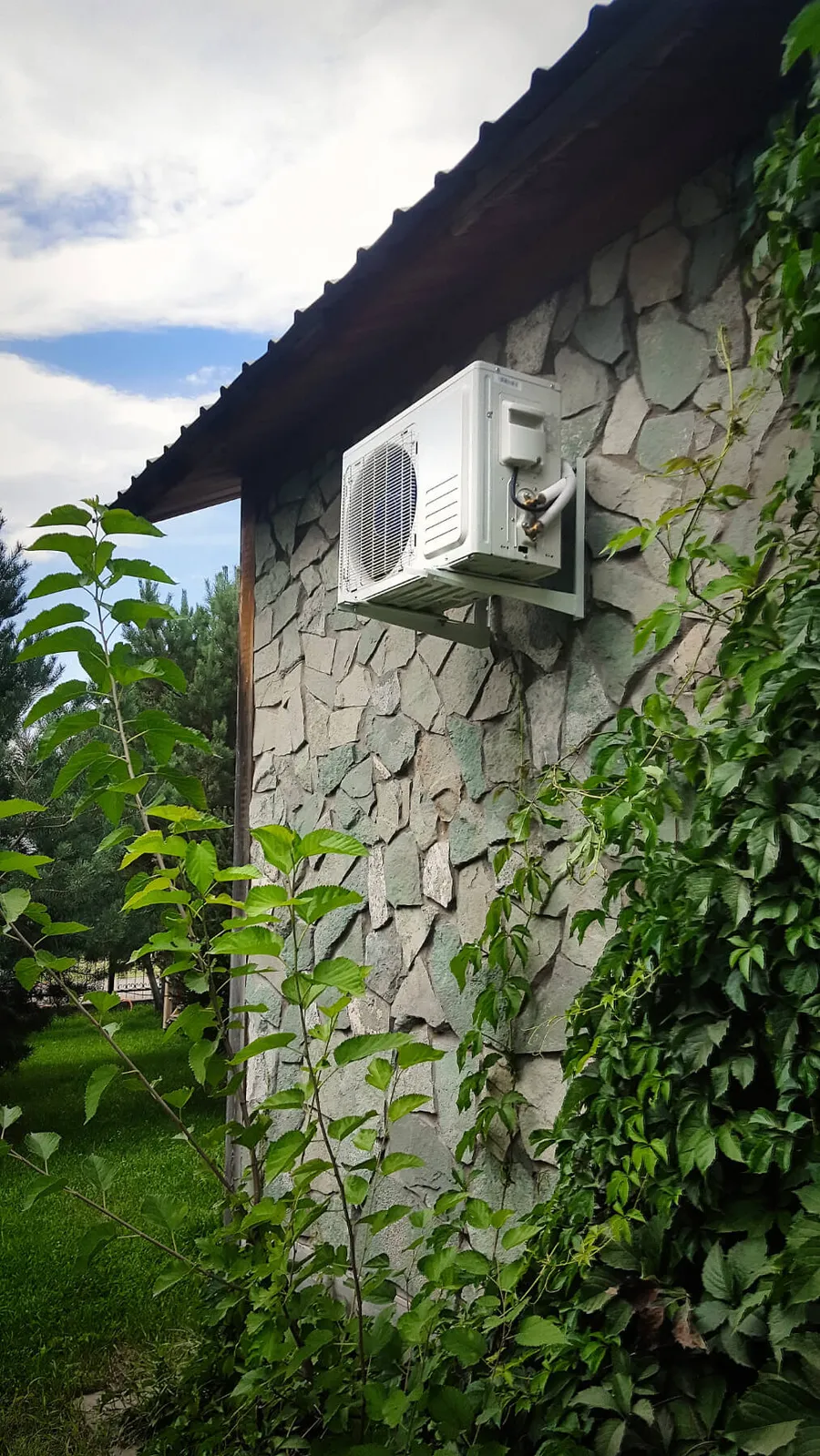
For a standard apartment installation where the outdoor unit goes on a terrace or exterior wall directly adjacent to the indoor unit, the full job takes 4-8 hours. Longer pipework runs (going around a corner, down an external wall, across a roof) add time and cost. The refrigerant pipe has a maximum practical run length, typically 15-25m depending on the unit, before the efficiency drops or an additional refrigerant charge is needed.
The drainage pipe from the indoor unit needs to exit the building as well. In apartments, this usually runs through the same core hole as the refrigerant pipe and drains onto the external wall or into a drain point. Poorly installed drainage is one of the more common causes of water damage from AC units: condensate builds up and drips inside rather than draining cleanly outside. Any installer worth using will run this cleanly.
Getting the size right
How to size a split AC unit correctly
Getting the capacity right matters more than most people realise. Both undersizing and oversizing cause problems.
An undersized unit runs continuously and never reaches the set temperature. It works harder than it should, wears out faster, and consumes more electricity relative to the cooling it delivers. An oversized unit short-cycles: it cools the air temperature quickly but doesn't run long enough to remove humidity. The room reaches the set temperature but feels cold and clammy. On the Riviera in August, where humidity compounds the heat, this is genuinely uncomfortable.
The rough sizing guide for a room with standard ceiling height (2.4-2.7m) and average insulation:
These figures shift upward for south-facing rooms, older properties with poor insulation, rooms with high ceilings (above 3m), or large window areas. A top-floor apartment under a flat roof in Nice will need more cooling capacity per square metre than a ground-floor stone apartment in the same building.
A good installer will assess the room in person before specifying a unit. If a contractor quotes you a size without visiting the property, treat that as a yellow flag. It doesn't mean they're wrong, but you have no way to check.
Equipment
Which AC brand to choose in France
The brands available and their relative status in France differ from the UK, US and Germany. This matters because after-sales support (spare parts availability, local service engineers, warranty claims) depends on the brand's presence in the French market, not its global reputation.
Daikin is widely regarded as the premium choice in France. The brand has a strong network of trained installers and service engineers in the Alpes-Maritimes and Var, and spare parts are well stocked. For a property you intend to use long-term, Daikin's reliability record and service network make a price premium worthwhile.
Mitsubishi Electric sits alongside Daikin at the premium end. The MXZ and MSZ series are commonly specified by quality installers. After-sales is good in this region. Note that Mitsubishi Electric (HVAC) and Mitsubishi Heavy Industries (also HVAC, different products) are separate entities, so check which you're being quoted.
Toshiba and Fujitsu are solid mid-to-upper-range options, well represented in France and with reasonable service availability regionally. Both are reliable choices if Daikin or Mitsubishi Electric exceeds your budget.
Atlantic is a French manufacturer with strong local distribution and competitive pricing. Popular for rental properties and budget-conscious installations. The after-sales network is domestic, which can be an advantage.
Samsung and LG are available and capable products but their professional installer and service networks in the Alpes-Maritimes are thinner than the brands above. Fine for a secondary application; less ideal as the primary system in a property you depend on year-round.
Get matched with vetted English-speaking installers in your area.
Get quotesWhat to budget
Split AC installation costs on the Cote d'Azur
Prices below are for a single split unit fully installed, including the outdoor unit, indoor unit, refrigerant pipework, electrical connection and commissioning. They are pre-subsidy figures.
What moves the price most: brand and model choice, the capacity of the unit, how far the refrigerant pipe has to run, and whether additional electrical work is needed (a dedicated circuit for the unit, or a distribution board upgrade).
If you're installing a reversible unit (which covers both cooling and heating), it may qualify for MaPrimeRénov' and CEE credits in its heating role, which can meaningfully reduce the net cost. The amount depends on your household income category and current subsidy rates. A pure cooling-only unit does not qualify.
Financial aid
Subsidies for split AC installation in France
This is where the reversible versus cooling-only distinction has real financial consequences.
MaPrimeRénov' does not apply to air conditioning units installed for summer cooling only. The scheme covers energy-saving installations, and a pure cooling unit doesn't qualify. However, a reversible split system (one that provides both heating in winter and cooling in summer) qualifies under the heating category. The same grant amounts that apply to a heat pump installation apply to a reversible split system used for heating.
To access this, the installation must be handled by an RGE-certified contractor, the application must be made before work begins through the ANAH portal, and the unit must be registered and invoiced as a reversible heating installation. If your contractor installs it as "climatisation" only, the subsidy path closes. Ask about this explicitly before signing the devis.
CEE credits follow similar rules: reversible heating-capable installations can attract support; pure cooling cannot.
TVA réduite at 10% applies to qualifying renovation work on residential properties. Your contractor applies this on the devis.
Coming from abroad
What's different from back home
UK
Residential split AC is rare in the UK, so most British buyers have no reference point for what good installation looks like or what a fair price is. The French market is mature and competitive. British homeowners sometimes assume the work will be difficult to organise or expensive because it was unusual at home. In practice, qualified installers are widely available in the region, the standard is generally good, and the market is well supplied with equipment. The main adjustment is learning to work through a French devis process and understanding what to ask.
US
American homeowners are familiar with central HVAC or window units, but the European split system is the dominant residential format here and the installation process is different. BTU ratings used in the US are not used on French equipment specs: everything is in kW. The electrical standards are also different: 230V/50Hz single-phase (or three-phase for larger systems). American experience with HVAC contractors doesn't map directly to the French context, and North American equipment won't work here. Your French installer will assess the room and specify equipment from scratch.
Germany
Germans are accustomed to European electrical standards but often less familiar with residential split AC, which is less common in Germany than in France. The F-gaz certification requirement for refrigerant handling is consistent with European-wide regulations, so that aspect isn't surprising. What sometimes catches German buyers is the copropriete permission requirement. Getting syndic approval before making external modifications is specifically French in character and has no direct equivalent in German apartment ownership structures.
Choosing a contractor
What to look for in an AC installer on the Cote d'Azur
The certification to ask about specifically for refrigerant-based systems is F-gaz (also written as F-Gas or fluor). This is a French (and EU-wide) requirement for anyone who handles refrigerants: charging, recovering, or working on the refrigerant circuit. It is not optional, and an installer who can't provide evidence of F-gaz certification should not be doing this work.
For subsidy eligibility, you additionally need an RGE-certified contractor. The specific label for cooling and heat pump work is Qualif Climatique or QualiPAC. An installer can have F-gaz certification without RGE, which means they can do the installation but can't access MaPrimeRénov'. If subsidies matter to you, check both.
A good devis for split AC installation will include: the exact make and model of both units, the kW capacity, the refrigerant type, the pipework run length included in the price, whether the electrical connection is in scope, commissioning and first refrigerant charge, and warranty terms for parts and labour separately. If the quote is a single round number without these details, ask for more.
One specific question to ask: who handles warranty claims? Some installers are brand-authorised service agents; others are not. If you need a warranty repair in year two, knowing whether your installer can do it or whether you need to find someone else matters.
French terms
Key terms to know
Key French terms for this service
Questions
Frequently asked questions about split AC installation
If your question isn't here, send it with your request and we'll answer it directly.
A standard single-unit installation in an apartment or villa room takes 4-8 hours for a competent crew. The range depends mainly on pipework run distance. If the outdoor unit goes directly behind or beside the indoor unit on an exterior wall, the job is at the shorter end. If the refrigerant pipes need to run along a wall, through a cavity, or around a corner to reach a terrace or roof position for the outdoor unit, add time. Multi-unit installations on the same day are possible but unusual. Most installers do a single unit per visit. If commissioning (refrigerant charge) is done the same day — which it usually is for pre-charged systems — you will have working AC by late afternoon.
Possibly, yes. If your apartment is in a copropriete (shared building with a syndic), you likely need approval from the syndic before installing an outdoor unit on the building facade. The rules vary by building. Some coproprietes have a blanket policy against visible outdoor units on street-facing facades; others permit it if the unit is installed neatly and does not affect neighbours. Check your reglement de copropriete (the building's governing document) and ask your syndic before ordering equipment. Getting approval after the fact is considerably more stressful than getting it before. For houses (maisons individuelles), no syndic permission is needed, though if your property is in a protected zone (near a listed building or in an ABF zone), there may be rules on external modifications.
As a rough guide: a 2.5kW unit covers 20-25m2; a 3.5kW unit covers 30-40m2; a 5kW unit covers 50-65m2. These figures assume reasonable ceiling height (2.4-2.7m) and average insulation. High ceilings, large windows, south-facing rooms and poor insulation all push the requirement higher. Oversizing causes humidity problems — the unit cools the air quickly but does not run long enough to remove moisture, leaving the room feeling cold but clammy. Undersizing means the unit runs constantly and never quite gets the room to temperature. A good installer will assess the room before recommending a size rather than simply going for the next unit up.
Daikin and Mitsubishi Electric are the premium options and have the best after-sales service networks in France. Both are widely used by professional installers, spares are readily available, and their service networks in the Alpes-Maritimes and Var are established. Toshiba and Fujitsu are solid mid-to-upper-range options. Atlantic is a French brand with good availability and local support. Samsung and LG are available and competitive on price but their after-sales networks in this region are thinner. For a property you intend to use long-term, paying a premium for Daikin or Mitsubishi Electric is usually worth it. For a rental property where you want reliability at lower cost, Atlantic or Toshiba are reasonable choices.
The mechanical installation (mounting brackets, drilling, running pipes) is technically possible yourself. However, handling refrigerants in France requires F-gaz certification. This certification is required by law for anyone who charges, recovers or works on refrigerant circuits — it is not optional. Installing a pre-charged unit without touching the refrigerant is a grey area, but most units bought through trade channels require a certified installer to commission them. Units sold through consumer channels (DIY stores) sometimes come pre-charged with a "no-pipe" installation claim, but these have significant limitations in pipework flexibility. For a professional installation that you can get warranted, serviced and potentially subsidised, use a certified installer.
Ready to get quotes from English-speaking cooling specialists on the Côte d'Azur?
Tell us what you need and we'll connect you with vetted, English-speaking tradespeople in Nice, Antibes, Cannes and across the Côte d'Azur.