Decentralised ventilation for Cote d'Azur properties, installed without major building work
Apartments and older properties on the Cote d'Azur often cannot accommodate central VMC ductwork. Decentralised ventilation units install room by room through a single wall opening, with no ductwork, no ceiling voids, and no disruption to neighbouring apartments. We connect you with English-speaking specialists across the region.
Looking for an English-speaking installer on the Côte d'Azur? Get quotes →
How it works
How does decentralised ventilation work?
A decentralised ventilation unit is a self-contained device mounted through an exterior wall. It brings fresh air into a room and extracts stale air independently, without connecting to any other unit in the building. There are no ducts, no ceiling voids, and no shared infrastructure. Each room with a unit manages its own ventilation cycle.
Most units work in a push-pull cycle: the unit runs in extract mode for a set period, drawing stale air out, then reverses to supply mode, drawing fresh air in through the same wall opening. A ceramic heat exchanger inside the unit stores heat from the outgoing air and releases it to the incoming air, recovering 70-90% of the heat that extract-only ventilation would lose. This is quite different from the continuous-flow approach of a central VMC system, which runs a single fan at low speed throughout the day.
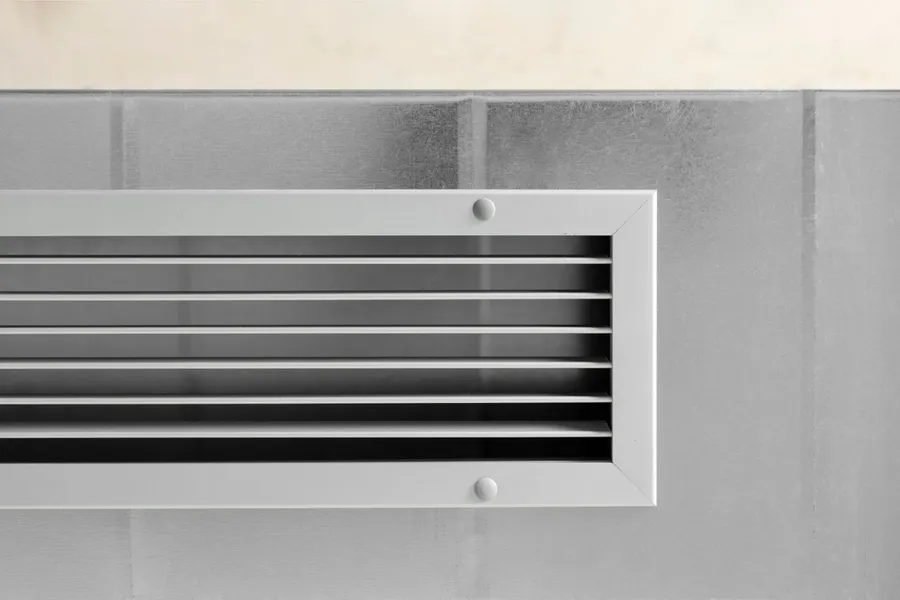
Installation requires one core drill per unit through the exterior wall (typically 160 mm in diameter) plus electrical wiring. No ductwork, no false ceiling, and no structural alterations. A skilled installer can fit a unit in a morning. For apartments in dense urban blocks in Nice, Cannes, or Antibes where a central VMC would require cutting through shared walls and running ducts across common areas, decentralised units are often the only practical solution.
Unit types
Which decentralised ventilation unit is right for each room?
Best all-round choice
Single-room heat recovery unit (VmR)
The most capable option: extract and supply in a single unit, with a ceramic heat exchanger recovering warmth from outgoing air. Suitable for bedrooms, living rooms, and home offices. Runs quietly enough (25-35 dB on low speed) to use in sleeping areas. Most models include humidity sensors, CO2 sensors, or both. Units cycle between extract and supply typically every 70-90 seconds. Install one per habitable room for a complete solution.
Cost per unit installed: 800-1,500 EUR depending on spec and access.
Extract-only unit (bathroom/WC)
A simpler unit for wet rooms: extracts stale, humid air to the outside without a supply function. Humidity-triggered operation activates the unit when moisture rises above a set threshold. No heat recovery. The simplest and lowest-cost option for bathrooms, WCs, and utility rooms where odour and humidity extraction is the main goal. Air inlet comes from living rooms through door gaps. Suitable where building regulations require mechanical extract but full heat recovery is not the priority.
Kitchen extract unit
Kitchens produce high volumes of moisture, odours, and particulates when cooking. A dedicated kitchen extract unit handles the continuous background ventilation requirement (separate from any cooker hood above the hob). Some models include a grease filter for direct installation above or near the cooking area. Where a conventional canopy hood cannot vent through the roof or exterior wall directly, a recirculating hood plus a dedicated wall extract unit is the standard workaround for French apartments.
Paired units (balanced ventilation)
Two units installed in opposite walls of a large room: one in supply mode while the other extracts, then reversing together. This gives a continuous, balanced airflow rather than the cyclic push-pull of a single unit. More consistent air quality in large living areas or open-plan spaces. Higher cost than a single unit but avoids the brief pause between extract and supply cycles. Recommended for larger rooms above 30-35 m2 where a single unit may not cover the full volume effectively.
Get matched with vetted English-speaking installers in your area.
Get quotesLocal context
Why is ventilation more important in sealed Cote d'Azur properties?
Older Cote d'Azur properties were built for natural ventilation: high ceilings, shuttered windows, and building mass that moderated temperatures. When those same properties are retrofitted with split air conditioning, the windows stay closed for much of the summer. Sealed, air-conditioned spaces accumulate CO2, moisture, and stale air faster than naturally ventilated rooms, but residents often tolerate it because the temperature is comfortable.
Poor ventilation in sealed buildings has measurable effects on sleep quality and concentration at CO2 levels above 1,000 ppm, a level easily reached in a closed bedroom overnight. Decentralised heat recovery units with CO2 sensors respond to this automatically, ramping up airflow when CO2 rises and returning to low speed when the room is unoccupied or well-ventilated.
For second-home owners, decentralised units have an additional benefit: they can run continuously at very low speed while the property is unoccupied, preventing the build-up of humidity and the mould that affects closed properties during the wetter autumn and winter months. This is particularly relevant for apartments near the coast in Nice, Antibes, or Menton, where sea air raises ambient humidity.
What to budget
What does decentralised ventilation cost to install?
Costs include unit, wall sleeve, electrical connection, and installation labour. All figures are per unit unless noted.
CEE subsidies (Certificats d'Économies d'Énergie) may be available on qualifying heat recovery ventilation installations. MaPrimeRénov' does not generally cover decentralised units. TVA réduite at 10% applies to installation on residential properties over 2 years old. Your installer will confirm what applies at the devis stage.
French terms
Key terms to know
Key French terms for this service
Questions
Frequently asked questions about decentralised ventilation on the Cote d'Azur
If your question isn't here, send it with your request and we'll answer it directly.
A standard VMC system (ventilation mécanique contrôlée) is centralised: one fan unit handles ventilation for the whole property, with ducts running to each wet room and air inlet grilles in the living rooms. It is effective but requires ductwork throughout the building, which can be difficult or impossible to install in older properties, apartments, or renovation projects without major structural work. Decentralised ventilation uses individual self-contained units installed room by room. Each unit handles its own airflow independently, with no connecting ducts. The main advantages are that installation is non-invasive — just a wall core drill per unit — and that each room can be controlled and balanced separately. The tradeoff is higher unit cost per room compared to a central system.
It is one of the best solutions for apartments and copropriétés precisely because it requires no shared ductwork and causes minimal disruption. Each unit needs only a core drill through the exterior wall of the room it serves, which is contained entirely within the private parts of the apartment. There is no need to access common areas, no ductwork in shared walls, and no coordination required with neighbours. For apartments in older Nice, Cannes, or Antibes buildings with solid masonry walls and no ceiling void, decentralised units are often the only practical mechanical ventilation solution short of a full renovation. A bathroom unit, a kitchen unit, and bedroom units can be installed independently over time as budget allows.
Many decentralised units include a heat exchanger (VmR: ventilation mécanique répartie avec récupération de chaleur) that recovers warmth from outgoing stale air and transfers it to incoming fresh air. In winter, a good heat exchanger recovers 70-90% of the heat that would otherwise be lost to extraction. On the Cote d'Azur, winters are mild enough that heat recovery is less critical than in northern France, but it still reduces heating bills during the cooler months of November through February. In summer, the heat exchanger can work in reverse, pre-cooling incoming air using the cooler indoor air being extracted. The net effect is lower heating and cooling costs year-round compared to simple extract ventilation.
Unit costs range from around 400 EUR for a basic bathroom extract unit to 800-1,500 EUR for a heat recovery unit suitable for a bedroom or living room. Installation adds 150-300 EUR per unit for the core drill and wiring. A typical three-bedroom apartment requiring four units (bathroom, kitchen, and two bedroom units) would cost 3,000-6,000 EUR installed, depending on unit specification and access conditions. Central VMC installed in a comparable property from scratch typically costs 2,000-4,000 EUR but requires ductwork that may be impractical. For existing properties where ductwork is not feasible, decentralised units are often the only viable option regardless of cost comparison.
No planning permission is required for internal ventilation units. The installation involves a core drill through the exterior wall for each unit, which is permitted work requiring no formal application. In a copropriété, you will typically need to notify the syndic before drilling through an exterior wall, as this is considered a modification to the building envelope. A written notification with the installer's technical details is usually sufficient. If the building is listed or in a classified heritage zone, your local Architecte des Bâtiments de France may have a view on exterior wall openings — your installer will advise if this applies.