Air filtration for Cote d'Azur properties: Saharan dust, pollen, and wildfire smoke
The Cote d'Azur has specific air quality challenges that northern European homeowners often don't anticipate: Saharan dust events, a long and intense pollen season, and occasional wildfire smoke from the arrière-pays. Proper filtration makes a measurable difference for allergy sufferers and for sealed, air-conditioned properties. We connect you with English-speaking specialists across the region.
Looking for an English-speaking installer on the Côte d'Azur? Get quotes →
Why it matters here
What makes air quality on the Cote d'Azur different from northern Europe?
Northern European homeowners arriving on the Cote d'Azur often assume air quality will be better than at home. In many ways it is. But the region has pollution sources that don't feature much further north. Saharan dust is carried across the Mediterranean several times a year, depositing fine PM10 particles across the PACA region in a recognisable orange-red haze. These events are tracked by Météo-France and tend to last 1-3 days. During a dust event, outdoor PM10 levels can reach multiples of France's national PM10 alert threshold of 80 µg/m³.
Wildfire smoke is a seasonal risk from July through September. Fires in the Var and Alpes-Maritimes arrière-pays produce smoke that can reduce air quality significantly in affected areas. Coastal sea breeze usually keeps the coast cleaner than inland during these events, but properties in the hills are exposed. Pollen seasons here are longer and more intense than in northern Europe: the olive, cypress, grass, and plane tree pollen seasons overlap in spring, and can run from February to July in a mild year.
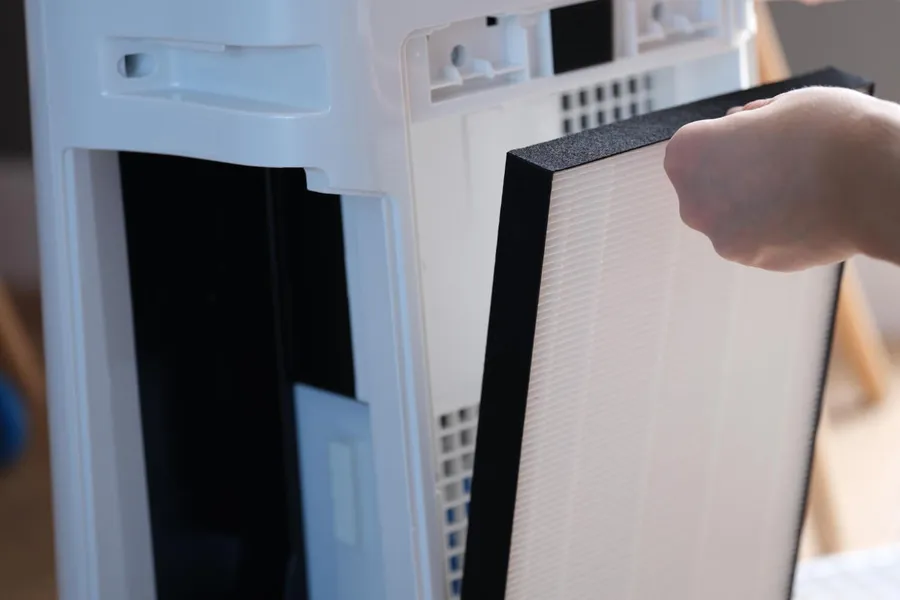
For properties kept sealed with air conditioning running through summer, these particles concentrate indoors unless actively removed. A closed, air-conditioned room with no filtration accumulates particles from any infiltration through gaps and opening doors over weeks and months. Running a HEPA purifier continuously in the main living areas keeps particle levels consistently low regardless of what is happening outdoors.
Filtration options
Which air filtration system suits your property?
Most practical for most properties
Standalone HEPA room purifiers
The most common starting point: plug-in units with a true HEPA filter, pre-filter, and usually an activated carbon layer for odours. One unit per main room covers the highest-use areas. No installation required beyond placing the unit and running a power cable neatly. Modern units from brands including Blueair, Coway, IQAir, and Dyson are quiet enough to run continuously in a bedroom. For allergy sufferers, the main bedroom and living room are the priority rooms. Cost per unit: 300-800 EUR. Filter replacement: 80-200 EUR per year per unit.
VMC-integrated whole-home filtration
For properties with a central VMC system, high-efficiency filters can be specified at the air handling unit, cleaning incoming fresh air before it enters the rooms. This covers the whole property from a single installation point. A G4 or F7 grade filter on the supply side removes pollen and most coarse particles; an F7 or F9 removes fine particulate. (G4, F7, and F9 are legacy EN 779 designations; the current ISO 16890 equivalents are ISO Coarse, ePM2.5, and ePM1 respectively.) Requires professional installation and annual filter changes. Best suited to properties where a central VMC is already planned or in place.
AC filter upgrades
Standard split AC units include a basic pre-filter that catches larger dust and hair. Some units accept optional upgraded filters with higher particle capture ratings. An annual deep clean of the AC filter and evaporator coil removes accumulated mould spores and bacteria, which can be redistributed into the room air if left. Filter cleaning is part of standard AC maintenance. This is not a substitute for HEPA filtration but is worth maintaining properly regardless.
Decentralised ventilation with enhanced filtration
Single-room heat recovery ventilation units used in decentralised ventilation include a filter on the incoming air stream. Higher-grade filters (F7 class, or ePM2.5 in ISO 16890 terms) can be specified on some units, providing a level of pollen and particle filtration alongside the ventilation function. This is not HEPA-grade filtration, but it reduces the particulate load in incoming fresh air and suits properties where ventilation and basic filtration are both needed without a central system.
Get matched with vetted English-speaking installers in your area.
Get quotesPractical guidance
How should you approach air filtration for a Cote d'Azur property?
For most properties — apartments, villas, and secondary residences — the most practical approach is standalone HEPA units in the priority rooms, combined with properly maintained AC and VMC filters. This is the lowest-cost entry point, requires no installation work, and delivers measurable air quality improvement in the rooms where it matters most.
For primary residences where a family member has allergies or respiratory conditions, a whole-home approach makes more sense. This typically means specifying enhanced filters when installing or upgrading a VMC system, combined with HEPA units in the bedroom. Running the VMC on a slight positive pressure relative to the outdoor air reduces particle infiltration through gaps in the building envelope — your installer can advise on this setting.
For second-home owners returning to a property that has been closed, running a HEPA unit on a high setting for several hours before sleeping in the property will clear the accumulated particulate from months of closure. A smart unit can be switched on remotely before arrival. Some owners also use an air quality monitor (measuring CO2, PM2.5, and VOC levels) to get a real-time picture of indoor air quality and track the purifier's effect.
What to budget
What does air filtration cost for a Cote d'Azur property?
Costs vary significantly by approach. Standalone units require no professional installation. VMC-integrated filtration requires a contractor.
CEE subsidies may apply to qualifying VMC filtration installations when combined with an eligible ventilation system. TVA réduite at 10% applies to professional installation work on residential properties over 2 years old. Standalone purifiers purchased without installation are subject to standard 20% TVA.
French terms
Key terms to know
Key French terms for this service
Questions
Frequently asked questions about air filtration on the Cote d'Azur
If your question isn't here, send it with your request and we'll answer it directly.
The region has several distinct sources of poor air quality that don't apply to much of northern Europe. Saharan dust events occur several times a year, depositing fine particulate matter (PM10) across the PACA region — these events are visible as a reddish haze and leave a film on outdoor surfaces. Wildfire smoke from summer fires in the arrière-pays can significantly affect indoor air quality in affected areas for days at a time. Pollen seasons are long and intense: olive trees, cypress, and various grasses produce high pollen loads across an extended spring and early summer season. Coastal properties also accumulate fine sea salt aerosols. Properties kept closed with air conditioning running concentrate these particles indoors unless a filtration system removes them.
A standalone air purifier (purificateur d'air) is a plug-in unit that filters air in a single room. It draws room air through one or more filters — typically a pre-filter, a HEPA filter, and sometimes an activated carbon layer for odours — and returns clean air to the room. It requires no installation work beyond placing the unit and connecting it to power. A whole-home filtration system is integrated into the building's ventilation or HVAC system, filtering all incoming air centrally before it is distributed through the property. This gives more consistent coverage but requires professional installation. For most apartments and smaller properties on the Cote d'Azur, a combination of standalone units in the main living areas and bedrooms is the practical starting point.
For a split AC system: most indoor units have a basic pre-filter that catches larger particles. Some units accept optional high-grade filter upgrades, and some premium models include an ioniser or photocatalytic filter as standard. What no split AC can do is provide HEPA-grade filtration — the airflow and filter design are not compatible. For this reason, a split AC is not a substitute for a dedicated air purifier if air quality is a priority. For a VMC system: whole-home filtration can be integrated at the air handling unit, filtering incoming fresh air before it enters the rooms. This is more practical for central VMC systems than for decentralised units.
For allergy sufferers, the difference is typically significant. A true HEPA filter removes 99.97% of particles 0.3 microns and larger — which covers pollen, mould spores, dust mite allergen particles, and the PM2.5 fine particulate matter that causes the most respiratory irritation during Saharan dust events or wildfire smoke periods. Studies consistently show reduced allergy symptom scores in HEPA-filtered rooms during high-pollen periods. The effect is proportional to how consistently the unit runs and how well the room is sealed during high outdoor pollution events — running an air purifier with the windows open during a Saharan dust event is not effective. For non-allergy households, the main benefits are odour control (with activated carbon) and a reduction in airborne virus particles, though the evidence base for the latter in real-world residential settings is less definitive.
Pre-filters in standalone units should be cleaned monthly and replaced every 3-6 months depending on use. True HEPA filters typically last 12-18 months in a room with moderate pollution and normal use. Activated carbon filters may need replacing more frequently (every 6-12 months) as the carbon saturates. VMC-integrated filters follow the schedule recommended by the system manufacturer, typically annually. During a Saharan dust event or a wildfire smoke period, filters accumulate particles faster than normal — inspect and replace sooner if the unit's performance indicator shows increased resistance. Many modern standalone units have filter life indicators that track actual usage and particulate load rather than just time.