Cooling and ventilation on the Cote d'Azur, from English-speaking installers
Most apartments and older villas on the Riviera have no cooling at all when you move in. Getting a system installed means navigating French contractor quotes, equipment sizing in kW rather than BTU, and subsidy rules that depend on which type of unit you choose. We connect English-speaking homeowners with vetted, certified installers across Nice, Antibes, Cannes and inland.
Looking for an English-speaking installer on the Côte d'Azur? Get quotes →
Why it matters
English-speaking AC contractors on the Cote d'Azur
AC installation is the most common job expats need done in their first summer on the Riviera. The work itself is not complicated, but getting the right system at a fair price requires understanding a few things that are easy to get wrong without clear communication.
Sizing is the first issue. France uses kilowatts (kW) for cooling capacity. The UK and US use BTU ratings. If you're used to BTU specs from a previous country, the kW figures on French quotes will look unfamiliar. A 2.5kW unit covers roughly 20-25m2; a 3.5kW unit covers 30-40m2. Contractors who deal regularly with expats know to explain this, because an undersized unit that runs constantly and never reaches temperature is a common outcome when the sizing conversation gets lost in translation.
Quotes (devis) also vary a lot in what they include. A good devis for AC installation should cover: the exact make and model of the indoor and outdoor units, the kW capacity, the refrigerant type, the pipework run length, whether the electrical connection is included, and the warranty terms. Quotes that skip these details are harder to compare and sometimes hide costs that appear later. When you can read and question a devis properly, you get better quotes.
There's also the subsidy question. A pure cooling unit attracts no government subsidy. A reversible unit that also heats can qualify for MaPrimeRénov' and CEE credits. Many contractors don't raise this unless asked, particularly if they assume you're just looking for summer cooling. For most expat properties on the Riviera, a reversible unit makes financial and practical sense.
Climate context
Why summer cooling is not optional on the Riviera
The Cote d'Azur gets genuinely hot in summer. Coastal temperatures sit at 30-35°C through July and August. A few kilometres inland, in the Var and the Alpes-Maritimes hills, temperatures push to 35-40°C on the hottest days. These aren't brief spikes. The heat persists for weeks.
Most apartments built before 2000, and many older villas, have no mechanical cooling. Shutters help during the day. But in a south-facing stone apartment, the thermal mass of the walls means the interior is still releasing heat at 11pm. Many new arrivals from northern Europe underestimate how much this affects sleep and daily comfort, particularly in a first-floor or top-floor flat.
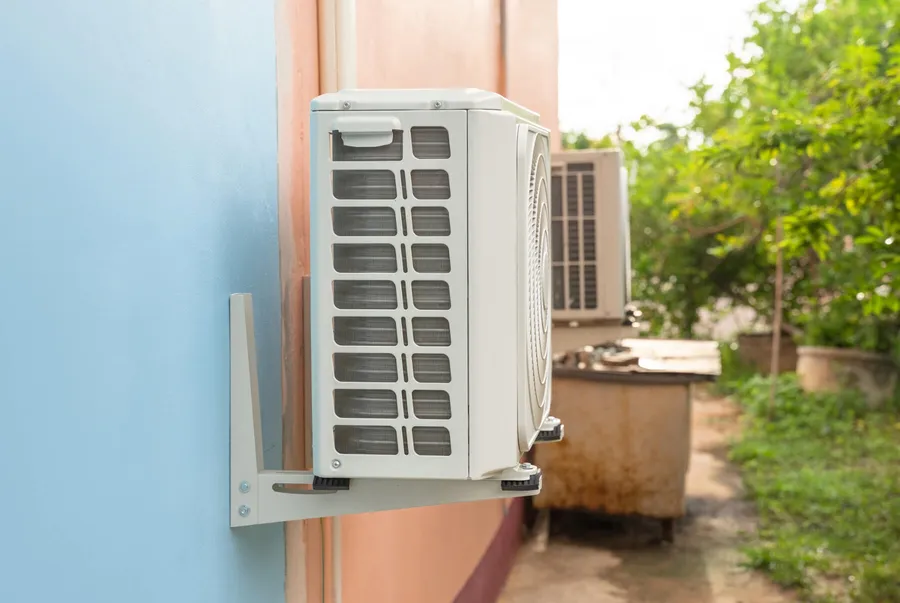
The standard solution is a split system: an outdoor compressor unit connected via refrigerant pipe to one or more indoor wall units. These are quiet, efficient and straightforward to install in most apartments and villas. They cool quickly and, in reversible form, cover both summer cooling and winter heating from a single system.
Reversible heat pumps are popular precisely because the climate demands both. January nights on the coast drop to 5-8°C (cold enough to need heating), while July afternoons are firmly in AC territory. One reversible unit handles both. It's also the configuration that qualifies for French energy subsidies, since it contributes to heating rather than just providing summer comfort. Full detail on reversible systems is on our reversible heat pump page.
Services
Cooling and ventilation systems we cover
From a single split unit for an apartment bedroom to whole-house ventilation for a larger villa renovation, the systems below cover the main options available on the Cote d'Azur.
Split AC systems
A single outdoor unit connected to one indoor wall unit. The standard choice for cooling one or two rooms in an apartment or smaller villa. Installation typically takes 4-8 hours. Available in reversible form for year-round use.
Learn moreMulti-split AC systems
One outdoor unit connected to multiple indoor units across several rooms. Popular in larger apartments and villas where you want cooling throughout without multiple external compressors. More complex installation but a cleaner external appearance.
Learn moreReversible heat pumps
A reversible system heats in winter and cools in summer from the same unit. This is the dominant choice for expat properties on the Riviera and qualifies for French energy subsidies in its heating role. Full detail is on the reversible heat pump page in our heating section.
Learn moreCentral ventilation (VMC)
Whole-house mechanical ventilation with heat recovery extracts stale air from wet rooms and introduces fresh air throughout the property, recovering heat in the process. Required in new builds and increasingly common in renovations. Can qualify for CEE subsidies.
Decentralised ventilation
Individual room ventilation units that recover heat without requiring ductwork. A simpler retrofit option for apartments and smaller properties where a full centralised VMC system is not practical.
Air filtration
Standalone and integrated filtration systems for improving indoor air quality. Relevant for allergy sufferers and for properties near busy roads. Often installed alongside a split AC or VMC system.
Get matched with vetted English-speaking installers in your area.
Get quotesFinancial aid
Subsidies for cooling and ventilation in France
The subsidy picture for cooling is more limited than for heating, but there are options worth knowing before you commit to a system.
MaPrimeRénov' does not cover air conditioning installed purely for cooling. A split or multi-split system that is only used for summer cooling carries no MaPrimeRénov' eligibility. The exception is a reversible unit explicitly used for heating: it qualifies under the heating category, and the same grant amounts apply as for a heating-only heat pump. This is a meaningful distinction. Two contractors quoting for the same hardware may structure it differently, and only the one who registers it as a reversible heating installation will open up grant access.
CEE (Certificats d'Economies d'Energie) credits can apply to VMC (mechanical ventilation) systems. VMC installations that meet the technical specifications for CEE can attract a contribution from energy suppliers, which typically comes as a discount or cashback through your installer. Ask your contractor whether the VMC system they're proposing qualifies.
TVA réduite at 10% applies to qualifying energy renovation work on residential properties over two years old. Your contractor applies this rate on the devis if the work qualifies: no separate application is needed.
Coming from abroad
What's different from back home
UK
Most British expats arrive expecting not to need air conditioning. The English summer doesn't prepare you for three months of 30°C+ on the Riviera, particularly in an apartment with no airflow. The other adjustment is that residential AC installation is far more normalised in France than in the UK, which means the industry is mature and prices are competitive. British homeowners sometimes assume it will be expensive because it was rare at home. It isn't, once you understand the local market.
US
American homeowners are familiar with AC but the sizing conventions are different. In the US, BTU ratings are standard for residential units. In France, capacity is quoted in kW. To convert roughly: 1kW of cooling capacity equals about 3,412 BTU/h. So a 2.5kW unit is approximately 8,500 BTU/h. French installers quote in kW, the equipment data sheets are in kW, and any discussion with a French contractor will use kW throughout. The electrical standards also differ: 230V/50Hz in France vs the US split-phase system.
Germany
Germans tend to underestimate how hot the Riviera gets. Germany has AC in many commercial spaces but residential AC is still relatively uncommon in northern Germany. The assumption that good insulation and shutters will manage the heat is reasonable in Bavaria; it doesn't hold in Cannes in August. Germans arriving with that mindset often need a rethink by mid-summer. The good news is that the climate argument for a reversible heat pump, which is also useful in winter, tends to make economic sense quickly once the summer reality is experienced.
French terms
Key terms to know
Key French terms for this service
Questions
Frequently asked questions about cooling on the Cote d'Azur
If your question isn't here, send it with your request and we'll answer it directly.
Most British arrivals assume they won't. They're usually wrong by the end of their first July. Coastal temperatures regularly reach 30-35°C in July and August, and a south-facing apartment with stone walls and shuttered windows can easily hit 28°C inside by mid-afternoon even with good natural ventilation. Inland areas — Grasse, Valbonne, the Var hills — can push to 38-40°C on hot days. Most French apartments and older villas were built before residential cooling was standard, so there's often nothing in place when you move in. A correctly sized split system changes the livability of a property significantly during the three summer months.
Functionally, very little in most modern units. A split AC unit typically refers to a system designed primarily for cooling, with heating as a secondary function or not at all. A reversible heat pump (PAC réversible) is explicitly designed and rated for both heating and cooling with equal efficiency in each direction. On the Cote d'Azur, nearly all new installations are reversible, because the climate requires both: cold enough in January to need heating, hot enough in July to need cooling. Reversible units also qualify for energy subsidies in their heating role, which pure cooling units do not. See our reversible heat pump page for full detail on that system.
A single split unit installed in one room of an apartment — including the outdoor unit, refrigerant pipework and electrical connection — typically costs 1,500-3,000 EUR depending on brand, capacity and how far the pipework needs to run. Daikin and Mitsubishi Electric at the premium end; Atlantic and Toshiba in the mid-range. For a whole-property multi-split system covering three to five rooms in a villa, budget 6,000-15,000 EUR installed. These are pre-subsidy figures. If the unit is reversible and used for heating, it may qualify for MaPrimeRénov' and CEE credits — ask your contractor to include subsidy estimates in the devis.
Not for pure cooling. MaPrimeRénov' does not cover AC systems installed purely for summer cooling. However, if you install a reversible heat pump that is also used for heating, it qualifies under the heating category. The distinction matters: a non-reversible AC unit brings no subsidy eligibility. A reversible unit of the same capacity, used year-round, can attract significant grant support. For ventilation, VMC systems (mechanical ventilation with heat recovery) can qualify for CEE credits and, in some cases, MaPrimeRénov'. Ask your contractor to confirm eligibility for the specific equipment before signing anything.
Ready to get quotes from English-speaking cooling specialists on the Côte d'Azur?
Tell us what you need and we'll connect you with vetted, English-speaking tradespeople in Nice, Antibes, Cannes and across the Côte d'Azur.